JEDDAH: Turkish President Recep Tayyip Erdogan seeks to build stronger ties with the US administration and says Donald Trump’s stance is “encouraging,” amid increasingly sour relations with the EU states.
Voters in Turkey went to the polls on Sunday, and voted “yes” in a constitutional referendum to replace the country’s parliamentary system with a presidential model.
US President Donald Trump was among the first to call Erdogan to congratulate him on the referendum victory.
The move gave Erdogan sweeping new powers — but the president has denied claims this makes him a “dictator.”
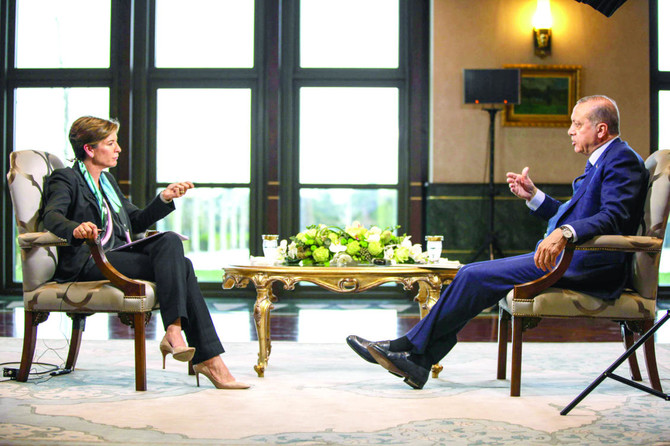
He was speaking exclusively to CNN’s Becky Anderson in his first interview since the vote.
“I haven’t been a dictator. Everyone is free in their thinking, free in their expressions,” he told CNN.
“If you claim that a dictator will emerge out of a ballot box, it would be unjust to the people who are casting their votes… the choices of the people will have been insulted if you say such things.”
“Democracy gains power from the people. This is what we call a national will, the nation’s will. However, the nation’s will shall prevail, we all have to respect that.”
Erdogan went on to defend the “stronger” presidential system that has been voted in, denying claims that it is purely for his own benefit.
“This system is not tailored for Recep Tayyip Erdogan. I am a mortal, I may die any minute,” he told CNN.
“We are going to have an executive president to show that the country can be governed in a much stronger fashion. This is what we have achieved and this is what we are going to do.”
Turkey’s relations with the EU are at a low ebb, following a war of words between Ankara and several European states in the run-up to the referendum. Some EU countries had banned Turkish ministers from addressing rallies of expatriates ahead of the vote.
Erdogan confirmed that Trump called him to offer his congratulations for his success after Sunday’s referendum — something most EU leaders did not follow in doing.
He said that he senses Trump’s approach as “encouraging,” adding that a face-to-face meeting between the two NATO powers is in the pipeline.
“Our concern is to have a good a relationship as possible with Mr. Trump,” he told CNN.
“We are going to sit down and determine a road map as two strategic partners… We believe we can resolve specific problems.”
The telephone call took place on Easter Day.
“While he was congratulating me, he stated that our mutual relationship will only get stronger in the future. And he shared his opinions and thoughts with me, his thoughts on Syria.
“I have specifically mentioned one thing... After the referendum, we have to move on from making phone calls to one another and instead get together face-to-face whereby we can further strengthen relations between the US and Turkey.”
Turkey and the US earlier hit a diplomatic stumbling block over the expected assault on Daesh in Raqqa, Syria. The US wants to use the Kurdish People’s Protection Units (YPG) in the offensive, but Turkey objected as it considers the YPG an extension of the Kurdish PKK militant group.
“In order to hit a terrorist organization such as Daesh using another terrorist organization such as YPG… it’s not right. It’s a terrorist organization,” Erdogan told CNN.
“The US, the coalition forces and Turkey would be sufficient and would be strong enough to fight Daesh once and for all,” he added.
Erdogan’s victory in the referendum was a slim one, with the “yes” vote winning by 51.4 percent compared to 48.6 percent for the “no” side. Critics pointed to alleged one-sided media coverage and the use of emergency powers in Turkey as having possibly influenced the result.
But Erdogan said that a win is a win.
“I’m a person who has played football for many years and I know for sure, whether you win one to zero, or three to zero, the points you will get at the end will be the same. What matters most at the end of the day is to score and win the game.”
Erdogan also accused the EU of breaking its promises in a deal to stem the flow of refugees into the bloc in return for financial assistance and an easing of visa restrictions.
“We rose up to the occasion and we did what we were supposed to. But the EU failed to keep the promises that were made to us,” he said. “Not a single promise had been kept.”
Turkish prosecutors earlier launched an investigation into 17 US politicians, bureaucrats and academics in connection with the attempted coup last summer.
Those included in the investigation are former CIA Director John Brennan and Senate minority leader Chuck Schumer, along with others accused of collaborating with Turkish resistance groups to overthrow Erdogan, a Turkish state-run news service reported.
Erdogan told CNN that the investigations into the coup continue, and that he has renewed an extradition request to the US concerning his arch-rival Fethullah Gülen.
“We have renewed our extradition requests and when we visit the US we are going to sit down and talk about these issues,” Erdogan said. “The evidence is there. The documents have been amassed pointing to the No. 1 perpetrator of this failed coup as Fethullah Gülen.”
Erdogan also claimed “terrorist organizations” — presumably his political rivals — are being supported by the West.
“These people are supporting those terrorist organizations, and behind those terrorist organizations you will find these strong media outlets of the Western world,” he said.


![]()
Erdogan looks to build ties with ‘encouraging’ Trump
Erdogan looks to build ties with ‘encouraging’ Trump
Related
Latest updates


© 2026 SAUDI RESEARCH & PUBLISHING COMPANY, All Rights Reserved And subject to Terms of Use Agreement.