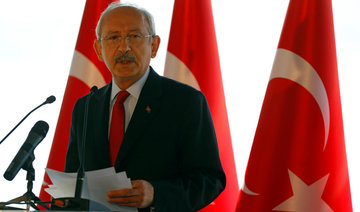
ANKARA: Turkey’s prime minister declared victory for the ‘Yes’ camp in Sunday’s referendum on expanding the powers of President Recep Tayyip Erdogan, saying the country had opened a “new page” in its democracy.
“The presidential system, according to unofficial results, has been confirmed with a ‘Yes’ vote,” Binali Yildirim told flag-waving supporters from the balcony of the headquarters of the Justice and Development Party (AKP) in Ankara.
“This is a decision made by the people. In our democracy’s history, a new page has opened with this vote.
“There are no losers in this referendum, the winner is Turkey, the winner is the dear people.”
Turkey’s two main opposition parties earlier said they would challenge the results.
The pro-Kurdish Peoples’ Democratic Party said it would challenge two-thirds of ballots cast.
In a remark apparently directed at those disappointed by the close result, Yildirim said “no one’s heart should be broken.”
The bitterly-fought campaign saw both sides throwing accusations at each other with Erdogan suggesting links between those voting ‘No’ and militants, terrorists as well as coup-plotters.
Meanwhile, the main opposition party leader suggested last summer’s failed coup was a “controlled” putsch.
“Now the time has come for solidarity, to be united, to be together, all of Turkey,” Yildirim added.
“In the squares, different things were said, different things were explained to the nation, but the last word was from the people: they said ‘Yes’, they put a full stop here.”
The ‘Yes’ campaign had won 51.3 percent of the vote while the ‘No’ campaign had mustered 48.7 percent, the election commission said in figures quoted by state news agency Anadolu, in a count based on 99 percent of the ballot boxes.

Turkey PM declares victory in referendum on expanding Erdogan powers
Basic services resume at Syrian camp housing Daesh families as government takes control
AL HOL: Basic services at a camp in northeast Syria holding thousands of women and children linked to Daesh group are returning to normal after government forces captured the facility from Kurdish fighters, a United Nations official said on Thursday.
Forces of Syria’s central government captured Al-Hol camp on Jan. 21 during a weekslong offensive against the Kurdish-led and US-backed Syrian Democratic Forces, or SDF, that had been running the camp near the border with Iraq for a decade. A ceasefire deal has since ended the fighting.
Celine Schmitt, a spokesperson for the UN refugees agency told The Associated Press that the interruption of services occurred for two days during the fighting around the camp.
She said a UNHCR team visited the recaptured came to establish “very quickly the delivery of basic services, humanitarian services,” including access to health centers. Schmitt said that as of Jan. 23, they were able to deliver bread and water inside the camp.
Schmitt, speaking in Damascus, said the situation at Al-Hol camp has been calm and some humanitarian actors have also been distributing food parcels. She said that government has named a new administrator for the camp.
Camp residents moved to Iraq
At its peak after the defeat of Daesh in Syria in 2019, around 73,000 people were living at Al-Hol. Since then the number has declined with some countries repatriating their citizens. The camp’s residents are mostly children and women, including many wives or widows of Daesh members.
The camp’s residents are not technically prisoners and most have not been accused of crimes, but they have been held in de facto detention at the heavily guarded facility.
The current population is about 24,000, including 14,500 Syrians and nearly 3,000 Iraqis. About 6,500 from other nationalities are held in a highly secured section of the camp, many of whom are Daesh supporters who came from around the world to join the extremist group.
The US last month began transfering some of the 9,000 Daesh members from jails in northeast Syria to Iraq. Baghdad said it will prosecute the transfered detainees. But so far, no solution has been announced for Al-Hol camp and the similar Roj camp.
Amal Al-Hussein of the Syria Alyamama Foundation, a humanitarian group, told the AP that all the clinics in the camp’s medical facility are working 24 hours a day, adding that up to 150 children and 100 women are treated daily.
She added that over the past 10 days there have been five natural births in the camp while cesarean cases were referred to hospitals in the eastern province of Deir Ezzor or Al-Hol town.
She said that there are shortages of baby formula, diapers and adult diapers in the camp.
A resident of the camp for eight years, who spoke on condition of anonymity due to concerns over the safety of her family, said there have been food shortages, while the worst thing is a lack of proper education for her children.
“We want clothes for the children, as well as canned food, vegetables and fruits,” she said, speaking inside a tent surrounded by three of her daughters, adding that the family has not had vegetables and fruits for a month because the items are too expensive for most of the camp residents.
‘Huge material challenges’
Mariam Al-Issa, from the northern Syrian town of Safira, said she wants to leave the camp along with her children so that thy can have proper education and eat good food.
“Because of the financial conditions we cannot live well,” she said. “The food basket includes lentils but the children don’t like to eat it any more.”
“The children crave everything,” Al-Issa said, adding that food at the camp should be improved from mostly bread and water. “It has been a month since we didn’t have a decent meal,” she said.
Thousands of Syrians and Iraqis have returned to their homes in recent years, but many only return to find destroyed homes and no jobs as most Syrians remain living in poverty as a result of the conflict that started in March 2011.
Schmitt said investment is needed to help people who return home to feel safe. “They need to get support in order to have a house, to be able to rebuild a house in order to have an income,” she said.
“Investments to respond and to overcome the huge material challenges people face when they return home,” she added.
Forces of Syria’s central government captured Al-Hol camp on Jan. 21 during a weekslong offensive against the Kurdish-led and US-backed Syrian Democratic Forces, or SDF, that had been running the camp near the border with Iraq for a decade. A ceasefire deal has since ended the fighting.
Celine Schmitt, a spokesperson for the UN refugees agency told The Associated Press that the interruption of services occurred for two days during the fighting around the camp.
She said a UNHCR team visited the recaptured came to establish “very quickly the delivery of basic services, humanitarian services,” including access to health centers. Schmitt said that as of Jan. 23, they were able to deliver bread and water inside the camp.
Schmitt, speaking in Damascus, said the situation at Al-Hol camp has been calm and some humanitarian actors have also been distributing food parcels. She said that government has named a new administrator for the camp.
Camp residents moved to Iraq
At its peak after the defeat of Daesh in Syria in 2019, around 73,000 people were living at Al-Hol. Since then the number has declined with some countries repatriating their citizens. The camp’s residents are mostly children and women, including many wives or widows of Daesh members.
The camp’s residents are not technically prisoners and most have not been accused of crimes, but they have been held in de facto detention at the heavily guarded facility.
The current population is about 24,000, including 14,500 Syrians and nearly 3,000 Iraqis. About 6,500 from other nationalities are held in a highly secured section of the camp, many of whom are Daesh supporters who came from around the world to join the extremist group.
The US last month began transfering some of the 9,000 Daesh members from jails in northeast Syria to Iraq. Baghdad said it will prosecute the transfered detainees. But so far, no solution has been announced for Al-Hol camp and the similar Roj camp.
Amal Al-Hussein of the Syria Alyamama Foundation, a humanitarian group, told the AP that all the clinics in the camp’s medical facility are working 24 hours a day, adding that up to 150 children and 100 women are treated daily.
She added that over the past 10 days there have been five natural births in the camp while cesarean cases were referred to hospitals in the eastern province of Deir Ezzor or Al-Hol town.
She said that there are shortages of baby formula, diapers and adult diapers in the camp.
A resident of the camp for eight years, who spoke on condition of anonymity due to concerns over the safety of her family, said there have been food shortages, while the worst thing is a lack of proper education for her children.
“We want clothes for the children, as well as canned food, vegetables and fruits,” she said, speaking inside a tent surrounded by three of her daughters, adding that the family has not had vegetables and fruits for a month because the items are too expensive for most of the camp residents.
‘Huge material challenges’
Mariam Al-Issa, from the northern Syrian town of Safira, said she wants to leave the camp along with her children so that thy can have proper education and eat good food.
“Because of the financial conditions we cannot live well,” she said. “The food basket includes lentils but the children don’t like to eat it any more.”
“The children crave everything,” Al-Issa said, adding that food at the camp should be improved from mostly bread and water. “It has been a month since we didn’t have a decent meal,” she said.
Thousands of Syrians and Iraqis have returned to their homes in recent years, but many only return to find destroyed homes and no jobs as most Syrians remain living in poverty as a result of the conflict that started in March 2011.
Schmitt said investment is needed to help people who return home to feel safe. “They need to get support in order to have a house, to be able to rebuild a house in order to have an income,” she said.
“Investments to respond and to overcome the huge material challenges people face when they return home,” she added.
© 2026 SAUDI RESEARCH & PUBLISHING COMPANY, All Rights Reserved And subject to Terms of Use Agreement.