Bugs for dinner? New Aussie food trend has legs (and wings)

1 / 6
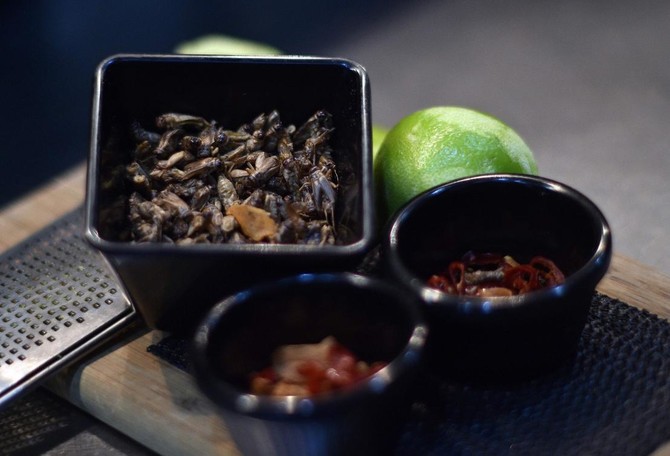
This photo taken on March 16, 2017 shows ingredients for a starter that includes crickets on a kitchen table at a restaurant in Sydney. (AFP)
2 / 6
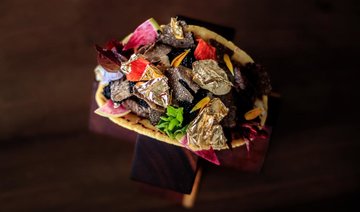
This photo taken on March 16, 2017 shows sous-chef Nowshad Alam Rasel displaying a signature cricket dish at a restaurant in Sydney. (AFP)
3 / 6
This photo taken on March 16, 2017 shows sous-chef Nowshad Alam Rasel giving a final touch to his signature cricket dish at a restaurant in Sydney. (AFP)
4 / 6
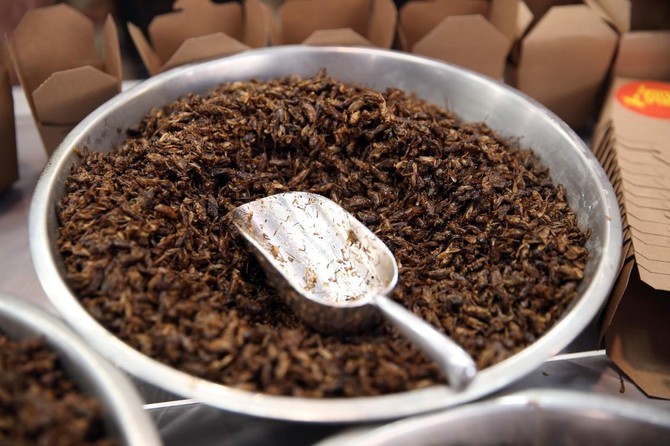
This photo taken on January 28, 2017 shows a bowl full of fried crickets for sale at a market in Sydney. (AFP)
5 / 6
This photo taken on March 16, 2017 shows sous-chef Nowshad Alam Rasel giving the final touch to his signature cricket dish at a restaurant in Sydney. (AFP)
6 / 6
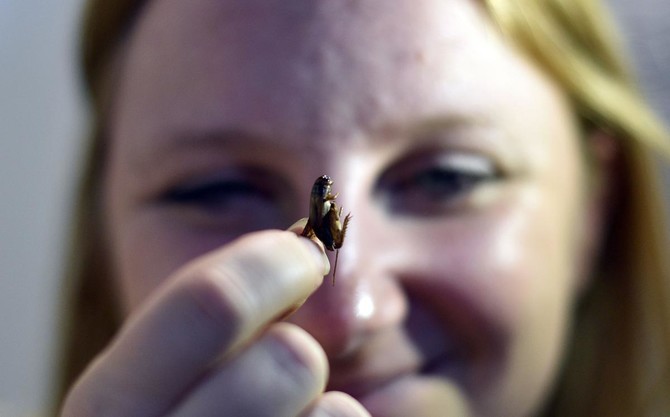
This photo taken on February 16, 2017 shows Skye Blackburn, an entomologist and owner of Australia's largest insect supplier, the Edible Bug Shop, holding a cricket at her work place in Sydney. (AFP)
Updated 20 April 2017
Follow

Bugs for dinner? New Aussie food trend has legs (and wings)

SYDNEY: With a twist of lime and a dash of salt Sydney chef Nowshad Alam Rasel flavours a hot pan full of crickets, tossing them over a flaming stove.
The savoury snack, which would not be out of place at a Mexican cantina or a Bangkok street stall, is creeping onto menus at Australian boutique eateries such as El Topo, challenging the inhibitions of diners.
“When they come for the first time, the customer very much wants to know what it is,” says sous-chef Rasel, as he neatly plates up the fried critters, topped with slices of fresh chilli.
Roasted cockroach, honey-flavoured ants, mealworm and chocolate coated popcorn are now available to try and buy — and while the cuisine remains a novelty, there are signs it is growing in popularity.
Consumer attitude toward eating insects are usually split explains Skye Blackburn, owner of Australia’s largest insect supplier, the Edible Bug Shop in Sydney.
“The first kind of people are completely grossed out and they really can’t change their mind and they kind of just want to come and have a look and don’t want to try it really,” the entomologist says.
“And then we get the second kind of people that really want to learn more and some of them will try edible insects and some of them won’t, but they will go away and talk about insects and they’ll spread the word about what they have seen that day,” she adds.
High in protein, cheap to produce, and with a much lighter carbon footprint than meat or dairy farming, bugs are already part of the diet for more than two billion people worldwide, according to the United Nations.
Advocates of increased consumption say it will help feed a bulging global population as land becomes scarce and climate change threatens conventional food supplies like fish.
Insects such as beetles, caterpillars, crickets and even spiders are common in diets across parts of Asia, Latin America and Africa, while Australia’s Aborigines have eaten bush tucker including ants, moths and larvae for thousands of years.
But they are a difficult sell in the Western world where people struggle to dissassociate the nutritional value from the source, with most insects considered pests.
“You have to name them something else,” suggested one El Toro patron when asked about overcoming fears of eating insects in Australia.
“We don’t eat cow, we tend to eat steak and sausages,” he says. “With pig we eat pork and bacon, so you have to start by naming them something else.”

Blackburn is leading the charge to change the perception of edible insects.
She runs Australia’s only commercial bug farm, supplying a growing number of restaurants across the country, breeding hundreds of kilogrammes of insects each week, including savoury crickets, dehydrated ants, and even a “special” kind of roasted cockroach “that don’t have any germs on them.”
Australia’s trendy urban farmer’s markets too are a popular spot for her produce, with inquisitive foodies sampling creations like mealworm and chocolate coated popcorn, and green tea and honey roasted black ants.
“I’m going to go a big gob,” says 53-year-old market goer Guy McEwan, putting a handful of a savoury mix of mealworms, ants, crickets and popcorn into his mouth.
“It’s great. I love em, I love bugs,” he adds, likening the texture and flavour to crisps.
Others at the crowded Saturday market in the hip Sydney suburb of Redfern are drawn to the novelty.
“Sometimes when you move the packet it looks like they’re alive,” says Danny Stagnitta, 42, while giving his snack box a shake.
Back at El Topo, while the bugs remain a hot item among Sydney’s experimental diners, it may be some time yet before it becomes a staple in Australian homes.
Nine-year-old diner Alexandria winces as she samples the fried crickets.
She concludes: “It feels awkward and weird that you’re eating an insect. You would normally eat meat.”

Filipinos master disaster readiness, one roll of the dice at a time

Updated 7 sec ago
Follow

Filipinos master disaster readiness, one roll of the dice at a time

  • In a library in the Philippines, a dice rattles on the surface of a board before coming to a stop, putting one of its players straight into the path of a powerful typhoon
MANILA: In a library in the Philippines, a dice rattles on the surface of a board before coming to a stop, putting one of its players straight into the path of a powerful typhoon.
The teenagers huddled around the table leap into action, shouting instructions and acting out the correct strategies for just one of the potential catastrophes laid out in the board game called Master of Disaster.
With fewer than half of Filipinos estimated to have undertaken disaster drills or to own a first-aid kit, the game aims to boost lagging preparedness in a country ranked the most disaster-prone on earth for four years running.
“(It) features disasters we’ve been experiencing in real life for the past few months and years,” 17-year-old Ansherina Agasen told AFP, noting that flooding routinely upends life in her hometown of Valenzuela, north of Manila.
Sitting in the arc of intense seismic activity called the “Pacific Ring of Fire,” the Philippines endures daily earthquakes and is hit by an average of 20 typhoons each year.
In November, back-to-back typhoons drove flooding that killed nearly 300 people in the archipelago nation, while a 6.9-magnitude quake in late September toppled buildings and killed 79 people around the city of Cebu.
“We realized that a lot of loss of lives and destruction of property could have been avoided if people knew about basic concepts related to disaster preparedness,” Francis Macatulad, one of the game’s developers, told AFP of its inception.
The Asia Society for Social Improvement and Sustainable Transformation (ASSIST), where Macatulad heads business development, first dreamt up the game in 2013, after Super Typhoon Haiyan ravaged the central Philippines and left thousands dead.
Launched six years later, Master of Disaster has been updated this year to address more events exacerbated by human-driven climate change, such as landslides, drought and heatwaves.
More than 10,000 editions of the game, aimed at players as young as nine years old, have been distributed across the archipelago nation.
“The youth are very essential in creating this disaster resiliency mindset,” Macatulad said.

- ‘Keeps on getting worse’ -

While the Philippines has introduced disaster readiness training into its K-12 curriculum, Master of Disaster is providing a jolt of innovation, Bianca Canlas of the Department of Science and Technology (DOST) told AFP.
“It’s important that it’s tactile, something that can be touched and can be seen by the eyes of the youth so they can have engagement with each other,” she said of the game.
Players roll a dice to move their pawns across the board, with each landing spot corresponding to cards containing questions or instructions to act out disaster-specific responses.
When a player is unable to fulfil a task, another can “save” them and receive a “hero token” — tallied at the end to determine a winner.
At least 27,500 deaths and economic losses of $35 billion have been attributed to extreme weather events in the past two decades, according to the 2026 Climate Risk Index.
“It just keeps on getting worse,” Canlas said, noting the lives lost in recent months.
The government is now determining if it will throw its weight behind the distribution of the game, with the sessions in Valenzuela City serving as a pilot to assess whether players find it engaging and informative.
While conceding the evidence was so far anecdotal, ASSIST’s Macatulad said he believed the game was bringing a “significant” improvement in its players’ disaster preparedness knowledge.
“Disaster is not picky. It affects from north to south. So we would like to expand this further,” Macatulad said, adding that poor communities “most vulnerable to the effects of climate change” were the priority.
“Disasters can happen to anyone,” Agasen, the teen, told AFP as the game broke up.
“As a young person, I can share the knowledge I’ve gained... with my classmates at school, with people at home, and those I’ll meet in the future.”