Iraqi Christians return to ransacked town with fear and hope

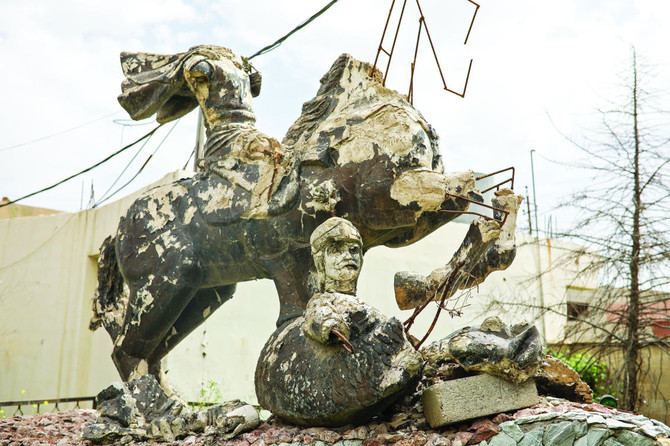
A damaged statue is seen outside a church in Qaraqosh, south of Mosul, Iraq. (Reuters)
Updated 15 April 2017
Follow

Iraqi Christians return to ransacked town with fear and hope

QARAQOSH, Iraq: With Daesh expelled, Iraqi Christians are trickling back to the ransacked town of Qaraqosh, beset by anxiety for their security and yet hopeful they can live in friendship with Muslims of all persuasions.
The town, about 20 km from the battlefront with Daesh in the northern city of Mosul, shows why Christians have mixed feelings about the future of their ancient community.
In the desecrated churches of Qaraqosh, Christians are busy removing graffiti daubed by the militants during two and a half years of control — only for new slogans to have appeared, scrawled by Shiite members of the Iraqi forces fighting street to street with the terrorists in Mosul.
Encouraged by security checkpoints and patrols by a volunteer force, up to 10 Christian families have returned to what used to be the minority’s biggest community in Iraq until Daesh seized it in 2014.
Iraqi forces pushed the group out of Qaraqosh in October, part of a six-month offensive to retake Mosul. But residents are worried that the Shiite slogans signal a new kind of sectarian division.
“We are afraid of this, of tensions,” said Girgis Youssif, a church worker. “We want to live in peace and demand security,” said Youssif, who returned after fleeing to Irbil, about 60 km away in Iraqi Kurdistan.
Two Shiite flags also fly over Qaraqosh.
Most Sunnis, who are the dominant community in Mosul, have shrugged off the Shiite slogans as the work of a handful of religious zealots but Christians take them as a signal that their future remains uncertain.
“Of course we are afraid of such signs,” said Matti Yashou Hatti, a photographer who still lives in Irbil with his family. “We need international protection.”
Those families who have returned to Qaraqosh — once home to 50,000 people — are trying to revive Christian life dating back two millennia. However, most stay only two or three days at a time to refurbish their looted and burnt homes.
“We want to come back but there is no water and power,” said Mazam Nesin, a Christian who works for a volunteer force based in Qaraqosh but has left his family behind in Irbil.
By contrast, displaced Muslims have been flocking back to markets in eastern Mosul since Daesh’s ejection from that part of the city, despite the battle raging in the Old City across the Tigris river which is the militants’ last stronghold.
Numbers of Christians in Iraq have fallen from 1.5 million to a few hundred thousand since the violence, which followed the 2003 toppling of Saddam Hussein. Many Baghdad residents who could not afford to go abroad went to Qaraqosh and other northern towns where security used to be better than in the capital, rocked by sectarian warfare after the US-led invasion.
But with the arrival of Daesh, residents abandoned their homes with some applying for asylum in Europe. Germany alone took in 130,000 Iraqis, among them many Christians, in 2015 and 2016. But most ended up in Irbil with relatives or in homes paid for by aid agencies.
Supermarkets and restaurants remain closed in Qaraqosh, with windows smashed and burnt furniture strewn across floors.
Army and police have tried to ease fears by stationing soldiers in front of churches, and even helping Christian volunteers to set up a massive cross at the town’s entrance.
On Palm Sunday last weekend, soldiers escorted a procession in preparation for Easter, Christianity’s most important festival, and provided chairs for worshippers.
Some Christian policemen joined in, singing “Hallelujah” with civilians. But walking along rows of burnt out homes and supermarkets, others were still afraid.
“The security measures are not sufficient,” said Hatti, the photographer. “We want security to surround the town.”


Syrian military tells civilians to evacuate contested area east of Aleppo amid rising tensions

Updated 50 min 32 sec ago
Follow

Syrian military tells civilians to evacuate contested area east of Aleppo amid rising tensions

  • Syria’s military has announced it will open a “humanitarian corridor” for civilians to evacuate from an area in Aleppo province
  • This follows several days of intense clashes between government forces and the Kurdish-led Syrian Democratic Forces

DAMASCUS: Syria’s military said it would open a corridor Thursday for civilians to evacuate an area of Aleppo province that has seen a military buildup following intense clashes between government and Kurdish-led forces in Aleppo city.
The army’s announcement late Wednesday — which said civilians would be able to evacuate through the “humanitarian corridor” from 9 a.m. to 5 p.m. Thursday — appeared to signal plans for an offensive in the towns of Deir Hafer and Maskana and surrounding areas, about 60 kilometers (40 miles) east of Aleppo city.
The military called on the Kurdish-led Syrian Democratic Forces and other armed groups to withdraw to the other side of the the Euphrates River, to the east of the contested zone.
Syrian government troops have already sent troop reinforcements to the area after accusing the SDF of building up its own forces there, which the SDF denied. There have been limited exchanges of fire between the two sides, and the SDF has said that Turkish drones carried out strikes there.
The government has accused the SDF of launching drone strikes in Aleppo city, including one that hit the Aleppo governorate building on Saturday shortly after two Cabinet ministers and a local official held a news conference there.
The tensions in the Deir Hafer area come after several days of intense clashes last week in Aleppo city that ended with the evacuation of Kurdish fighters and government forces taking control of three contested neighborhoods. The fighting killed at least 23 people, wounded dozens more, and displaced tens of thousands.
The fighting broke out as negotiations have stalled between Damascus and the SDF, which controls large swaths of northeast Syria, over an agreement to integrate their forces and for the central government to take control of institutions including border crossings and oil fields in the northeast.
Some of the factions that make up the new Syrian army, which was formed after the fall of former President Bashar Assad in a rebel offensive in December 2024, were previously Turkiye-backed insurgent groups that have a long history of clashing with Kurdish forces.
The SDF for years has been the main US partner in Syria in fighting against the Daesh group, but Turkiye considers the SDF a terrorist organization because of its association with the Kurdistan Workers’ Party, or PKK, which has waged a long-running insurgency in Turkiye. A peace process is now underway.
Despite the long-running US support for the SDF, the Trump administration has also developed close ties with the government of interim Syrian President Ahmad Al-Sharaa and has pushed the Kurds to implement the integration deal. Washington has so far avoided publicly taking sides in the clashes in Aleppo.
The SDF in a statement warned of “dangerous repercussions on civilians, infrastructure, and vital facilities” in case of a further escalation and said Damascus bears “full responsibility for this escalation and all ensuing humanitarian and security repercussions in the region.”
Adm. Brad Cooper, commander of US Central Command, said in a statement Tuesday that the US is “closely monitoring” the situation and called for “all parties to exercise maximum restraint, avoid actions that could further escalate tensions, and prioritize the protection of civilians and critical infrastructure.” He called on the parties to “return to the negotiating table in good faith.”
Al-Sharaa blasts the SDF
In a televised interview aired Wednesday, Al-Sharaa praised the “courage of the Kurds” and said he would guarantee their rights and wants them to be part of the Syrian army, but he lashed out at the SDF.
He accused the group of not abiding by an agreement reached last year under which their forces were supposed to withdraw from neighborhoods they controlled in Aleppo city and of forcibly preventing civilians from leaving when the army opened a corridor for them to evacuate amid the recent clashes.
Al-Sharaa claimed that the SDF refused attempts by France and the US to mediate a ceasefire and withdrawal of Kurdish forces during the clashes due to an order from the PKK.
The interview was initially intended to air Tuesday on Shams TV, a broadcaster based in Irbil — the seat of northern Iraq’s semi-autonomous Kurdish region — but was canceled for what the station initially said were technical reasons.
Later the station’s manager said that the interview had been spiked out of fear of further inflaming tensions because of the hard line Al-Sharaa took against the SDF.
Syria’s state TV station instead aired clips from the interview on Wednesday. There was no immediate response from the SDF to Al-Sharaa’s comments.