Russia urges ‘restraint’ over N. Korea tensions: Kremlin

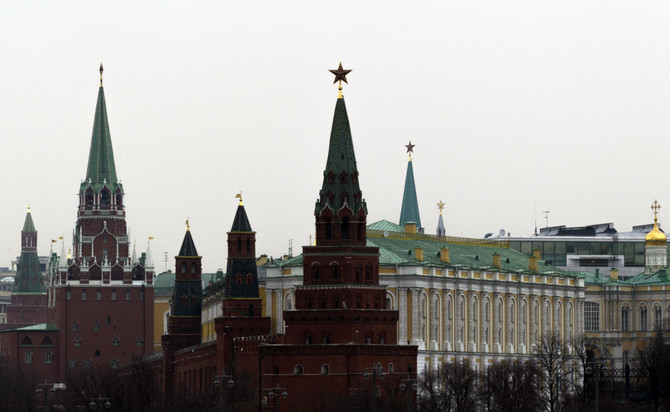
The Kremlin Palace and Towers are seen in Moscow, Russia. (AP)
Updated 14 April 2017
Follow

Russia urges ‘restraint’ over N. Korea tensions: Kremlin

MOSCOW: Russia on Friday called for “restraint” over the situation in North Korea, warning against any “provocative steps” after Washington said it was assessing military options in response to the country’s weapons programs.
“Moscow is watching with great concern the escalation of tensions on the Korean peninsula,” Kremlin spokesman Dmitry Peskov told journalists.
“We call for restraint from all countries and warn countries not to pursue actions that could consist of any provocative steps,” he added.
Speculation has mounted in recent days that Pyongyang is preparing to fire a trial nuke or missile when it marks a major anniversary on Saturday, prompting US President Donald Trump to pledge the matter “will be taken care of.”
Trump has sent an aircraft carrier-led strike group to the Korean peninsula to press his point, in one of a series of signals indicating his willingness to shake up foreign policy strategy.
Russia’s North Korea envoy Alexander Matsegora on Friday said he does not rule out a test or launch in the near future, expressing concern that Trump could take a fateful decision without any North Korea experts on his team.
“If Mr. Trump would listen to a Russian Korea expert with 40 years of experience, I would advise him not to do it,” he told RIA-Novosti of a potential US strike.
“Right now we all must stop at the edge of the abyss and not take this fateful step,” he said.


Nigerian president vows security reset in budget speech

Updated 6 sec ago
Follow

Nigerian president vows security reset in budget speech

  • Government plans to buy 'cutting-edge' equipment to boost the fighting capability of military


ABUJA: Nigeria’s president vowed a national security overhaul as he presented the government budget, allocating the largest share of spending to defense after criticism over the handling of the country’s myriad conflicts.
Nigeria faces a long-running insurgency in the northeast, while armed “bandit” gangs commit mass kidnappings and loot villages in the northwest, and farmers and herders clash in the center over dwindling land and resources.
President Bola Tinubu last month declared a nationwide security emergency and ordered mass recruitment of police and military personnel to combat mass abductions, which have included the kidnapping of hundreds of children at their boarding school.
He told the Senate that his government plans to increase security spending to boost the “fighting capability” of the military and other security agencies by hiring more personnel and buying “cutting-edge” equipment.
Tinubu promised to “usher in a new era of criminal justice” that would treat all violence by armed groups or individuals as terrorism, as he allocated 5.41 trillion naira ($3.7 billion) for defense and security.
Security officials and analysts say there is an increasing alliance between bandits and extremists from Nigeria’s northeast, who have in recent years established a strong presence in the northwestern and central regions.
“Under this new architecture, any armed group or gun-wielding non-state actors operating outside state authority will be regarded as terrorists,” said Tinubu, singling out, among others, bandits, militias, armed gangs, armed robbers, violent cult groups, and foreign-linked mercenaries.
He said those involved in political or sectarian violence would also be classified as terrorists.
On the economic front, Tinubu hailed his “necessary” but not “painless” reforms that have plunged Nigeria into its worst economic crisis in a generation.
He said inflation has “moderated” for eight successive months, declining to 14.45 percent in the last month from 24.23 percent in March this year.
He projected that the budget deficit will drop next year to 4.28 percent of GDP from around 6.1 percent of GDP in 2023, the year he came into office.