US strike in Afghanistan: What is the ‘Mother of All Bombs’?

1 / 3
A video grab from 2003 file footage courtesy the US Air Force (USAF) shows a mushroom cloud created by a GBU-43/B Massive Ordnance Air Blast bomb prototype moments after impact at a test site at Eglin Air Force Base, in Florida. (AFP/US AIR FORCE)
2 / 3
A video grab from 2003 file footage courtesy the US Air Force (USAF) shows a GBU-43/B Massive Ordnance Air Blast bomb prototype moments before impact at a test site at Eglin Air Force Base in Florida. (AFP/US AIR FORCE)
3 / 3
A video grab from 2003 color file footage courtesy the US Air Force (USAF) shows a mushroom cloud created by a GBU-43/B Massive Ordnance Air Blast bomb prototype moments after impact at a test site at Eglin Air Force Base, in Florida. (AFP/US AIR FORCE)
Updated 14 April 2017
Follow

US strike in Afghanistan: What is the ‘Mother of All Bombs’?

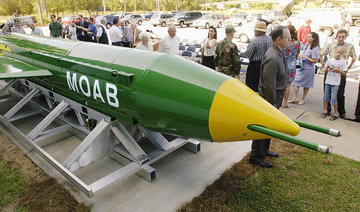
KABUL: The United States has dropped a GBU-43/B Massive Ordnance Air Blast (MOAB) bomb, otherwise known as the ‘Mother of All Bombs’, on an Daesh stronghold in Afghanistan’s eastern Nangarhar province.
It is the first time the bomb, developed in the early days of the Iraq war, has been used in combat.
The 9.8-ton guided bomb, the largest non-nuclear weapon in America’s arsenal, is described by the US-based GlobalSecurity.org watchdog as “large, powerful and accurately delivered.”
It is a demolition bomb containing 18,700 pounds (8,480 kilogrammes) of the explosive H6, the watchdog’s website says, with a blast yield equivalent to 11 tons of TNT.
Nine meters (30 feet) long, with a diameter of one meter, according to GlobalSecurity.org, it is the largest-ever satellite-guided, air-delivered weapon in history. Popular Mechanics described it as weighing as much as an F-16 fighter jet.
Guided by GPS, it is dropped from the cargo ramp of a C-130 transport plane with its descent slowed by parachute, meaning it can be deployed from a greater height — giving US pilots more time to reach safety.
It is a concussive bomb, meaning it is designed to detonate before it hits the ground. Its thin aluminum skin helps to maximize its blast radius and generate a shockwave which Wired.com said can reach up to 150 meters.
It was developed in 2002-2003 by Alabama-based aerospace and defense company Dynetics in partnership with the Air Force Research Lab (AFRL), according to the company’s website.
The website said the bomb’s preliminary concept was developed into a detailed design within just three months, and successfully tested three times in 13 days. It was first produced for use in the early days of the Iraq war.
According to the Air Force, the last time the MOAB was tested in 2003, a huge mushroom cloud could be seen from 20 miles (32 kilometers) away.
The US Air Force said the target of Thursday’s bombing was a tunnel complex in Achin district in Afghanistan’s eastern Nangarhar province, a hotbed of Daesh militancy on the border with Pakistan.

Achin District Governor Esmail Shinwari said the bomb landed in the Momand Dara area while the defense ministry said the attack killed at least 36 Daesh militants. A damage assessment is still being carried out.
The area is extremely remote and mountainous, inaccessible to government forces. It is north of Tora Bora, the complex network of caves from where Al-Qaeda leader Osama Bin Laden gave US forces the slip and escaped into Pakistan in late 2001.
The US said it believed the area was so remote that no civilians were in the area.
The strike hit a system of tunnels and caves that Daesh fighters had used to “move around freely, making it easier for them to target US military advisers and Afghan forces” nearby, White House spokesman Sean Spicer said.
Wired.com said a concussive bomb such as the MOAB has the advantage in such terrain: “Its blast can turn corners, and push all the way to the furthest reaches of a cave.”
London police using withdrawn powers to clamp down on pro-Palestine rallies: Probe

Updated 5 sec ago
Follow

London police using withdrawn powers to clamp down on pro-Palestine rallies: Probe

  • ‘Cumulative disruption’ cited to ban, reroute rallies but power granted by concept withdrawn by Court of Appeal in May
  • Network for Police Monitoring: This demonstrates ‘ongoing crackdown on protest’ that has reached ‘alarming point’

LONDON: London’s Metropolitan Police have used powers that have been withdrawn to clamp down on pro-Palestine rallies in the capital, legal experts have said.

The Guardian and Liberty Investigates obtained evidence that police officers had imposed restrictions on at least two protests based on the principle of “cumulative disruption.” But that power was withdrawn by the Court of Appeal in May, according to legal experts.

All references to cumulative disruption have been removed from relevant legislation, yet the Home Office and the Met continue to insist that police officers retain the power to consider the concept when suppressing protests.

On May 7, five days after the powers were withdrawn, the Met banned a Jewish pro-Palestine group from holding its weekly rally in north London, citing the cumulative impact on the neighborhood’s Jewish community.

Last month, the Met forced the Palestine Coalition to change the route of its rally on three days’ notice, highlighting the cumulative impact on businesses during Black Friday weekend.

Raj Chada, a partner at Hodge, Jones & Allen and a leading criminal lawyer, said: “There is no reference to cumulative disruption in the original (legislation). The regulations that introduced this concept were quashed in May 2025, so I fail to see how this can still be the approach taken by police. There is no legal basis for this whatsoever.”

The Met appeared “not to care” if it was acting within the law, the Network for Police Monitoring said, adding that the revelation surrounding “cumulative disruption” demonstrated an “ongoing crackdown on protest” that had reached an “alarming point” by police in London.

Home Secretary Shabana Mahmood announced plans in October to reintroduce the power to consider cumulative impact in toughened form.

But Nick Glynn, a retired senior officer from Leicestershire Police, said: “The police have too many protest powers already and they definitely don’t need any more. If they are provided with them, they not only use them (but) as in this case, they stretch them.

“They go beyond what was intended. The right to protest is sacrosanct and more stifling of protest makes democracy worth less.”

Cumulative disruption was regularly considered and employed in regulations if protests met the threshold of causing “serious disruption to the life of the community.”

The Court of Appeal withdrew the power following a legal challenge by human rights group Liberty.

Ben Jamal, the Palestine Solidarity Campaign’s director, was reportedly told by Alison Heydari, the Met’s deputy assistant commissioner, that her decision on imposing protest regulations “will be purely around the cumulative effect of your protests.”

She reportedly added that “this is not just about Saturday’s protest but it’s a combination of all the impacts of all the processions so far,” referencing “serious disruption” to the business community.

“You’ve used this route in November 2024, and you’ve used it a few times before then as well. So, there is an impact.”

The repeated disruption to PSC-hosted marches, the largest pro-Palestine events in London, was a “demobilizer,” Jamal said.

It also caused confusion about march starting points and led to protesters being harassed by police officers who accused them of violating protest conditions, he added.

A Met spokesperson told The Guardian: “The outcome of the judicial review does not prevent senior officers from considering the cumulative impact of protest on the life of communities.

“To determine the extent of disruption that may result from a particular protest, it is, of course, important to consider the circumstances in which that protest is to be held, including any existing disruption an affected community is already experiencing.

“We recognise the importance of the right to protest. We also recognise our responsibility to use our powers to ensure that protest does not result in serious disorder or serious disruption. We use those powers lawfully and will continue to do so.”