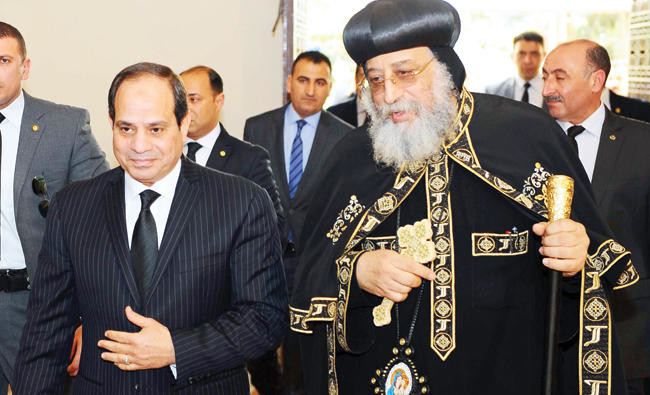
CAIRO: Egyptian President Abdel Fattah El-Sisi pledged to hunt down the perpetrators of last week’s twin church bombings as he visited Coptic Pope Tawadros II on Thursday, his office said.
El-Sisi’s visit to the papal seat in Cairo came a day after the Interior Ministry identified one of the two suicide bombers who struck two Coptic churches on Palm Sunday, killing 45 people.
Daesh claimed the attacks, which followed a Dec. 11 suicide bombing that killed 29 people in a Cairo church.
El-Sisi said “state agencies were exerting their utmost effort to chase down the perpetrators of those vile acts,” the presidency said in a statement.
The ministry on Wednesday offered a 100,000-pound (about $5,500) reward for information leading to the arrest of 18 suspects it said were members of terrorist cells linked to the church attacks.
Sunday’s first bombing at the Mar Girgis church in Tanta, north of Cairo, killed 28 people.
The second struck outside Saint Mark’s church in Alexandria, killing 17 people after a suicide bomber was prevented from entering the building.
El-Sisi declared a three-month state of emergency after the bombings and called on the army to protect “vital” installations around the country.
The Coptic Church said on Wednesday it would cut back Easter celebrations to a single mass after the bombings.
The violence came ahead of Catholic Pope Francis’s first visit to Egypt, which a Vatican official said will go ahead as planned on April 28 and 29 despite the attacks.
Meanwhile, a senior bishop said the government needs to do more to protect Coptic Christians from a “wave of persecution.”
Bishop Macarius, head of the Coptic diocese in Minya, south of Cairo, was skeptical that a state of emergency was adequate security and said the church wanted further guarantees.
Copts make up about 10 percent of the 92-million population of mostly Muslim Egypt and are the region’s largest Christian denomination, with a nearly 2,000-year-old history in the country.
“We can consider ourselves in a wave of persecution, but the church has gone through a lot in 20 centuries,” the bearded Macarius told Reuters.
“There are waves of persecution. It reaches the highest point like a pyramid and then it goes down again,” the bishop said. “We are at a very high point.”
He added: “Security solutions never succeeded alone. No state in the world should be a police state, either here or elsewhere. Emergency all the time makes people nervous.”
El-Sisi needs advisers who could brief him better on the religious, cultural and security aspects of the crisis, said Macarius, wearing an embroidered black cap.
The state also needed to find those who endorsed the ideology of the suicide bomber, he said, and authorities should devote more effort to monitoring social media.
Not far from where Macarius was speaking, Emad Aziz, 56, sat in his clothes shop counting the cost of the latest assault.
Egyptians usually buy new clothes to mark holidays such as Easter. Not this year, however.
“People are sad, and people buy new clothes when they are happy. The situation is really bad,” Aziz, a Christian, told Reuters. “Why would any Egyptian do this to his country? Is this loyalty to the country? Many people don’t want Egypt to get better.”
He agreed a state of emergency was “not a solution” to the situation of Copts in Egypt — where an economic crisis has severely eroded the living standards of millions.
Security appeared light at the Minya diocese but in Cairo, police have deployed around churches in force, erecting security barriers and metal detectors to screen those attending services in the days leading up to Easter.
In the Cairo district of Shubra, where many Christians live, worshippers filled a service at St. Mark’s Church, some following proceedings by scrolling the order of service across the screens of their smart phones.
A metal detector had been moved down the street so that any bomber could be stopped before reaching the church.
Romainy, a security guard, said members of the congregation were “sad but not scared.”
Across the street, a chicken seller, her dress flecked with feathers, said people were attending church as they always had.
“I would have gone to the service myself but I have work to do,” she said, declining to give her name.
Not everyone was so relaxed. At a nearby church, a plainclothes police officer told journalists: “It’s a very tense time in Egypt.”


![]()
El-Sisi vows to hunt down church bombers
El-Sisi vows to hunt down church bombers

Latest updates


© 2026 SAUDI RESEARCH & PUBLISHING COMPANY, All Rights Reserved And subject to Terms of Use Agreement.