

Abu Sayyaf leader behind execution of foreigners is killed, Philippines says

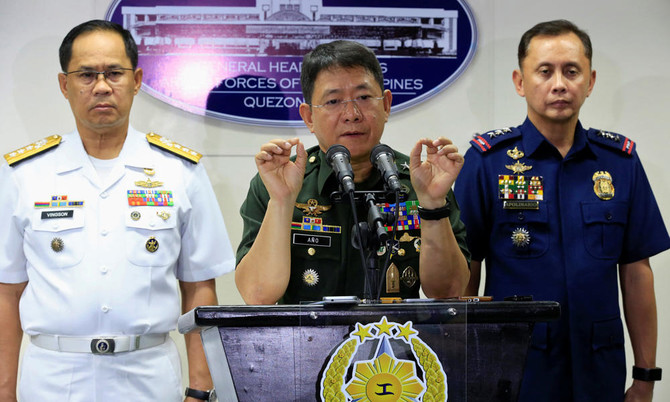
Armed Forces of the Philippines (AFP) Chief of Staff Gen. Eduardo Ano (C) gestures during a news conference inside the military headquarters in Manila on Wednesday. With him are Vice Admiral Narciso Vingson and national police chief Ramon Apolinariio. (REUTERS/Romeo Ranoco)
Updated 12 April 2017
Follow

Abu Sayyaf leader behind execution of foreigners is killed, Philippines says

MANILA, Philippines: Philippines troops battling militants on a central resort island killed a young Abu Sayyaf commander who was involved in the beheadings of two Canadians and a German and who had sailed far from the extremists’ southern jungle hideouts to capture more hostages, the military chief said Wednesday.
Military chief of staff Gen. Eduardo Ano told The Associated Press that troops recovered and identified the remains of Moammar Askali at the scene of the battle in a coastal village on Bohol island. Five other Abu Sayyaf gunmen, three soldiers and a policeman also were killed in Tuesday’s clashes.
Ano said captured Abu Sayyaf militants identified Askali from a photo troops took of the young militant leader after death, which confirmed that the gunmen who quietly cruised into Bohol on three motorboats Monday night then clashed with troops belonged to the Islamic extremist group. Askali, who used the nom de guerre Abu Rami, had partly served as an Abu Sayyaf spokesman in recent years.
“This is a major blow to the Abu Sayyaf,” Ano told The AP. “If they have further plans to kidnap innocent people somewhere, they will now have to think twice.”
Askali was an emerging hard-line leader of Abu Sayyaf and had pledged allegiance to the Daesh group. He had received bomb-making training from Malaysian Zulkifli bin Hir, or Marwan, a top Southeast Asia militant leader who was killed in 2015, according to a police profile.
It was Abu Sayyaf’s first known attempt to carry out ransom kidnappings deep in the central Philippines heartland, far from the group’s jungle lairs in the southern provinces of Sulu and Basilan. Ano said the troops were still hunting at least five Abu Sayyaf gunmen, though fighting had eased Wednesday.
While the bold kidnapping attempt appears to have been foiled, the militants’ success in penetrating the bustling region of beach resorts and other popular attractions could raise concern among tourists and businessmen.

Bohol island lies about 640 kilometers (397 miles) southeast of Manila and is about an hour by boat from Cebu province, a trade and tourism center which has hosted some of the meetings of the Association of Southeast Asian Nations, the regional bloc the Philippines is leading this year.
Ano said military intelligence operatives had been trying to track the movements of Askali’s group for several days after learning of their planned abductions.
The gunmen traveled on motorboats along a river to Inabanga’s Napo village, where government forces assaulted them, military spokesman Col. Edgard Arevalo said, adding that troops recovered four rifles and a homemade bomb from the dead gunmen.

                                                                                                            Moammar Askali

The US Embassy in Manila had earlier advised Americans to take precautions amid “unsubstantiated yet credible information” of possible kidnappings by terrorists in Bohol and other central areas.
The United States and the Philippines both list Abu Sayyaf as a terrorist organization for bombings, kidnappings for ransom and beheadings.
Abu Sayyaf militants have crossed the sea border with Malaysia on powerful speedboats and kidnapped scores of foreign tourists in past years, reflecting their growing capability and desperation for money. In 2001, they sailed as far as western Palawan province, where they seized 20 people, including three Americans, from a resort.
Philippine President Rodrigo Duterte has ordered troops to destroy the extremists and has threatened to declare martial law in the country’s south if the threat posed by the Abu Sayyaf and other extremist groups aligned with the Daesh group gets out of control.
Although Abu Sayyaf have been weakened by years of battle setbacks, they beheaded two Canadians last year and a German hostage earlier this year after ransom deadlines lapsed. Askali was involved in those kidnappings and the captives’ gruesome murders, Ano said.
The militants are still holding at least 29 captives in Sulu’s jungles, many of them foreign tugboat and cargo ship crewmen seized in the seas surrounded by southern Philippines, Malaysia and Indonesia.
___
Associated Press writer Teresa Cerojano contributed to this report.


What Bangladesh’s election means for India, China and Pakistan ties

Bangladesh Nationalist Party supporters gather for a rally ahead of the upcoming national election, in Sylhet on Jan. 22, 2026.
Updated 8 sec ago
Follow

What Bangladesh’s election means for India, China and Pakistan ties

  • Bangladeshis will vote on Feb. 12, almost two years after the 2024 student-led uprising
  • After nearly 2 years of tensions, experts expect a thaw with India under elected government

DHAKA: As Bangladesh prepares to hold its first elections since the 2024 ouster of Sheikh Hasina, its longest-serving prime minister, the outcome will define Dhaka’s relations with the most important regional powers — China, India, and Pakistan.

Nearly 128 million Bangladeshis will head to the polls on Feb. 12 to bring in new leadership after an 18-month rule of the current caretaker administration.

The interim government, led by Nobel laureate Muhammad Yunus, took control following a student-led uprising that ended 15 years in power of Hasina and her Awami League party.

The two main parties out of the 51 competing for power are the Bangladesh Nationalist Party and Jamaat-e-Islami. The Awami League, which for decades has had close ties with India, was excluded from the election ballot over its role in the deadly crackdown on the 2024 student-led protests, in which 1,400 people were killed.

While Bangladesh’s relationship India has deteriorated since the fall of Hasina, who has been in self-exile in New Delhi, the period of diplomatic strain is expected to ease when the new government takes office.

“Whoever comes to power in Bangladesh, due to domestic pressure in the country, relationships with India need a resetting,” Humayun Kabir, former ambassador to the US, told Arab News.

“It’s anticipated that India will also engage with the new government, but they will protect their interests, and we also have to do the same. It’s most likely that the India-Bangladesh relationship will be normalized under the new, elected, government.”

Since 2024, India has suspended key transshipment access that allowed Bangladeshi exports to go via Indian ports and airports. It also put on hold most normal visa services for Bangladeshis, who were among its largest groups of medical tourists.

From Hasina’s heavy pro-India orientation, the interim government has tried to rebalance Bangladesh’s foreign policy toward the two other key regional players — China and Pakistan — who at the same time are India’s main rivals. 

If New Delhi regains its importance, it should not deal a blow to the newly expanded relations with Pakistan, with whom Bangladesh has recently increased exchanges, especially economic, and last month resumed direct flights — after a 14-year gap.

Since the relations have been expanded under the caretaker government, Prof. Delwar Hossain from the International Relations Department at Dhaka University forecast that they would only further improve, no matter who comes to power, and there is no likelihood of a sudden change.

“For Pakistan, any political coalition — whether BNP or Jamaat — will be positive. The BNP has a long history of having good relations with Pakistan during their rule ... Jamaat also has a strong and very positive influence in Pakistan,” he said.

“For Pakistan, the new regime or new government is not the issue. The issue is what the (India) policy of the new government would be and to what extent it would actually support Pakistan’s view.”

Both the BNP and Jamaat have repeatedly said they wanted friendly relations with India, and Hossain expected that they would, at the same time, continue the balanced approach introduced by the caretaker administration.

“India is a reality as a neighbor. At the same time, India is also showing interest in mending relations or adopting a more cooperative approach after the vote, with the government that will be elected ... I think there will be pragmatism from both sides,” he said.

“I don’t see there is a long-term threat to Bangladesh-India relations ... When China and Pakistan were trying to create a trilateral cooperative system or some kind of coalition — China, Bangladesh and Pakistan — we have seen that Bangladesh opted out. It seems that Bangladesh is going to continue its policy of maintaining a balance among these great powers.”

Bangladesh’s relations with China have not changed since the ouster of Hasina, whose government signed several economic agreements with Beijing. Yunus’s administration has continued this cooperation, and China was among the very few countries he officially visited during his term.

During the visit, he secured about $2.1 billion in Chinese investments, loans and grants, including funding for infrastructure like Mongla Port and a special economic zone in Chattogram — Bangladesh’s largest port. China has also eased visa rules for Bangladeshi businesspeople, medical travelers and tourists.

According to Munshi Faiz Ahmed, Bangladesh’s former ambassador to Beijing, China’s importance for Bangladesh cannot be substituted by any other country, especially as over the past few years it has emerged not only as its key investor, but also the largest trade partner.

In the fiscal year 2024-25, Bangladesh’s trade with China was over $21.3 billion, according to National Board of Revenue data. With India, it was about $11.5 billion.

The trade — especially import — dependence on Beijing started long before the regime change. In terms of trade volume, China overtook India already in 2018.

“Even when people thought that we had very close relations with India, our relations with China continued to grow in terms of trade and commerce ... Our trade with China has surpassed India’s, and China is a much bigger investor in Bangladesh’s development projects,” Ahmed said.

“Bangladesh will continue to cooperate with China for a long time to come because what China can provide, no other country can.”
