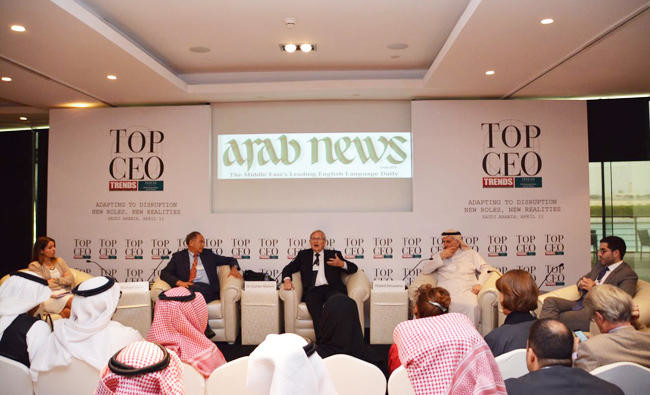
KING ABDULLAH ECONOMIC CITY: Opening up Saudi Arabia to more journalists and tourists would help address some of the negative perceptions about the country and wider region, an Arab News panel heard on Tuesday.
The discussion on the “Middle East’s perception problem,” held at the Top CEO Conference at King Abdullah Economic City, examined the region’s image, how it can be changed, and why there has arguably been a failure in communication with the rest of the world.
It is the first time the Top CEO event has been held in Saudi Arabia, following previous sessions in Dubai.
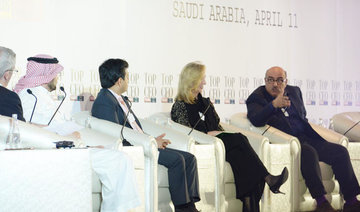
Moderated by Faisal J. Abbas, editor in chief of Arab News, Tuesday’s panel discussion included four key experts working in the region or world of diplomacy.
While the panel agreed that there are issues with the Arab world’s image in the West, there was debate over how the region is portrayed by, for example, Hollywood films.
Elisabetta Martini, the consul general of Italy based in Jeddah, said that opening up a country like Saudi Arabia to more people would help the world see it in a more positive and realistic light.
“How can you fix the image (problem)? First of all, having journalists coming… also tourists,” she said.
The diplomat said that changing perceptions about Saudi Arabia was much easier when more people get the chance to visit. Citizens of most nations require visas before entering the Kingdom.
Martini said that part of her job as a diplomat is promoting the image of Saudi Arabia in her native Italy — and that this is much easier when people get a chance to actually visit the country.
“It’s not that difficult to change the perception (of my people about Saudi Arabia) once they have the opportunity to come here,” she said.
But opening up the Kingdom to more people could not be selective, and people may have positive or critical reactions, the diplomat said.
“Once you have journalists then you cannot choose who you want. You have the exploring ones, and the critical ones,” she said. “They will see something that is completely unexpected.”
Former German Ambassador Dr. Gunter Mulack, of the German Orient Institute in Berlin, also spoke during the panel discussion.
Mulack entered into the German diplomatic service in 1971, and served mostly in the Arab world. He was German ambassador to Bahrain, Kuwait and Syria as well as consul general in Casablanca, along with other postings.
He agreed that opening up Saudi Arabia would help the world understand it better.
“I think we have on all sides to open up, to be more self-critical, and to see what is wrong and what is right in the negative image,” he told the Arab News panel.
“Saudi Arabia should really open up to tourism, to visitors, show the friendly face… Then you get on the same wavelength as Oman, the Emirates.
“Please, open up. You are a proud civilization in Saudi Arabia but maybe you were too much afraid of the outside influences. Open up, get into discussions, and try to win this battle for the hearts and minds of the outside world.”
A Hollywood conspiracy thriller?
Faisal J. Abbas, Arab News’ editor in chief, asked panel members whether they thought there is a Hollywood “conspiracy” against the Arab world, due to the way many movies cast people from the Middle East as villains.
Michael Garin, CEO of the Abu Dhabi-based media and entertainment company Image Nation, said that there is no conspiracy.
With over 40 years’ experience in the industry, Garin’s media career began at Time Inc. where he worked for TIME, Fortune and Time-Life Television for over a decade.
He said that there has always been bad guys in films.
“Movies are about fantasy. And fantasy requires good guys and bad guys. So Hollywood has always had bad guys, whether they were Indians, whether they were Nazis… now they’re Arabs. They’re using Arabs as proxies for something they’ve always done,” he said.
“It’s because scriptwriters are lazy. There’s nothing more complicated to it than that.”
But fellow panelist Khaled Al-Maeena, managing partner of Quartz communication company, disagreed. The former Arab News editor has a unique perspective about the image of the region overseas, having held a broad range of positions in the Saudi media over almost 30 years.
He said that Arabs are often portrayed negatively in Hollywood and Bollywood films.
“Every time, there is an Arab rogue or a villain, I don’t know why,” he said.