JEDDAH: Few would dispute that Saudi Arabia’s economy has witnessed some tough times.
But as this week’s Top CEO Conference will hear, there are some golden opportunities amid the gloom that followed the oil-price crash.
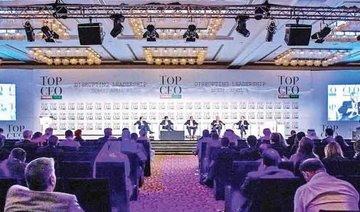
Some of the burning issues facing corporations today will be discussed at the conference, which is being held for the first time in Saudi Arabia after previous editions in Dubai.
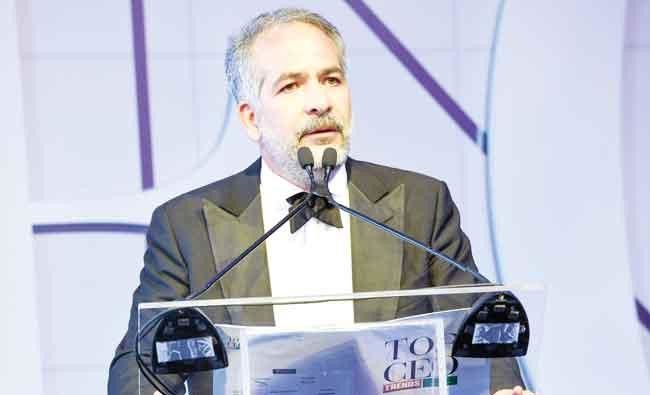
Held under the theme “Adapting to Disruption: New Roles, New Realities,” the event is organized by Dubai-based Trends magazine, an international publication on Arab affairs, in association with Insead business school.
Julien Hawari, co-CEO of Mediaquest Corp, the publisher of Trends, said that it is significant that this is the first time the event will be held in the Kingdom.
The country, grappling with significant economic challenges, last year laid out the ambitious Vision 2030 reform plan, which aims to wean it off its addiction to oil.
“With great challenges come great opportunities,” Hawari told Arab News.
“Hosting the Top CEO Conference and Awards in Saudi Arabia made sense, as Saudi (Arabia) is the giant economy of the region and it is fully taking on its role (as the) engine of growth for the region.
“Saudi Arabia is preparing itself (for) a transformation that will benefit society and create more jobs for our children. The issues are complex and the Top CEO Conference addresses many of those.”
The diversification of the economy is the underlying theme of Saudi Arabia’s reform plan — something that is common to strategies pursued by some other regional countries.
“Moving away from an oil economy has become a necessity for the entire GCC,” Hawari said.
“We believe that the Arab world has a lot to offer... (Members of) our new generation are bringing with them expertise and experience from the outside and a deep knowledge on how to take forward our societies.”
Key factors in this regional change include corporate governance and transparency, ensuring fair competition, and creating jobs — all issues that are set to be addressed at the Top CEO event.
The roller coaster ride in oil prices is not the only factor impacting the Arabian Gulf. New technology is also turning old business models upside down.
“One of the key issues Top CEO is focusing on this year is disruption,” said Hawari. “The full impact of the technology revolution is hitting the region. This makes the life of business leaders extremely challenging, as they need to have their eyes on 10 different things to take forward their organizations.
“A new norm is shaping and changing many status quos in regional business.”
The Top CEO event is set to be held on April 10-11 at King Abdullah Economic City (KAEC) near Jeddah.
In its third edition in 2017, the accompanying awards will honor the top 100 chief executive officers after evaluating their companies’ listings on the Gulf Cooperation Council’s (GCC) stock exchanges.

The Saudi economy: ‘With great challenges come great opportunities’
What MENA’s wild 2025 funding cycle really revealed
RIYADH: The Middle East and North Africa startup funding story in 2025 was less a smooth arc than a sequence of sharp gears: debt-led surges, equity-led recoveries, and periodic quiet spells that revealed what investors were really underwriting.
By November, the region had logged repeated bursts of activity — culminating in September’s $3.5 billion spike across 74 deals — yet the year’s defining feature was not just the size of the peaks, but the way capital repeatedly clustered around a handful of markets, instruments, and business models.
Across the year’s first eleven months, funding totals swung dramatically: January opened at $863 million across 63 rounds but was overwhelmingly debt-driven; June fell to just $52 million across 37 deals; and September reset expectations entirely with a record month powered by Saudi fintech mega facilities.
The net result was a market that looked expansive in headline value while behaving conservatively in underlying risk posture — often choosing structured financing, revenue-linked models, and geographic familiarity over broad-based, late-stage equity appetite.
Debt becomes the ecosystem’s shock absorber
If 2024 was about proving demand, 2025 was about choosing capital structure. Debt financing repeatedly dictated monthly outcomes and, in practice, became the mechanism that let large platforms keep scaling while equity investors stayed selective.
January’s apparent boom was the clearest example: $863 million raised, but $768 million came through debt financing, making the equity picture almost similar to January 2024.
The same pattern returned at larger scale in September, when $3.5 billion was recorded, but $2.6 billion of that total was debt financing — dominated by Tamara’s $2.4 billion debt facility alongside Lendo’s $50 million debt and Erad’s $33 million debt financing.
October then reinforced the playbook: four debt deals accounted for 72 percent of the month’s $784.9 million, led by Property Finder’s $525 million debt round.
By November, more than half the month’s $227.8 million total again hinged on a single debt-backed transaction from Erad.
This isn’t simply ‘debt replacing equity.’ It is debt acting as a stabilizer in a valuation-reset environment: late-stage businesses with predictable cash flows or asset-heavy models can keep expanding without reopening price discovery through equity rounds.
A two-speed geography consolidates around the Gulf
The regional map of venture capital in 2025 narrowed, widened, then narrowed again — but the center of gravity stayed stubbornly Gulf-led.
Saudi Arabia and the UAE alternated at the top depending on where mega deals landed, while Egypt’s position fluctuated between brief rebounds and extended softness.
In the first half alone, total investment reached $2.1 billion across 334 deals, with Saudi Arabia accounting for roughly 64 percent of capital deployed.
Saudi Arabia’s rise was described as ‘policy-driven,’ supported by sovereign wealth fund-backed VC activity and government incentives, with domestic firms such as STV, Wa’ed Ventures, and Raed Ventures repeatedly cited as drivers.
The UAE still posted steady growth in the first half — $541 million across 114 startups, up 18 percent year-on-year — but it increasingly competed in a market where the largest single cheques were landing elsewhere unless the Emirates hosted the region’s next debt mega round.
The concentration became stark in late-year snapshots. In November, funding was ‘tightly concentrated in just five countries,’ with Saudi Arabia taking $176.3 million across 14 deals and the UAE $49 million across 14 deals, while Egypt and Morocco each sat near $1 million and Oman had one undisclosed deal.
Even in September’s record month, the top two markets — Saudi with $2.7 billion across 25 startups and the UAE with $704.3 million across 26 startups — absorbed the overwhelming majority of capital.
A smaller but notable subplot was the emergence of ‘surprise’ markets when a single deal was large enough to change rank order.
Iraq briefly climbed to third place in July on InstaBank’s $15 million deal, while Tunisia entered the top three in June entirely via Kumulus’ $3.5 million seed round.
These moments mattered less for the totals than for what they suggested: capital can travel, but it still needs an anchor deal to justify attention.
Events, narrative cycles, and the ‘conference effect’
2025 also showed how regional deal flow can bunch around events that create permission structures for announcements.
February’s surge — $494 million across 58 deals — was explicitly linked to LEAP 2025, where ‘many startups announced their closed deals,’ helping push Saudi Arabia to $250.3 million across 25 deals.
September’s leap similarly leaned on Money20/20, where 15 deals were announced and Saudi fintechs dominated the headlines.
This ‘conference effect’ does not mean deals are created at conferences, but it does change the timing and visibility of closes.
Sector leadership rotates, but utility wins
Fintech retained structural dominance even when it temporarily lost the top spot by value.
It led January on the back of Saudi debt deals; dominated February with $274 million across 15 deals; remained first in March with $82.5 million across 10 deals; topped the second quarter by capital raised; and reclaimed leadership in November with $142.9 million across nine deals — again driven by a debt-heavy transaction.
Even when fintech fell to ninth place by value in October with $12.5 million across seven rounds, it still remained ‘the most active sector by deal count,’ a sign of persistent baseline demand.
Proptech was the year’s other headline sector, but its peaks were deal-specific. Nawy’s $75 million round in May helped propel Egypt to the top that month and pushed proptech up the rankings.
Property Finder’s debt round in October made proptech the month’s top-funded sector at $526 million. In August, proptech led with $96 million across four deals, suggesting sustained investor appetite for real-estate innovation even beyond the megadeal.
Outside fintech and proptech, the year offered signals rather than dominance. July saw deeptech top the sector charts with $250.3 million across four deals, reflecting a moment of investor appetite for IP-heavy ventures.
AI repeatedly appeared as a strategic narrative — especially after a high-profile visit by US President Donald Trump alongside Silicon Valley investors and subsequent GCC AI initiatives — yet funding didn’t fully match the rhetoric in May, when AI secured just $25 million across two deals.
By late year, however, expectations were already shifting toward mega rounds in AI and the industries built around it, positioning 2025 as a runway-building year rather than a breakout year for AI funding in the region.
Stage discipline returns as valuations reset
In 2025, MENA’s funding landscape tried to balance two priorities: sustaining early-stage momentum while selectively backing proven scale. Early-stage rounds dominated deal flow. October saw 32 early-stage deals worth $95.2 million, with just one series B at $50 million. November recorded no later-stage rounds at all, while even September’s record month relied on 55 early-stage startups raising $129.4 million.
When investors did commit to later stages, the cheques were decisive. February featured Tabby’s $160 million series E alongside two $28 million series B rounds, while August leaned toward scale with $112 million across three series B deals. Late-stage equity was not absent — it was episodic, appearing only when scale economics were defensible.
B2B models remained the default. In the first half, B2B startups raised $1.5 billion, or 70 percent of total funding, driven by clearer monetisation and revenue visibility.
The gender gap remained structural. Despite isolated spikes, capital allocation continued to overwhelmingly favour male-led startups.
What 2025 actually said about 2026
Taken together, 2025 looked like a year of capital market pragmatism. The region demonstrated capacity for outsized rounds, but much of that capacity ran through debt, a handful of megadeals, and a narrow set of markets — primarily Saudi Arabia and the UAE.
Early-stage deal flow stayed active enough to keep the pipeline moving, even as growth-stage equity became intermittent and increasingly selective.
By year-end, the slowdown seen in November read less like a breakdown than a deliberate pause: a market in consolidation mode preserving firepower, waiting for clearer valuation anchors and the next wave of platform-scale opportunities.
If 2025 was about proving the region can absorb large cheques, 2026 is shaping up to test where those cheques will go — especially as expectations build around AI-led mega rounds and the industries that will form around them.