Saudi Arabia to continue with expansionary spending in 2026 budget, says finance minister 

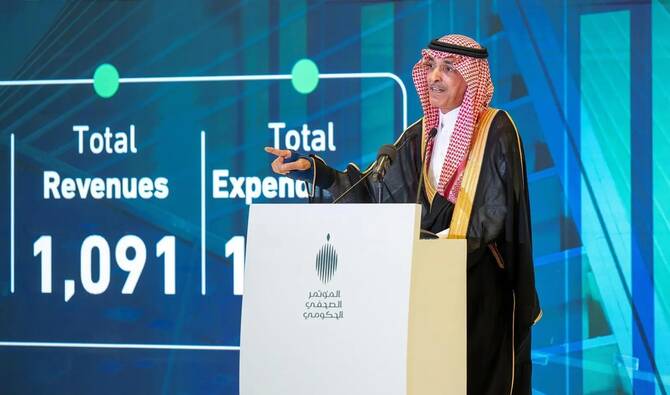
Saudi Arabia’s Minister of Finance, Mohammed Al-Jadaan, affirmed that the government will continue expansionary spending in the 2026 budget. SPA
Short Url
Updated 03 December 2025
Follow

Saudi Arabia to continue with expansionary spending in 2026 budget, says finance minister 

RIYADH: Saudi Finance Minister Mohammed Al-Jadaan confirmed on Wednesday that the government will maintain expansionary spending in the 2026 budget, emphasizing stability and medium-term planning.

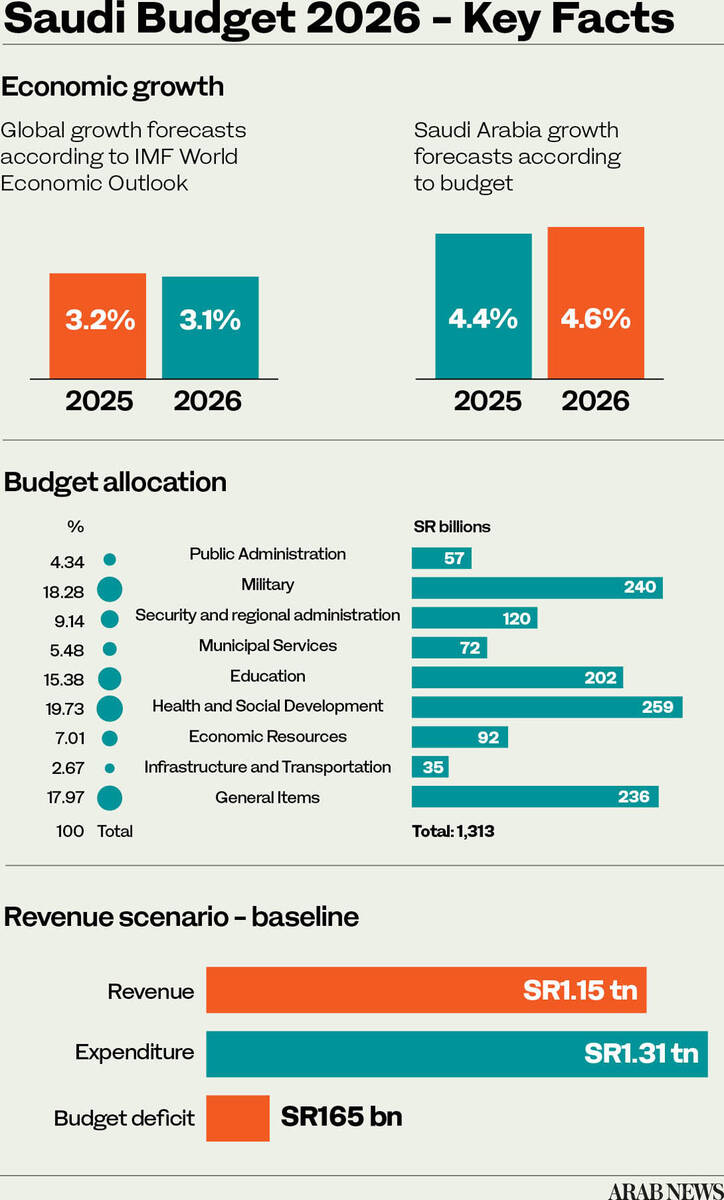
He said total expenditure is expected to reach SR1.31 trillion ($348.9 billion) in 2026 and rise to about SR1.41 trillion by 2028, with revenue growth supported by accelerated economic expansion.

During a Dec. 3 press conference after the approval of the 2026 budget, Al-Jadaan stated: “Despite all spending on major strategies and projects, the government continues to focus on and improve basic services to enhance services provided to citizens, including education, health, social services, and municipal services, which are set to reach SR533 billion in 2026.”

He explained that the next stage — maximizing impact — will begin early next year, requiring significant work from both the government and private sector.
Al-Jadaan highlighted Crown Prince Mohammed bin Salman’s statement on the budget, which reviewed Vision 2030 achievements, government focus on citizens, and future directions, including the third phase of the Vision. He said: “Ninety-three percent of the targeted Vision 2030 performance indicators have been achieved or are on track, while 85 percent of initiatives have been completed or are progressing as planned. 299 Vision indicators have already met their targets ahead of 2030.”

He reviewed the 2025 budget, with expenditures of roughly SR1.33 trillion, revenues of about SR1.09 trillion, and a deficit of approximately SR245 billion. He noted: "Last year I spoke, and I will repeat briefly, that the budget deficit differs based on its uses. For us in Saudi Arabia in this period… the deficit was a targeted strategic deficit, based on a government policy… even if we need to borrow.”

“The goal is for this borrowing of SR245 billion to achieve a return higher than its cost, and that is what is happening in the Kingdom. The growth in the economy today, especially in the non-oil economy, averages 5 percent over the past four or five years.”

He added: “The returns from most of the spending we are undertaking now will come after years, not now. Therefore, it may be good for us to continue… in 2026, 2027, and 2028, increasing spending as long as the return on this spending is higher than the cost of borrowing.”

Al-Jadaan emphasized that citizens remain the government’s priority: “The cornerstone of the government’s work is the citizen and what benefits them directly or indirectly through projects and strategies that create job opportunities and ensure security, stability, peace, and prosperity.”

He highlighted the structural transformations since Vision 2030, including a 40 percent increase in private investment’s share of GDP and non-oil activity’s rise to 55.4 percent. He called this growth “unprecedented” and noted that the tourism sector’s trade surplus is increasing, while the budget deficit is moving toward a surplus.

Al-Jadaan pointed out that the number of micro, small, and medium enterprises has grown from 500,000 to 1.7 million, generating 1.2 million jobs. He said the government will continue supporting sector growth, particularly in AI, technology, and government tech, while pursuing revenue growth through economic expansion and private sector enablement.

He noted that international rating agencies recognize Saudi Arabia’s approach, affirming or upgrading the Kingdom’s rating despite rising debt and deficit. Al-Jadaan projected real GDP growth of 4.4 percent in 2025, with nominal GDP reaching SR5.6 trillion by 2028, and stressed that inflation remains among the lowest globally.

On long-term economic returns, he said: “Some returns are achieved quickly, while others take many years, especially in infrastructure projects such as roads, airports, and railways. Some phases may show temporary negative returns due to the import of equipment and materials, but the real gains become evident over subsequent years and decades.”

He noted that full sustainability has not yet been reached, with revenues still affected by oil prices. Vision 2030 aims to maximize non-oil revenues while using oil wealth to build a robust economy for future generations. He also highlighted the Public Investment Fund’s growth from SR150 billion to over SR800 billion: “The PIF does not distribute dividends to the government. The goal is long-term investment for future generations.”

Regarding government revenues, he said all income except the White Land tax is deposited into the unified treasury and allocated to designated accounts, such as Social Security. White Land tax revenues fund housing development. On health and education, spending will exceed SR460 billion in 2026, and privatization will not reduce services for citizens.

Al-Jadaan confirmed Saudi Arabia’s economic policy is based on “productive debt” and pledged continued focus on industry, tourism, transport and logistics, technology (including AI), water, and energy over the next five years. He added: “The Saudi government will handle inflation prudently… rates are among the lowest internationally.”


Why Amazon is betting big on Saudi Arabia’s AI ambitions

Updated 05 December 2025
Follow

Why Amazon is betting big on Saudi Arabia’s AI ambitions

  • AWS is investing over $10 billion in the Kingdom in hopes of becoming a cornerstone of its AI industry

SEATTLE: Executives from Amazon Web Services, the world’s largest data center provider and a key player in the global AI race, are eyeing opportunities nearly 10,000 km away in Saudi Arabia. 

In the last year, the Kingdom has taken its AI ambitions into overdrive, launching some of the most ambitious goals and investments in the technology anywhere, with over $40 billion earmarked for investment by 2030. 

A figure — and an opportunity — that has not gone unnoticed by big tech on the US West Coast. Next year, AWS is set to launch a $5.3 billion “AI region,” housing data centers required for AI deployment, and is committing to invest a further $5 billion to create an “AI zone” in collaboration with Saudi AI firm Humain. 

A look at the global hyperscale cloud providers competing for market share in Saudi Arabia, including AWS, Microsoft, Google, Oracle, and stc. (creativecommons.org)

“Launching a region is a serious investment, and it reflects our confidence in the business potential of the Kingdom,” Ruba Borno, VP of Global Specialists and Partners at AWS, told Arab News at a media event held at the firm’s Seattle HQ in November. 

The company has high hopes for the country — which, despite facing some drawbacks on talent and security, is proving to be a viable base for AI infrastructure thanks in part to its deep pockets and, crucially, its abundance of hydrocarbon and green energy, which as AWS CEO Matt Garman pointed out, are proving to be among the biggest challenges of scaling AI. 

“We were worried about energy across every single country in the world that we operate in,” Garman told reporters at AWS HQ.

“I think the amount of power the world’s going to need 10 years from now is much, much, much more than we have today.” 

Matt Garman, CEO of AWS, speaking at the company’s Seattle headquarters, where he discussed the rising global demand for energy to support AI growth. (Supplied)

With Saudi Arabia keen to capitalize on its comparative advantages, the Kingdom is undergoing a massive infrastructure boom, racing to transform the desert into sprawling data centers. 

Borno explained that AWS’ centers will be focused heavily on AI and aim to give regional players the computing power they need to launch AI applications at scale. “This investment is a bit unique because it is actually tailor-made for AI workloads,” she said.

“It is the infrastructure that is specific for AI training and inference — to help train models that are developed in that region or trained in that region on data to support customers and partners in that region.” 

Opinion

This section contains relevant reference points, placed in (Opinion field)

Borno said AWS’ goal in Saudi Arabia is to “lay down the roads” to allow a viable AI ecosystem to take shape. She pointed out that this required not only infrastructure like data centers but also training to ensure the talent to utilize the hardware is available. 

“To start to extract the value from the oil, you’ve got to build physical roads and lay the tar, get the pumps, and I think we’re seeing much of that happening right now with AI,” she said.

Bridging the skills gap 

Conservative estimates suggest that Saudi Arabia may need to train or attract anywhere between 150,000 and 250,000 people — a hefty number for any nation. However, AWS seems confident in the Kingdom’s ability to meet demand, and through partnerships with Saudi firms like Manara, has made upskilling a core part of its KSA strategy. 

“We believe that there’s a tremendous opportunity to support the customers there to totally transform, but it has to be coupled with training,” Borno said.

“It’s not just about getting the certifications, it’s actually about getting them jobs. So it’s not just training them, getting them AWS certified, but actually placing them.” 

As part of their “AI zone” collaboration with Humain, AWS has committed to training 100,000 Saudi citizens in cloud computing and generative AI, including a dedicated upskilling initiative to train 10,000 women. 


This is being done while simultaneously signing partnerships that will see AWS become the infrastructure partner of choice in the Kingdom — aiming to make AWS foundational to all AI development. These partnerships include big players like Humain, but smaller startups as well. 

“I think when we launch these new regions, we’re going to see a lot more startups actually innovate, because they now have this innovation at their fingertips to be able to build businesses,” Borno said.

“There’s a KSA startup in this year’s cohort called Lisan, and they’re focused on language translation with the right dialect, using AI to actually support that language translation.” 

AWS recently made global headlines when it laid off 30,000 staff, prompting fears of a mass exodus of jobs as AI tools emerge. Confronted on the topic by reporters in Seattle, CEO Matt Garman admitted that he had little idea what AI’s impact may be on workforce size; however, he seemed confident that the upheaval would result in new opportunities. 

“I am not going to pretend I have any idea what the right size of the workforce is 10 years from now,” Garman said.

“What I will say is the thing that I feel confident about is the shape of the workforce will look different.”

DID YOU KNOW?

• Saudi Arabia has earmarked over $40 billion for AI investments by 2030, making it one of the most ambitious initiatives globally.

• The Kingdom’s abundant hydrocarbon and green energy resources make it a prime location for powering AI data centers.

• AWS sees Saudi Arabia as a strategic hub not just for AI infrastructure, but for fostering a whole regional AI ecosystem.

Managing risks 

In September this year, multiple undersea cables were cut in the Red Sea, causing internet disruptions. The act of vandalism — purported to be part of active campaigns of economic coercion in a politically volatile region — has sparked fears that the region’s AI ambitions could be hindered by geopolitical risk. 

However, speaking to Arab News, Sara Duffer, director of AWS Security Assurance, said the company was confident in its ability to mitigate these risks and stay ahead of disruptions, which she said impact many regions for varying reasons. 

“We think about that level of connectivity and ensure that we have multiple paths from a connectivity perspective so that you’re able to continue to engage within a specific region,” Duffer said. 

Attendees walk through an expo hall during AWS re:Invent 2025, a conference hosted by Amazon Web Services, at The Venetian Convention & Expo Center on December 2, 2025 in Las Vegas, Nevada. (AFP)

She said part of the advantage of having “cloud regions” and AI zones in different parts of the world was the ability to build to the exact requirements of each. Duffer stated that this would be no different in Saudi Arabia, where they hope that by having the infrastructure to store data locally, much of the risk could be mitigated. 

“We really design from the ground up our regions with the concept of data sovereignty,” she said.

“The availability and resiliency controls that we have enable our customers to choose which regions they want their content to reside in — down to even which data center they want it in.”