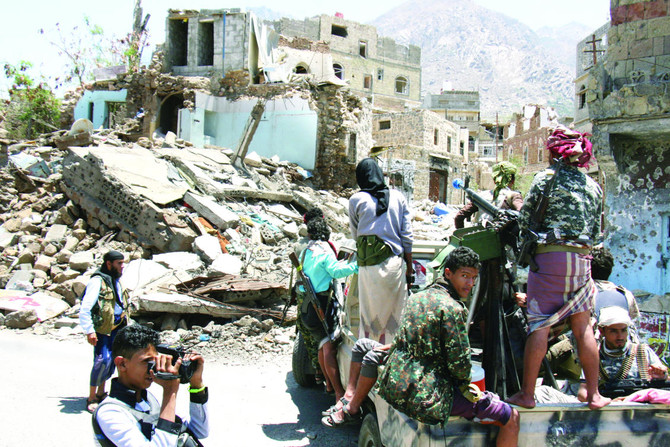
JEDDAH: Yemen’s legitimate government, in a move to accelerate its restoration of state institutions, will transfer its Parliament to the interim capital of Aden, as well as start reconstruction projects and operations at Al-Mokha Port.
Mohammed Al-Shaddadi, deputy speaker of the Yemeni Parliament, said in statements to Asharq Al-Awsat, that the Yemeni Parliament will soon begin to work from the interim capital of Aden.
“The parliament will carry out its governing and executive duties within the coming days, and work is currently ongoing to prepare a conference room to hold sessions while the headquarters is being prepared for the general secretariat to resume duties,” he said.
The deputy said the parliament will carry out its work from Aden following a decision from President Abed Rabbo Mansour Hadi.
The Yemeni government also announced its reconstruction of infrastructure destroyed by Houthi and Saleh militias in liberated areas. Prime Minister Ahmed Obeid bin Daghr made the announcement on Friday during his attendance of the laying of the foundation stone for a number of reconstruction projects in Aden, the Yemeni Press Agency reported.
He noted that the “wheel of development has spun once again.”
He said strategic projects scheduled to be rebuilt will advance the interim capital of Aden and overcome the stage of destruction brought on by the war, with participatory efforts from its citizens who made tremendous sacrifices.
Nasser Sharif Al-Khamis, deputy minister of transport, also announced plans to secure and revive the strategic Al-Mokha Port, as well as all other ports controlled by the legitimate government. He said the port is expected to resume operations in the coming days.
Shami Mohammed Al-Dhaheri, a Saudi rear admiral and strategy analyst, said Al-Mokha is considered one of Yemen’s strategic ports. It is located about 100 kilometers from Bab Al-Mandab, while a number of important islands in international navigation, such as Hanish Islands, are located off its coast. The port is also considered the sea front of Taiz, and with main roads linked Al-Mokha to Al-Hodaida, it is pivotal to liberating Al-Hodaida Port.
According to Al-Dhaheri, 10 of Yemen’s 12 ports have been liberated. Al-Hodaida and Al-Sareej ports remain in militant hands. Attempts are ongoing to liberate these two ports, he said, particularly Al-Hodaida as its liberation will constrain Houthi militias and halt the smuggling of weapons an equipment to these groups. This is what makes Al-Mokha port particularly strategic to legitimate coalition forces, not to mention its location as the sea gate to the province of Taiz, he said.
He added that its full operation will also provide a means to deliver food and medical assistance to families of Taiz.
Political analyst Abduallah Ismail also stressed the importance of completing steps to empty the occupied capital of Sana’a from Houthis.
The presence of Yemeni institutions in the interim capital of Aden is considered importance and critical, he said, noting that the decision to transfer the central bank to Aden, as well as the government previously, were also strategically important decisions.
Efforts to transfer other key institutions to Aden are also critical, he added. He said the Yemeni president has the right to transfer parliamentary sessions to other areas besides occupied Sana’a for certain reasons, especially as Aden has now emerged as the Yemeni capital. Such a move may continue for some time, and is key in that it will undermine attempts by rebels to destroy Yemen further, he said.
MPs are in support of the legitimate government, as are organizations and Arab and Islamic parliaments who are supporters of the legitimate government led by the government of President Hadi, he said. Meetings held by rebels in the Parliament in the capital of Sana’a are illegitimate and unconstitutional, due to lack of quorum and their occurrence under the supervision of insurgents.


![]()
Wins for Yemen govt. as port reclaimed, Parliament set to move to Aden
Wins for Yemen govt. as port reclaimed, Parliament set to move to Aden


Latest updates


Recommended


© 2026 SAUDI RESEARCH & PUBLISHING COMPANY, All Rights Reserved And subject to Terms of Use Agreement.