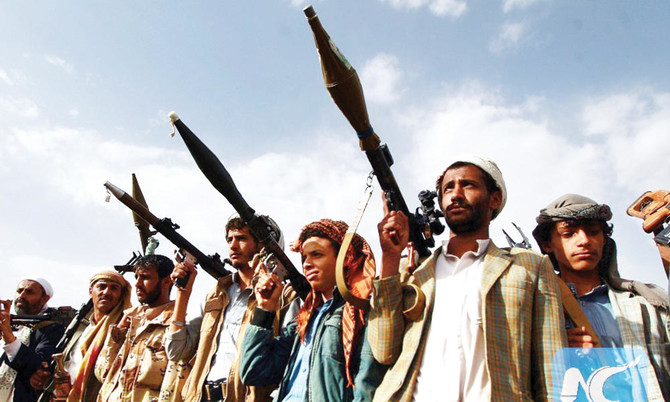
ADEN: The Yemeni government said people kidnapped and held at militants’ prisons number more than 14,000 since the militias started invading several provinces two years ago. Besides, young girls are being forced to marry leaders and soldiers of Houthi militants despite parents’ refusal, local Yemeni press reported recently.
Parents who object to the forced marriage of their daughters are threatened with death, imprisonment, torture and even displacement and confiscation of property, according to an SPA report.
Houthis have been attempting to impose a foreign agenda and beliefs on the Yemeni civilians living in Sanaa and in other areas under their control, according to the reports.
The “Houthi supervisors,” as residents in Ibb Province call them, turned to forced marriage after the Yemeni society proved reluctant to accept the militants’ foreign agenda and traditions. Yemeni tribes reject marriages unless they are based on their own customs and traditions.
Local media reported a man in Madaq village in Badan Province was about to have his house and land confiscated when he refused to give his 16-year-old girl in marriage to a Houthi leader.
In the town of Habish in the same province, one businessman was kidnapped and blackmailed into approving his daughter’s marriage to a Houthi supervisor in the area.
“Armed militants took him to force him to approve the marriage despite the girl’s young age and rejection of the marriage,” local people told the media.
In Al-Radhmah, east of Ibb Province, a girl was kidnapped by Houthis and forced to marry a Houthi leader at gunpoint.
Local sources in Ibb Province said more than 18 cases of forcible marriage are known to residents. The number could be in hundreds given the fact many parents are afraid of speaking out, they said.
Meanwhile, a statement by the Yemeni Human Rights Ministry showed that individuals that have been forcibly disappeared number nearly 3,000 people including Minister of Defense General Mahmoud Al-Subaihi and the senior member of the Al-Islah Party, Mohammad Qahtan. Senior Yemeni officials Nasir Mansour Hadi and Faisal Rajab who were included in the United Nations Security Council resolutions, also are missing. The statement said those kidnapped included many political, media and rights figures.
The statement also said the militias turned more than 400 government offices into prisons. An estimated 73 people died in these prisons as a result of torture.

Houthis marrying Yemeni underage girls by force: press
Syrian army declares a closed military zone east of Aleppo as tensions rise with Kurds
ALEPPO, Syria: The Syrian army on Tuesday declared an area east of the northern city of Aleppo a “closed military zone,” potentially signaling another escalation between government forces and fighters with the Kurdish-led Syrian Democratic Forces.
Several days of clashes in the city of Aleppo last week that displaced tens of thousands of people came to an end over the weekend with the evacuation of Kurdish fighters from the contested neighborhood of Sheikh Maqsoud.
Since then, Syrian officials have accused the SDF of building up its forces near the towns of Maskana and Deir Hafer, about 60 km (37 mi) east of Aleppo city, something the SDF denied.
State news agency SANA reported that the army had declared the area a closed military zone because of “continued mobilization” by the SDF “and because it serves as a launching point for Iranian suicide drones that have targeted the city of Aleppo.”
On Saturday afternoon, an explosive drone hit the Aleppo governorate building shortly after two Cabinet ministers and a local official held a news conference on the developments in the city. The SDF denied being behind the attack.
The army statement Tuesday said armed groups should withdraw to the area east of the Euphrates River.
The tensions come amid an impasse in political negotiations between the central state and the SDF.
The leadership in Damascus under interim President Ahmad Al-Sharaa signed a deal in March with the SDF, which controls much of the northeast, for it to merge with the Syrian army by the end of 2025. There have been disagreements on how it would happen.
Some of the factions that make up the new Syrian army, formed after the fall of former President Bashar Assad in a rebel offensive in December 2024, were previously Turkiye-backed insurgent groups that have a long history of clashing with Kurdish forces.
The SDF has for years been the main US partner in Syria in fighting against the Daesh group, but Turkiye considers the SDF a terrorist organization because of its association with the Kurdistan Workers’ Party, or PKK, which has waged a long-running insurgency in Turkiye. A peace process is now underway.
Despite the long-running US support for the SDF, the Trump administration in the US has also developed close ties with Al-Sharaa’s government and has pushed the Kurds to implement the March deal.
Shams TV, a station based in Irbil, the seat of northern Iraq’s semi-autonomous Kurdish region, had been set to air an interview with Al-Sharaa on Monday but later announced it had been postponed for “technical” reasons without giving a new date for airing it.
Several days of clashes in the city of Aleppo last week that displaced tens of thousands of people came to an end over the weekend with the evacuation of Kurdish fighters from the contested neighborhood of Sheikh Maqsoud.
Since then, Syrian officials have accused the SDF of building up its forces near the towns of Maskana and Deir Hafer, about 60 km (37 mi) east of Aleppo city, something the SDF denied.
State news agency SANA reported that the army had declared the area a closed military zone because of “continued mobilization” by the SDF “and because it serves as a launching point for Iranian suicide drones that have targeted the city of Aleppo.”
On Saturday afternoon, an explosive drone hit the Aleppo governorate building shortly after two Cabinet ministers and a local official held a news conference on the developments in the city. The SDF denied being behind the attack.
The army statement Tuesday said armed groups should withdraw to the area east of the Euphrates River.
The tensions come amid an impasse in political negotiations between the central state and the SDF.
The leadership in Damascus under interim President Ahmad Al-Sharaa signed a deal in March with the SDF, which controls much of the northeast, for it to merge with the Syrian army by the end of 2025. There have been disagreements on how it would happen.
Some of the factions that make up the new Syrian army, formed after the fall of former President Bashar Assad in a rebel offensive in December 2024, were previously Turkiye-backed insurgent groups that have a long history of clashing with Kurdish forces.
The SDF has for years been the main US partner in Syria in fighting against the Daesh group, but Turkiye considers the SDF a terrorist organization because of its association with the Kurdistan Workers’ Party, or PKK, which has waged a long-running insurgency in Turkiye. A peace process is now underway.
Despite the long-running US support for the SDF, the Trump administration in the US has also developed close ties with Al-Sharaa’s government and has pushed the Kurds to implement the March deal.
Shams TV, a station based in Irbil, the seat of northern Iraq’s semi-autonomous Kurdish region, had been set to air an interview with Al-Sharaa on Monday but later announced it had been postponed for “technical” reasons without giving a new date for airing it.
© 2026 SAUDI RESEARCH & PUBLISHING COMPANY, All Rights Reserved And subject to Terms of Use Agreement.