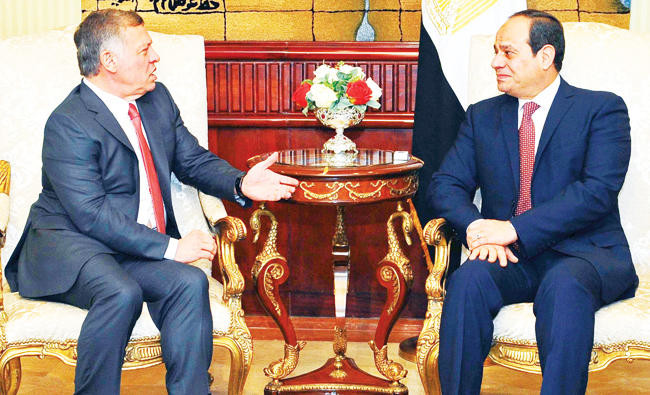
WASHINGTON: Following last month’s visits to Washington by Saudi Deputy Crown Prince Mohammed bin Salman and Iraqi Prime Minister Haider Al-Abadi, Egypt’s President Abdel Fattah El-Sisi and Jordan’s King Abdallah are set to follow suit next week to hold official meetings with US President Donald Trump separately at the White House.
The visits, in what Arab diplomatic sources described as “an inter-regional horse race” to meet with Trump, are expected to build on decisions reached at the Arab League Summit this week in Jordan.
El-Sisi’s arrival in Washington, expected today, will mark the first of an Egyptian president to the White House since 2009.
His meeting with Trump on Monday coincides historically with the first meeting that former President Jimmy Carter held with his Egyptian counterpart Anwar Sadat on April 3, 1977.
Forty years since that meeting, a White House official described Egypt as a “traditional pillar of stability” in the Middle East. “President Trump is excited to welcome President Sisi,” the official told reporters Friday. “He wants to use President Sisi’s visit to reboot the bilateral relationship and build on the strong connection the two presidents established when they first met in New York last September.”
Chemistry between Trump and El-Sisi was visible in their New York meeting, in contrast to the body language and tense relations he had with former US President Barack Obama. El-Sisi, a former commander in chief of Egypt’s Army, was the first foreign leader to call Trump on his cell phone after his electoral victory on Nov. 9.
The White House is seeking to “improve the tone of the relationship” and “boost military and economic cooperation with Egypt,” said the US official, who praised El-Sisi’s economic reforms. While designating the Muslim Brotherhood as a foreign terrorist organization was highly considered by the Trump team, and would have been welcomed by Cairo, the White House gave a noncommittal response on the issue.
“We, along with a number of countries, have some concerns about various activities that the Muslim Brotherhood has conducted in the region,” the official said. US sources told Arab News that the White House is backtracking on the designation “for legal purposes,” but “could consider other measures.”
Counterterrorism and deepening military cooperation will be high on the agenda. The US gives $1.3 billion annually in military aid to Egypt, which will continue under Trump. “We’re in the budget process right now, and those discussions are ongoing as to how it will be broken out,” the official said, prioritizing “the defeat of the terrorist threat in Sinai and improving security cooperation.”
The issues of human rights and democracy appear to have taken a back seat publicly in the Trump administration. White House statements since Trump took office emphasize security and stability. A US official said: “Our approach is to handle these types of sensitive issues in a private, more discreet way. We believe it’s the most effective way to advance those issues to a favorable outcome.”
Trump is expected to host King Abdallah on Wednesday at the Oval Office. The meeting is their first official one in the White House, and the second since last February following an informal sit-down at National Breakfast prayer in Washington.
The White House official described King Abdallah as a “key partner” for the US in the region, and drew a long list for the discussions between the two leaders. “They will discuss a range of shared priorities, the fight against Islamic State (Daesh) militants, the Syria crisis and advancing peace between Israelis and Palestinians,” said the White House.
Interim zones of stability in Syria will be raised with Jordan, said the White House official, as well as the new US position on Syrian President Bashar Assad.
“Our priority is no longer to sit there and focus on getting Assad out,” US Ambassador to the UN Nikki Haley said on Thursday, a position that echoes a new set of priorities in Syria for the US shared by Jordan and Egypt.
Resuming negotiations between the Israelis and Palestinians will be central in Trump’s meetings with both El-Sisi and King Abdallah. Securing a regional umbrella for the talks is sought by all sides before Palestinian President Mahmoud Abbas’ visit to Washington, expected at the end of this month.


![]()
Arab leaders flock to Washington: Trump meets El-Sisi and King Abdallah next week
Arab leaders flock to Washington: Trump meets El-Sisi and King Abdallah next week


Latest updates






© 2026 SAUDI RESEARCH & PUBLISHING COMPANY, All Rights Reserved And subject to Terms of Use Agreement.