LONDON/WASHINGTON: Global food crises worsened significantly in 2016 and conditions look set to deteriorate further this year in some areas with an increasing risk of famine, a report said on Friday.
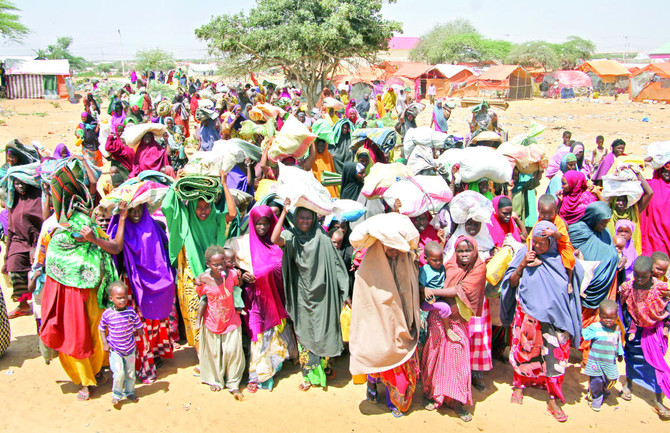
“There is a high risk of famine in some areas of north-eastern Nigeria, Somalia, South Sudan and Yemen because of armed conflict, drought and macro-economic collapse,” the Food Security Information Network (FSIN) said.
FSIN, which is co-sponsored by the UN food agency, the World Food Programme and the International Food Policy Research Institute, said the demand for humanitarian assistance was escalating.
FSIN said that 108 million people were reported to be facing crisis-level food insecurity or worse in 2016, a drastic increase from the previous year’s total of almost 80 million.
The network uses a five-phase scale with the third level classified as crisis, fourth as emergency and fifth as famine/catastrophe.
“In 2017, widespread food insecurity is likely to persist in Iraq, Syria (including among refugees in neighboring countries), Malawi and Zimbabwe,” the report said.
Meanwhile, US President Donald Trump has boosted the US military’s authority to step up airstrikes in the fight against insurgents in Somalia, the Defense Department said on Thursday.
According to a Pentagon official, who spoke on condition of anonymity, the new leeway accorded to the military will mean they no longer will have to justify a decision to launch airstrikes, potentially leading to more aggressive bombardments on militant hideouts.
This broader authority would allow the US to carry out offensive strikes against Al-Shabab militants even if the militants were not attacking partnered forces, the officials said.
They said rules to avoid civilian casualties would not be loosened.
The expanded powers also will give greater autonomy in decision-making on airstrikes to the head of US forces in Africa, Gen. Thomas Waldhauser.
“The president has approved a Department of Defense proposal to provide additional precision fires in support of the African Union Mission in Somalia and Somali security forces operations,” said Navy Captain Jeff Davis, a Pentagon spokesman, in a statement, released on Thursday.
The decision mirrors one the White House made in January this year when it declared parts of three provinces in Yemen an “area of active hostilities,” allowing the military greater flexibility to target Al-Qaeda militants there.
The forces are fighting to defeat Al-Shabab militants who were forced out of the capital in 2011 by African Union (AU) troops but still controls parts of the country.
“The additional support provided by this authority will help deny Al-Shabab safe havens from which it could attack US citizens or US interests in the region,” Davis said.
The decision is in line with the Republican Trump administration’s policy to expand the authority of the military, particularly in authorizing more aggressive airstrikes in certain countries.
The military had accused the previous Democratic administration of President Barack Obama of micromanaging combat operations.
Obama notably kept tight control over armed drone strikes, which his successor is pursuing in Somalia and Yemen.
Last Friday, Gen. Waldhauser said that greater ability to fight the militants would lead to more flexibility and quicker targeting.
In recent months, the US has carried out more than 40 strikes against Al-Qaeda militants in Yemen, which lies just across the Gulf of Aden from Somalia.
As many as 12 civilians, some of them women and children, were killed along with a US commando in a January raid in southern Yemen. The US has said that raid gathered valuable intelligence.
Al-Shabab has been able to carry out deadly bombings despite losing most of its territory to AU peacekeepers supporting the Somali government. The group’s insurgency aims to drive out the peacekeepers and topple Somalia’s Western-backed government.
The US has a small presence in Somalia and is allowed to carry out strikes in defense of partnered forces.
Two US defense officials, speaking on the condition of anonymity, said parts of Somalia had been declared an “area of active hostilities” for at least 180 days by the White House on Wednesday night. The capital Mogadishu was not included.


![]()
4 countries face famine threat as global food crisis deepens
4 countries face famine threat as global food crisis deepens
Latest updates


© 2026 SAUDI RESEARCH & PUBLISHING COMPANY, All Rights Reserved And subject to Terms of Use Agreement.