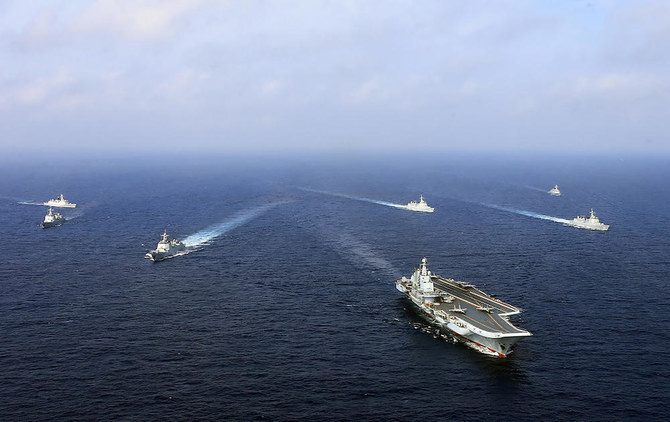
BEIJING: China began military exercises in the East China sea to the north of Taiwan on Tuesday, including live-fire exercises from warships, as the US and its allies conduct their drills in the Western Pacific.
China routinely conducts exercises along its coast, though the ones near Chinese-claimed Taiwan often attract the most attention.
China’s Maritime Safety Administration issued a no sail zone warning from late morning to mid-afternoon on Tuesday for an area off Taizhou city in Zhejiang province for live fire exercises from warships.
Other drills around the same location will last until late Tuesday evening, it said.
The drills are near the Dachen islands, which Taiwan controlled until 1955 until being evacuated after other nearby islands were seized by Chinese forces in a bloody battle.
Taiwan still controls the Matsu and Kinmen islands, off the coast of China’s Fujian province, held since the defeated Republic of China government fled to Taipei after losing a civil war with Mao Zedong’s communists.
China will hold separate exercises in another northern part of the East China Sea until late Wednesday afternoon, the maritime safety agency said.
China’s East China Sea exercises coincide with a quadrilateral naval exercise in the Philippine Sea that started on Friday involving the United States, Japan, Canada and France.
That includes two carrier strike groups led by US aircraft carriers USS Nimitz and USS Ronald Reagan jointly operating for the first time since June 2020, the US 7th Fleet said in a statement.

China holds live-fire drills in East China Sea north of Taiwan
https://arab.news/bt234
China holds live-fire drills in East China Sea north of Taiwan
- China routinely conducts exercises along its coast, though the ones near Chinese-claimed Taiwan often attract the most attention
- China’s East China Sea exercises coincide with a quadrilateral naval exercise in the Philippine Sea
Flash floods triggered by heavy rains in Afghanistan kill at least 17 people
- Afghanistan, like neighboring Pakistan and India, is highly vulnerable to extreme weather events, particularly flash floods following seasonal rains
- Decades of conflict, poor infrastructure, deforestation, and the intensifying effects of climate change have amplified the impact of such disasters
KABUL: The season’s first heavy rains and snowfall ended a prolonged dry spell but triggered flash floods in several areas of Afghanistan, killing at least 17 people and injuring 11 others, a spokesman for Afghanistan’s national disaster management authority said Thursday.
The dead included five members of a family in a property where the roof collapsed on Thursday in Kabkan, a district in Herat province, according to Mohammad Yousaf Saeedi, spokesman for the Herat governor. Two of the victims were children.
Most of the casualties have occurred since Monday in districts hit by flooding, and the severe weather also disrupted daily life across central, northern, southern, and western regions, according to Mohammad Yousaf Hammad, a spokesman for Afghanistan’s National Disaster Management Authority.
Hammad said the floods also damaged infrastructure in the affected districts, killed livestock, and affected 1,800 families, worsening conditions in already vulnerable urban and rural communities.
Hammad said the agency has sent assessment teams to the worst-affected areas, with surveys ongoing to determine further needs.
Afghanistan, like neighboring Pakistan and India, is highly vulnerable to extreme weather events, particularly flash floods following seasonal rains.
Decades of conflict, poor infrastructure, deforestation, and the intensifying effects of climate change have amplified the impact of such disasters, especially in remote areas where many homes are made of mud and offer limited protection against sudden deluges.
The United Nations and other aid agencies this week warned that Afghanistan is expected to remain one of the world’s largest humanitarian crises in 2026. The UN and its humanitarian partners launched a $1.7 billion appeal on Tuesday to assist nearly 18 million people in urgent need in the country.


