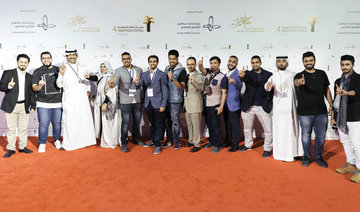
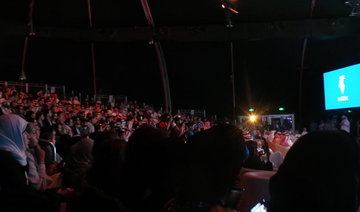
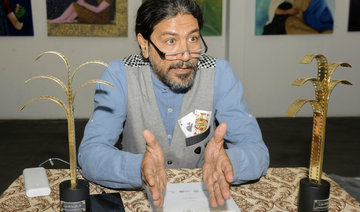
DHAHRAN: As the fourth edition of the Saudi Film Festival in Dhahran continues to delight audiences, Arab News got to the heart of the issue and asked festival-goers what movies mean to them.
For some, films are a window to another world while for others, movies can bridge the gap between various cultures and promote a sense of understanding.
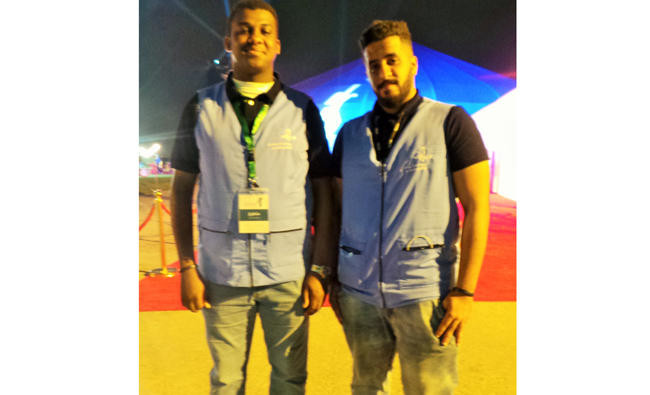
“Films and the cinema are a reflection of our lives. At the same time, they open up doors to other cultures and countries. They might be similar to our culture or they might be different but in either case, we get to witness how the world works,” Mohammed Al Shahri, a young student trainee at the University of Dammam’s Nursing College and festival volunteer, told Arab News.
Al Shahri further talks about how the emerging filmmaking industry in Saudi Arabia is promising, saying: “We have stories that are particular to Saudi Arabia. We can open up that window and let people see our culture, both negative and positive. These stories reflect on our image.”
Echoing Al Shahri’s comments, Yousef Al Rumaihi, a student trainee at the King Abdulaziz Center for World Culture, states that encouraging filmmaking is very important.
As a volunteer who dedicates his time to crowd management at the event, Al Rumaihi says he has had the opportunity to watch only one movie so far — “Sami,” which tells the story of a gangster whose daughter has been kidnapped.
Young filmmaker Mansour Asad Khan talks about using cinema to understand people. In his three-minute movie, “Sound,” Khan depicts the life and trials of deaf people and how society tends to treat them.
Despite lasting only three minutes, it was a challenge to bring together the seven crew members needed to shoot the movie. It took Khan two months to complete the filmmaking process for what is his first-ever entry in a nation-wide competition.
Some movies that were screened on the fourth day of this year’s Saudi Film Festival include: “Predicament in Sight” (drama, comedy), “Invitation” (drama, comedy), “Daesh Girl” (drama, thriller) and “Red Rose” (animation, music)

Festival-goers: ‘Films open up doors to other people, cultures and countries’
BBC slammed for ‘shameful’ cut to ‘free Palestine’ comment at BAFTA Awards
- Broadcaster removes from broadcast part of filmmaker Akinola Davies Jr.’s acceptance speech at the British Academy Film Awards
- Amnesty UK praises filmmaker for speaking up for those ‘facing and fleeing from persecution and mass atrocities’
LONDON: The BBC was accused on Monday of a “shameful” decision after it cut part of an acceptance speech at the previous night’s British Academy Film Awards in which a filmmaker uttered the phrase “free Palestine.”
British-Nigerian director and co-writer Akinola Davies Jr. and his brother, co-writer Wale Davies were collecting the award for outstanding debut by a British writer, director or producer for their film “My Father’s Shadow” when the former made the comment.
The BBC chose not to include the final part of his speech when it broadcast the BAFTAs ceremony later in the evening. However, the corporation did broadcast an inadvertent racist slur shouted by a person with Tourette syndrome while Black actors Michael B. Jordan and Delroy Lindo were presenting an award.
Akinola thanked industry figures and family for their support as he accepted the award, before dedicating it to “all those whose parents migrated to obtain a better life for their children.”
In the final part of his speech, cut by the BBC, he said: “To the economic migrant, the conflict migrant, those under occupation, dictatorship, persecution and those experiencing genocide, you matter and your stories matter more than ever.
“Your dreams are an act of resistance. To those watching at home, archive your loved ones, archive your stories yesterday, today and forever. For Nigeria, for London, Congo, Sudan, free Palestine. Thank you.”
The BBC, which broadcast the ceremony with a two-hour time delay, said the cut was made for timing reasons.
A spokesperson told Deadline: “The live event is three hours, and it has to be reduced to two hours for its on-air slot. The same happened to other speeches made during the night, and all edits were made to ensure the program was delivered to time. All winners’ speeches will be available to watch via BAFTA’s YouTube Channel.”
Human rights campaign group Amnesty UK described the decision by the BBC to cut part of the speech as “shameful.”
It added: “Thank you Akinola Davies Jr. for using your platform to speak out for the rights of migrants and people facing and fleeing from persecution and mass atrocities, from the Congo to Sudan to Palestine.”
In June last year, the BBC was at the center of a row after it broadcast a Glastonbury Festival performance by the duo Bob Vylan, during which the lead singer chanted “death to the IDF” in protest against the Israeli Defense Forces’ assault on Gaza.