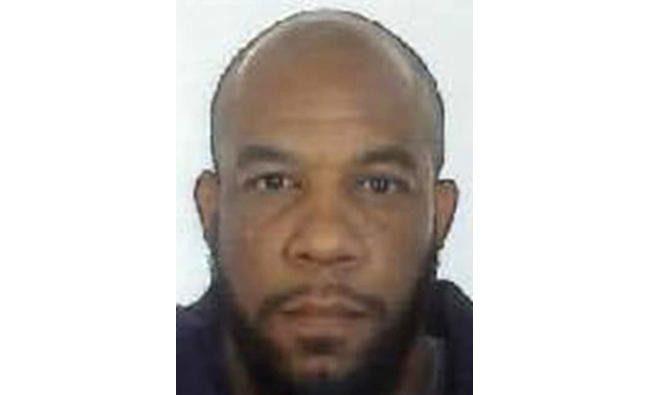
London attacker interested in jihad but no evidence of Daesh link: UK police

Updated 27 March 2017
Follow

London attacker interested in jihad but no evidence of Daesh link: UK police

LONDON: British police said on Monday they had found no evidence that Khalid Masood, who killed four people in an attack on Britain's Parliament last week, had any association with the so-called Daesh or Al-Qaeda, but he was clearly interested in jihad.
Masood drove a car through a crowd of pedestrians on Westminster Bridge, killing three and injuring about 50, then ran through the gates of Parliament and fatally stabbed a police officer, before he was shot dead by police.
Neil Basu, senior national coordinator for UK counter-terrorism policing, said there was no evidence that Masood had been radicalized in prison in 2003 and it was pure speculation to suggest that had happened.
Masood, 52, was British-born and had several previous convictions for offenses such as grievous bodily harm, possession of a knife and public order offences. He had not been convicted of any terrorism offense.
“His attack method appears to be based on low sophistication, low tech, low cost techniques copied from other attacks, and echo the rhetoric of IS leaders in terms of methodology and attacking police and civilians, but at this stage I have no evidence he discussed this with others," Basu said in a statement.
"I know when, where and how Masood committed his atrocities, but now I need to know why," he said, appealing to anyone who may have been in contact with him on the day of the attack to come forward.
Interior Minister Amber Rudd said on Sunday that technology companies should cooperate more with law enforcement agencies and should stop providing "a secret place for terrorists to communicate" using encrypted messages.
Media have reported that Masood sent an encrypted message moments before the attack.
"There has been much speculation about who Masood was in contact with immediately prior to the attack," Basu said. "All I will say on this point is that Masood’s communications that day are a main line of enquiry."


Italy approves new migration bill including powers to impose ‘naval blockades’ on migrant ships

Updated 3 sec ago
Follow

Italy approves new migration bill including powers to impose ‘naval blockades’ on migrant ships

ROME: Italy’s conservative government led by Premier Giorgia Meloni on Wednesday approved a bill introducing new measures aimed at fighting illegal immigration, including a so-called “naval blockade” for migrant ships trying to reach Italian shores.
A cabinet meeting in the late afternoon gave the go-ahead to the bill, which now needs to be discussed and approved in both chambers of parliament before becoming effective.
Italy’s new migration package — which also includes stricter surveillance at borders and cooperation with European agencies — comes a day after the approval of the new EU pact on migration and asylum, which Rome plans to implement swiftly.
The package includes new powers that would enable Italian authorities to impose a naval blockade on migrant ships trying to enter Italy’s territorial waters, under certain conditions.
Authorities can ban the crossing into Italian waters for up to 30 days, in cases in which the migrant ship poses “serious threats to public order or national security,” as in the concrete risk of terrorist acts or terrorist infiltration, the bill says. The blockade is extendable up to a maximum of six months.
It would also be possible to stop the ships from entering Italian waters in the case of a drastic influx in migrants that could jeopardize the secure management of borders.
Those violating the rules would face fines of up to 50,000 euros ($59,400) and would see their boats confiscated in the case of repeated violations, a measure that seems to target humanitarian rescue ships.
In those cases, the intercepted migrants could be “transported to third countries other than their country of origin, with which Italy has entered into specific agreements,” the bill says.
Under those rules, the Meloni government aims at restarting offshore processing hubs similar to the two controversial ones created in Albania, which have been substantially inactive for about two years due to legal hurdles.
These centers — a major effort by the Meloni government to manage migration flows — have constantly sparked debates about their legality and efficacy, raising strong opposition from humanitarian groups.
The Italian bill’s approval comes after European lawmakers on Tuesday voted to approve new immigration policies that allow nations to deny asylum and deport migrants because they either hail from a country designated safe or could apply for asylum in a country outside the 27-nation bloc.
Italy’s Foreign Minister Antonio Tajani hailed the new rules on Tuesday, saying the confirmation from the European Parliament on the list of safe countries “proves Italy right.”