LONDON: British police are combing through “massive amounts of computer data,” have searched more than 20 sites and have contacted thousands of witnesses in a vast operation to trace how a British man became radicalized and launched a deadly attack on Parliament, a senior official said Friday.
In a briefing outside Scotland Yard, London’s top counterterror officer, Mark Rowley, said more “significant” arrests had been made, bringing to 10 the number of people in custody over Wednesday’s attack, which killed four people and the assailant.
Police said the attacker, Khalid Masood, was born Adrian Russell Ajao in southern England in 1964. He was also known as Adrian Elms and “may also be known by a number of other names,” police said.
The latest arrests were a man and a woman detained early Friday in Manchester, northwest England. Police believe Masood acted alone but Rowley said police were trying to determine whether others “encouraged, supported or directed him.”
The Daesh group has claimed responsibility for the attack on Westminster Bridge and at Parliament.
Detectives have searched 21 properties in London, Brighton, Wales, Manchester and the central English city of Birmingham in one of Britain’s biggest counterterrorism operations in years. Wednesday’s attack was the deadliest in Britain since suicide bombers killed 52 commuters on London’s transit system in July 2005.
“We’ve seized 2,700 items from these searches, including massive amounts of computer data for us to work through,” Rowley said, adding that contact had been made with 3,500 witnesses.
“We’ve received hundreds of uploads of video images to our online platform. Given this attack was in the heart of the capital we also, of course, are dealing with statements from a wide range of nationalities.”
Raging mad
Masood drove his car into crowds on Westminster Bridge before fatally stabbing a police officer on Parliament grounds. He was shot dead by police.
An American man from Utah, a British retiree and British female school administrator were killed on the bridge, and police officer Keith Palmer was stabbed to death at Parliament, police said.
The latest victim, a man who died in a hospital Thursday, was identified as 75-year-old Leslie Rhodes from south London.
More than 50 people of a dozen nationalities were wounded in the attack, 31 of whom required hospital treatment.
“Those affected include a real cross-section of ages from at least 12 nationalities,” Rowley said. “It’s a poignant reminder, I think, that the impact of this attack on the capital will reach around the world. “
Rowley said two police officers targeted in the attack have significant injuries. Two other people also remain in critical condition, one with life-threatening injuries.
The 52-year-old attacker was born in southeastern England and had most recently been living in Birmingham, where several properties have been searched by police. Police say Masood has had a string of convictions between 1983 and 2003 for offenses including assault and possession of an offensive weapon.
Prime Minister Theresa May said Thursday that Masood was “investigated in relation to concerns about violent extremism” some years ago. But she called him “a peripheral figure.”
The manager of a hotel in the beachside city of Brighton in southern England, where Masood stayed the night before the attack, said he seemed unusually outgoing and mentioned details about his family, including having a sick father.
“He was normal, in fact friendly, because we spent possibly five or 10 minutes talking to him about his background,” Sabeur Toumi told Sky News.
Police raided the room at the Preston Park Hotel in Brighton after the attack, searching for clues.
Interfaith solidarity
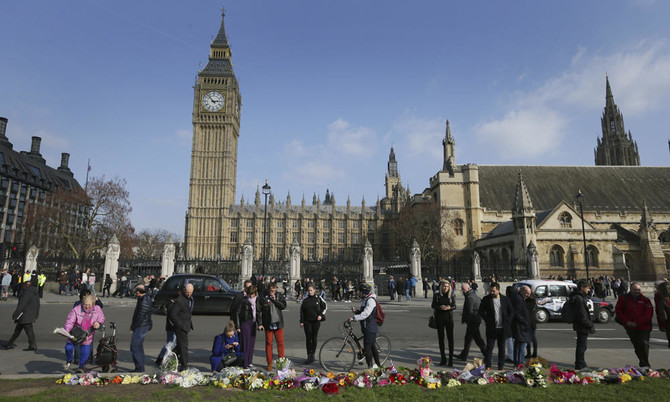
Londoners continued to lay flowers and sign condolence books for the victims on Friday, as Jewish, Christian and Muslim leaders gathered in solidarity outside Westminster Abbey.
Chief Rabbi Ephraim Mirvis said terrorists “seek to divide us. Londoners are showing right now that we will always stand up with strength to confront terror and we will never be cowed by it.”
Further details about the rampage continued to emerge.
A former British army officer told the BBC that rescuers held the hand of Constable Keith Palmer and talked to him as they tried in vain to save his life after he was stabbed.
Mike Crofts, a former army captain who served in Afghanistan, said he was in the courtyard outside the Houses of Parliament, then rushed toward the scene and began performing first aid. Ultimately, 20 to 30 people were working to save the officer’s life.
“Unfortunately, despite our best efforts, we were unable to save him,” Crofts said. “Palmer at the time was surrounded by a whole host of colleagues who really loved him. We held his hand through the experience.”
Some security experts, meanwhile, criticized police procedures after newly published video showed confusion and delays as the prime minister was being rushed out of Parliament after the attack. Ken Wharfe, a former bodyguard to the late Princess Diana, said the video reveals that May was not properly protected for about 10 seconds.
Rowley, Scotland Yard’s counter-terrorism chief, said changes to Parliamentary security may be needed.
“My team will work with Parliamentary authorities to assess whether a different tone or a different balance is necessary,” he said.
Retired London bus driver Charlie Irvine, laying flowers outside police headquarters, said people should focus less on the killer and more on the victims and those who came to their aid.
“I disagree with the coverage of the guy who caused this,” Irvine said. “I don’t think he should get the publicity. He doesn’t deserve the publicity.”
___
Gregory Katz in London contributed.

UK police arrest 10 in London attack probe, search 21 sites
Foreign truckers ‘in God’s hands’ in militant-hit Mali
KIDIRA: Amath Mboup, a young Senegalese, is haunted by the charred and decomposing bodies of fellow truckers killed by jihadists lying along the highway to the Malian city of Kayes.
Since September, fighters from the Al-Qaeda-linked Group for the Support of Islam and Muslims, known by its Arabic acronym JNIM, have sought to cripple landlocked Mali’s economy and undermine its junta.
They have been blocking and sometimes attacking fuel tankers entering Mali and placing total blockades on certain strategic routes leading to the capital Bamako.
Hundreds of tankers from Abidjan, Ivory Coast’s economic capital, and the Senegalese capital Dakar have been set ablaze.
Dozens of drivers have been killed or kidnapped, particularly on the Kayes-Bamako road in the west of the country, near the border with Senegal.
After waiting two days for routine checks in the Senegalese border town of Kidira, one of the main crossing points between Senegal and Mali, Mboup — who is in his thirties — was preparing to travel onwards to Bamako, his truck loaded with goods.
Alone in the truck, where amulets hang to ward off bad luck, Mboup was apprehensive as he is every time he takes this route.
- ‘Everyone is afraid’ -
“Everyone is afraid to take this road because it’s too risky: You know you’re leaving, but you don’t know if you’ll come back alive,” he told AFP, his face dusty and pale with fatigue.
Malick Bodian, another Senegalese driver, told AFP he is always putting his life “in God’s hands.”
“Your mind is never at peace when you travel this road. You think you could be attacked at any moment,” he said.
Many of the truckers interviewed by AFP said there was no question of quitting their jobs.
“We don’t have a choice. It’s the only job I know how to do to feed my family,” said Mboup, a married father of two.
Behind him, dozens of trucks, engines rumbling, were lined up for several kilometers waiting to leave Senegal for the bumpy Malian roads and all their potential dangers.
Fuel tankers were not among the trucks, however. Last November, JNIM claimed in a propaganda video that all tanker drivers would henceforth be considered “military targets.”
The drivers in line were Senegalese, Malian, Ivorian and Burkinabe and many said they had encountered militants on their journeys.
“They often appear out of nowhere in the forest on motorcycles and are usually wearing turbans and heavily armed,” Malian driver Moussa Traore said.
“When you see them, you’re the one who slows down. Sometimes they stop you to ask for your documents, other times not,” he said.
- Obstacle course -
Mali imports most of its requirements, including fuel, fish, fruit and vegetables, by road from Senegal, Mauritania or Ivory Coast. More than 70 percent of its imports transit through Dakar port.
JNIM is waging a form of “economic jihad” in western Mali, aiming to destabilize the region by “targeting vital logistics routes,” according to a 2025 report by the Timbuktu Institute think tank.
Traveling on certain roads in Mali such as the one to Kayes has become an obstacle course.
“The flow of trucks that used to pass through Kidira is no longer the same,” said Modou Kayere, an official with the West African Truck Drivers Union, which represents some 15 countries.
In late November, Senegalese authorities reported that nearly 2,500 shipping containers filled with goods destined for Mali were blocked at Dakar port due to the security situation.
According to most of the drivers interviewed by AFP, vehicles carrying goods are rarely attacked by militants, unlike fuel tankers.
But the risk is real and the drivers are trying to adapt.
They have decided to stop driving at night and some have even set up alert networks on WhatsApp to warn their peers of danger on the road.
Since September, fighters from the Al-Qaeda-linked Group for the Support of Islam and Muslims, known by its Arabic acronym JNIM, have sought to cripple landlocked Mali’s economy and undermine its junta.
They have been blocking and sometimes attacking fuel tankers entering Mali and placing total blockades on certain strategic routes leading to the capital Bamako.
Hundreds of tankers from Abidjan, Ivory Coast’s economic capital, and the Senegalese capital Dakar have been set ablaze.
Dozens of drivers have been killed or kidnapped, particularly on the Kayes-Bamako road in the west of the country, near the border with Senegal.
After waiting two days for routine checks in the Senegalese border town of Kidira, one of the main crossing points between Senegal and Mali, Mboup — who is in his thirties — was preparing to travel onwards to Bamako, his truck loaded with goods.
Alone in the truck, where amulets hang to ward off bad luck, Mboup was apprehensive as he is every time he takes this route.
- ‘Everyone is afraid’ -
“Everyone is afraid to take this road because it’s too risky: You know you’re leaving, but you don’t know if you’ll come back alive,” he told AFP, his face dusty and pale with fatigue.
Malick Bodian, another Senegalese driver, told AFP he is always putting his life “in God’s hands.”
“Your mind is never at peace when you travel this road. You think you could be attacked at any moment,” he said.
Many of the truckers interviewed by AFP said there was no question of quitting their jobs.
“We don’t have a choice. It’s the only job I know how to do to feed my family,” said Mboup, a married father of two.
Behind him, dozens of trucks, engines rumbling, were lined up for several kilometers waiting to leave Senegal for the bumpy Malian roads and all their potential dangers.
Fuel tankers were not among the trucks, however. Last November, JNIM claimed in a propaganda video that all tanker drivers would henceforth be considered “military targets.”
The drivers in line were Senegalese, Malian, Ivorian and Burkinabe and many said they had encountered militants on their journeys.
“They often appear out of nowhere in the forest on motorcycles and are usually wearing turbans and heavily armed,” Malian driver Moussa Traore said.
“When you see them, you’re the one who slows down. Sometimes they stop you to ask for your documents, other times not,” he said.
- Obstacle course -
Mali imports most of its requirements, including fuel, fish, fruit and vegetables, by road from Senegal, Mauritania or Ivory Coast. More than 70 percent of its imports transit through Dakar port.
JNIM is waging a form of “economic jihad” in western Mali, aiming to destabilize the region by “targeting vital logistics routes,” according to a 2025 report by the Timbuktu Institute think tank.
Traveling on certain roads in Mali such as the one to Kayes has become an obstacle course.
“The flow of trucks that used to pass through Kidira is no longer the same,” said Modou Kayere, an official with the West African Truck Drivers Union, which represents some 15 countries.
In late November, Senegalese authorities reported that nearly 2,500 shipping containers filled with goods destined for Mali were blocked at Dakar port due to the security situation.
According to most of the drivers interviewed by AFP, vehicles carrying goods are rarely attacked by militants, unlike fuel tankers.
But the risk is real and the drivers are trying to adapt.
They have decided to stop driving at night and some have even set up alert networks on WhatsApp to warn their peers of danger on the road.
© 2026 SAUDI RESEARCH & PUBLISHING COMPANY, All Rights Reserved And subject to Terms of Use Agreement.


