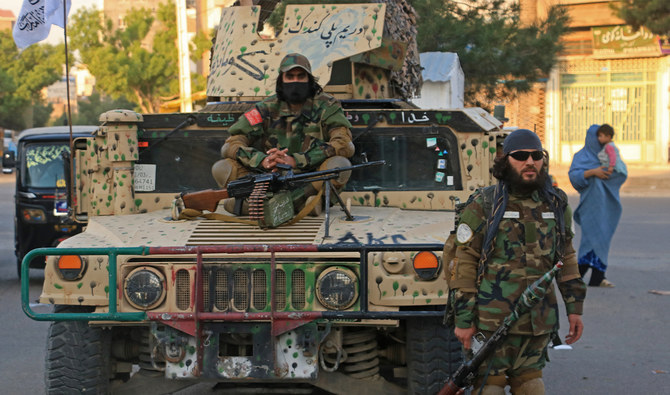
Gunman kills six in attack on Afghan mosque – Taliban spokesman

Afghan security personnel stand guard at a checkpoint in Herat on April 10, 2024. (AFP/File)
Short Url
Updated 30 April 2024
Follow

Gunman kills six in attack on Afghan mosque – Taliban spokesman

  • Locals say the mosque served the minority Shiite community just south of the Afghan city of Herat
  • While no group has claimed the attack, the regional chapter of Daesh is viewed as threat in Afghanistan

HERAT: A gunman stormed a mosque in western Afghanistan and killed six people, a government spokesman said Tuesday, with local residents claiming the minority Shiite community had been targeted.
Interior ministry spokesman Abdul Mateen Qani said that “an unknown armed person shot at civilian worshippers in a mosque” in Herat province’s Guzara district on Monday at around 9:00 p.m. (1630 GMT).
“Six civilians were martyred and one civilian was injured,” he wrote on social media platform X early Tuesday morning.
Locals said the mosque served the minority Shiite community in a district just south of the provincial capital of Herat city, and the imam and a three-year-old child were among those killed.
They also said a team of three gunmen staged the attack, contradicting the official account.
“One of them was outside and two of them came inside the mosque, shooting the worshippers,” said 60-year-old Ibrahim Akhlaqi, the brother of the slain imam. “It was in the middle of the prayers.”
“Whoever was in the mosque has either been martyred or wounded,” added 23-year-old Sayed Murtaza Hussaini.
While no group has claimed the attack, the regional chapter of Daesh is the largest security threat in Afghanistan and has frequently targeted Shiite communities.
The Taliban government has pledged to protect religious and ethnic minorities since returning to power in August 2021, but rights monitors say they’ve done little to make good on that promise.
The most notorious attack linked to Daesh since the Taliban takeover was in 2022, when at least 53 people — including 46 girls and young women — were slain in the suicide bombing of an education center.
Taliban officials blamed Daesh for the attack, which happened in a Shiite neighborhood of the capital Kabul.
Afghanistan’s new rulers claim to have ousted Daesh from the country and are highly sensitive to suggestions the group has found safe haven there since the withdrawal of foreign forces.
Taliban authorities have frequently given death tolls lower than other sources after bombings and gun attacks, or otherwise downplayed them, in an apparent attempt to minimize security threats.
A United Nations Security Council report released in January said there had been a decrease in Daesh attacks in Afghanistan because of “counter-terrorism efforts by the Taliban.”
But the report said Daesh still had “substantial” recruitment in the country and that the militant group had “the ability to project a threat into the region and beyond.”
Daesh chapter spanning Afghanistan, Pakistan and Central Asia claimed responsibility for the March attack on the Crocus City Hall concert venue in Moscow, killing more than 140 people.
It was the deadliest attack in Russia in two decades.


Hungary says it will block a key EU loan to Ukraine until Russian oil shipments resume

Updated 9 sec ago
Follow

Hungary says it will block a key EU loan to Ukraine until Russian oil shipments resume

  • Szijjártó said: “As long as Ukraine blocks the resumption of oil supplies to Hungary, Hungary will block European Union decisions that are important and favorable for Ukraine”
  • Hungary’s decision to block the key funding came two days after it suspended diesel shipments

BUDAPEST: Hungary will block a planned 90-billion-euro ($106-billion) European Union loan to Ukraine until the flow of Russian oil through the Druzhba pipeline resumes, Hungary’s foreign minister said.
Russian oil shipments to Hungary and Slovakia have been interrupted since Jan. 27 after what Ukrainian officials said was a Russian drone attack damaged the Druzhba pipeline, which carries Russian crude across Ukrainian territory and into Central Europe.
Hungary and Slovakia, which have both received a temporary exemption from an EU policy prohibiting imports of Russian oil, have accused Ukraine — without providing evidence — of deliberately holding up supplies. Both countries ceased shipping diesel to Ukraine this week over the interruption in oil flows .
In a video posted on social media Friday evening, Foreign Minister Péter Szijjártó accused Ukraine of “blackmailing” Hungary by failing to restart shipments. He said his government would block a massive interest-free loan the EU approved in December to help Kyiv to meet its military and economic needs for the next two years.
“We will not give in to this blackmail. We do not support Ukraine’s war, we will not pay for it,” Szijjártó said. “As long as Ukraine blocks the resumption of oil supplies to Hungary, Hungary will block European Union decisions that are important and favorable for Ukraine.”
Hungary’s decision to block the key funding came two days after it suspended diesel shipments to its embattled neighbor and only days before the fourth anniversary of Russia’s full-scale invasion.
Nearly every country in Europe has significantly reduced or entirely ceased Russian energy imports since Moscow launched its war in Ukraine on Feb. 24, 2022. Yet Hungary and Slovakia — both EU and NATO members — have maintained and even increased supplies of Russian oil and gas.
Hungary’s nationalist Prime Minister Viktor Orbán has long argued Russian fossil fuels are indispensable for its economy and that switching to energy sourced from elsewhere would cause an immediate economic collapse — an argument some experts dispute.
Widely seen as the Kremlin’s biggest advocate in the EU, Orbán has vigorously opposed the bloc’s efforts to sanction Moscow over its invasion, and blasted attempts to hit Russia’s energy revenues that help finance the war. His government has frequently threatened to veto EU efforts to assist Ukraine.
On Saturday, Slovakia’s populist Prime minister Robert Fico said his country will stop providing emergency electricity supplies to Ukraine if oil is not flowing through the Druzhba by Monday. Orbán’s chief of staff, Gergely Gulyás, said earlier this week that Hungary, too, was exploring the possibility of cutting off its electricity supplies to Ukraine.
Not all of the EU’s 27 countries agreed to take part in the 90-billion-euro loan package for Kyiv. Hungary, Slovakia and the Czech Republic opposed the plan, but a deal was reached in which they did not block the loan and were promised protection from any financial fallout.