Attacker among 4 dead in UK parliament 'terrorist' attack

1 / 6
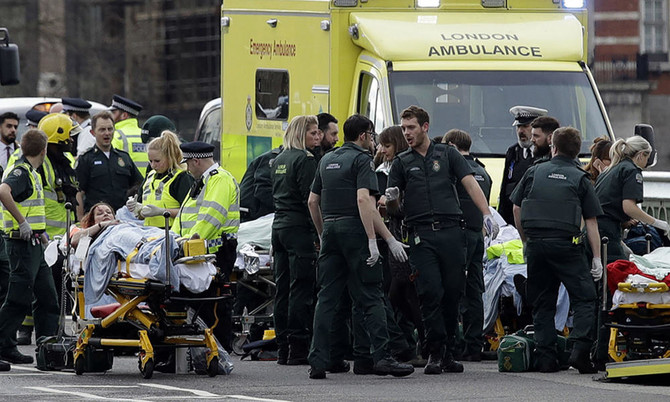
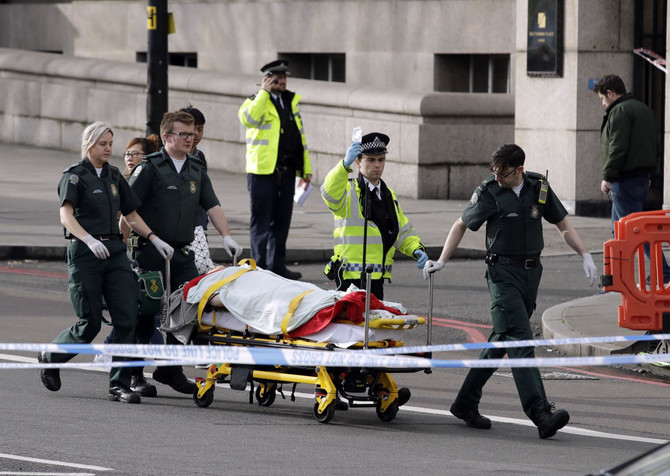
Emergency services staff provide medical attention close to the Houses of Parliament in London on Wednesday. (AP Photo/Matt Dunham)
2 / 6
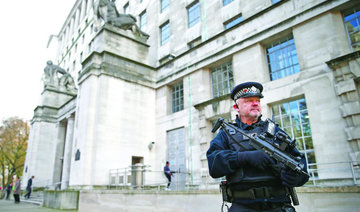
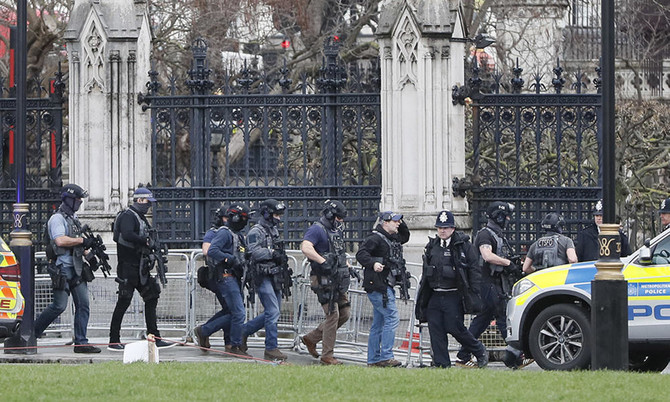
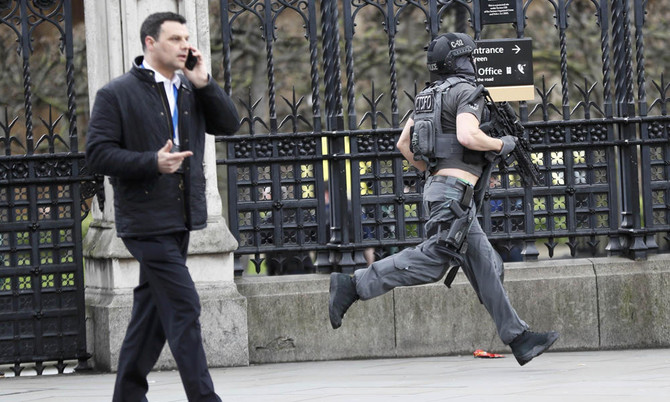
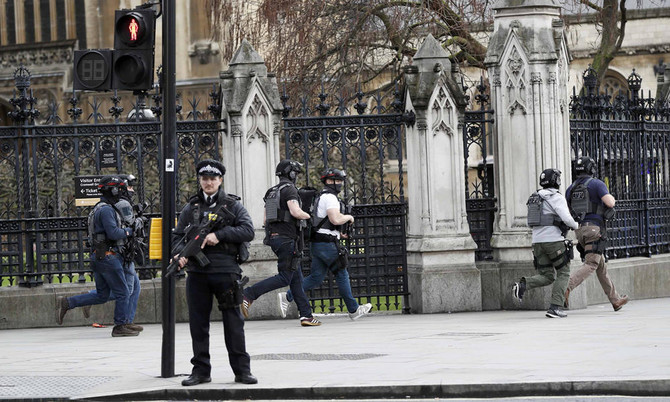
Armed police respond outside Parliament during an incident on Westminster Bridge in London on Wednesday. (REUTERS/Stefan Wermuth)
3 / 6
Emergency services staff provide medical attention close to the Houses of Parliament in London on Wednesday. (AP Photo/Matt Dunham)
4 / 6
Armed police officers enter the Houses of Parliament in London on Wednesday after the House of Commons sitting was suspended as witnesses reported sounds like gunfire outside. (AP Photo/Kirsty Wigglesworth)
5 / 6
Armed police respond outside Parliament during an incident on Westminster Bridge in London on Wednesday. (REUTERS/Stefan Wermuth)
6 / 6
Armed police respond outside Parliament during an incident on Westminster Bridge in London on Wednesday. (REUTERS/Stefan Wermuth)
Updated 24 March 2017
Follow

Attacker among 4 dead in UK parliament 'terrorist' attack

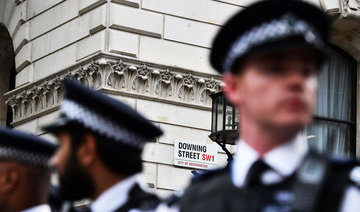
LONDON: Four people were killed and at least 20 injured in London on Wednesday after an attacker stabbed a policeman and a car plowed into pedestrians close to the British parliament, in what police called a terrorist incident.
The dead included the assailant and the policeman he stabbed, while the other two victims were among the pedestrians hit by the car as it tore along Westminster Bridge, which is right next to parliament.
“We’ve declared this as a terrorist incident and the counter-terrorism command are carrying out a full-scale investigation into the events today,” Mark Rowley, Britain’s most senior counter-terrorism officer, told reporters.
“The attack started when a car was driven over Westminster Bridge, hitting and injuring a number of members of the public, also including three police officers on their way back from a commendation ceremony.
“A car then crashed near to parliament and at least one man, armed with a knife continued the attack and tried to enter parliament.”
Witnesses who were inside parliament at the time heard loud bangs and shortly afterwards saw the knifeman and the stabbed policeman lying on the ground in a courtyard just outside, within the gated perimeter of the parliamentary estate.
Chris Doyle, director of the Council for Arab-British Understanding (Caabu), was inside the parliament building's Central Lobby on Wednesday afternoon when the incident happened.
He said that the parliament building was on lockdown and that there were "several hundred" people inside.
An announcement by officials said that there was a suspect vehicle outside the parliament that it was being dealt with by bomb squad units, Doyle said.
"It's calm now but there was panic earlier," Doyle told Arab News at 4 p.m. local time.
He said that a mass of people were trapped inside the building.
"Armed police are everywhere milling amongst politicians, the public and schoolchildren," he said.
Muddassar Ahmed, managing partner at Unitas Communications Ltd., and also an Arab News columnist, said he too was on lockdown inside the parliament building.
He was visiting an MP’s office in the building. After the alert was raised they were asked to evacuate the office but then told to return.
Police were carrying out “a door-to-door search” of the building, Ahmed told Arab News.
He said he was feeling “shaken” after about an hour on lockdown, with armed police still moving through the parliament building.
A Reuters photographer said he saw at least a dozen people injured on the bridge. His photographs showed people lying on the ground, some of them bleeding heavily and one under a bus.
A woman was pulled alive, but with serious injuries, from the Thames, the Port of London Authority said. The circumstances of her fall into the river were unclear.
Three French schoolchildren aged 15 or 16 were among those injured in the attack, French officials said.
The attack took place on the first anniversary of attacks by Islamist militants that killed 32 people in Brussels.

Bridge incident
On the bridge, witnesses said a vehicle struck several people, and photos showed a car plowed into railings.
The former Polish foreign minister Radoslaw Sikorski posted a video on Twitter that showed people lying injured on the bridge.
Sikorski, a senior fellow at Harvard Center for European Studies, says he saw at least five people lying on the ground after being “mown down” by a car.
The scene unfolded within clear sight of the London Eye, a large ferris wheel with viewing pods with views of the capital. Footage showed the pods full as viewers watched police and medical crews on the bridge.
The city was also on alert for the Thursday funeral of Martin McGuinness, former IRA commander.
The threat level for international terrorism in the UK was listed at severe. The city was also on alert for the Thursday funeral of Martin McGuinness, former IRA commander.

Parliament session suspended
“I just saw a car go out of control and just go into pedestrians on the bridge,” eyewitness Bernadette Kerrigan told Sky News. She was on a tour bus on the bridge at the time.
“As we were going across the bridge, we saw people lying on the floor, they were obviously injured. I saw about 10 people maybe. And then the emergency services started to arrive. Everyone was just running everywhere.”
The House of Commons, which was in session at the time, was immediately suspended and lawmakers were asked to stay inside.
Prime Minister Theresa May was safe after the incident, a spokesman for her office said. He declined to say where May was when the attack took place.
Journalist Quentin Letts of the Daily Mail newspaper told LBC radio that he had witnessed the stabbing of the policeman and the shooting of the assailant from his office in the parliament building.
“He (the assailant) ran in through the open gates ... He set about one of the policemen with what looked like a stick,” Letts said.
“The policeman fell over on the ground and it was quite horrible to watch and then having done that, he disengaged and ran toward the House of Commons entrance used by MPs (members of parliament) and got about 20 yards or so when two plain-clothed guys with guns shot him.”
Britain is on its second-highest alert level of “severe” meaning an attack by militants is considered highly likely.
In May 2013, two British Islamists stabbed to death soldier Lee Rigby on a street in southeast London.
In July 2005, four British Islamists killed 52 commuters and themselves in suicide bombings on the British capital’s transport system in what was London’s worst peacetime attack. (With Reuters)

UK veterans are ‘ticking time bomb’ after Iraq war chemical exposure

Updated 10 sec ago
Follow

UK veterans are ‘ticking time bomb’ after Iraq war chemical exposure

  • Fifteen former RAF personnel were deployed to the Qarmat Ali water plant in 2003, which was contaminated with sodium dichromate
  • Veterans say they were not screened or protected, and are now living with serious health conditions

LONDON: Fifteen British servicemen who worked on a carcinogen-contaminated water treatment site during the Iraq war say they were not offered biological screening despite official guidance saying they should have been.

The former Royal Air Force members, who have suffered from ailments including cancer, tumors and nosebleeds, told Sky News they were offered no medical assistance or subsequent treatment after having been exposed to toxic sodium dichromate at the Qarmat Ali water treatment plant in 2003.

The channel said it had seen a letter from the RAF’s medical authority stating that senior officers knew of the dangers posed by the substance.

Peter Lewis, 53, was one of 88 personnel deployed to guard the site, which was deemed vital for getting Iraq’s oil industry up and running. He told Sky: “I’ve had eight or nine operations to remove cancer.

“I’ve had so many lumps taken out of my neck, one on my face. This is something I’m literally fighting every year now. It’s constant.”

Qarmat Ali, the former troops say, was covered in ripped bags of bright orange sodium dichromate.

“We were never warned what the bags of chemicals were,” Jon Caunt, another former serviceman, said. “We were breathing this stuff in.”

His former comrade Tony Watters added: “I never thought about what it was. We were told the site is safe.”

Several months after deployment to the site, however, the servicemen were joined by two workers wearing protective gear who placed signs around it reading: “Warning. Chemical hazard. Full protective equipment and chemical respirator required. Sodium dichromate exposure.”

Watters said: “When you left the site, your uniform was contaminated, your webbing was contaminated.

“You went in your sleeping bag, and that was contaminated. And you were contaminating other people with it back at camp.”

Andy Tosh, who has led the group of veterans as they sought answers from the Ministry of Defence, said: “Even with the warning signs going up … they kept us there. They knowingly kept us exposed.”

The RAF gave some of the men a leaflet on their return to the UK, warning of the dangers of the substance, but not all were told.

The letter seen by Sky acknowledging the dangers posed to the veterans made a “strong” link to “increased risk of lung and nose cancer” as well as numerous other issues. It suggested personnel sent to Qarmat Ali should have their medical records altered to mention their exposure to sodium dichromate.

“Offer biological screening. This cannot be detailed until the numbers exposed are confirmed,” the letter also said.

An inquiry into US personnel deployed to Qarmat Ali found that 830 people were “unintentionally exposed” to sodium dichromate, giving them access to support from the US Department of Veterans Affairs. This came after the death of Lt. Col. James Gentry from cancer in 2009, which the US Army determined came “in line of duty for exposure to sodium dichromate.”

There has been no such inquiry by UK authorities despite British personnel being deployed at the site for longer than their American counterparts.

Thirteen of them have suffered from cancer and similar symptoms, including one who developed a brain tumor.

Jim Garth told Sky: “My skin cancer will never go away … It’s treatable, but when the treatment is finished, it comes back, so I’ve got that for life really.”

Lewis added: “I’m actually getting to the point now where I don’t care anymore … sooner or later, it’s going to do me.”

Caunt described his former colleagues’ conditions as a “ticking time bomb.”

He added: “We do not know what’s going to happen in the future."

The MoD insists medical screening was offered to personnel at the time, despite the men stating that it was not. In 2024, several met with Labour MPs about the issue. One, John Healey, who is now the UK defence secretary, said at the time the veterans should have “answers to their important questions.”

In a statement, the MoD said: “We take very seriously the concerns raised by veterans who were deployed to guard the Qarmat Ali Water Treatment Plant in 2003.

“As soon as we were alerted to the possible exposure of Sodium Dichromate, an environmental survey was conducted to evaluate typical exposure at Qarmat Ali. Results showed that the levels at the time were significantly below UK government guidance levels.”

A 2004 letter seen by Sky News suggested, however, that the MoD knew the levels of sodium dichromate were higher.

“Anyone who requires medical treatment can receive it through the Defence Medical Services and other appropriate services,” the MoD said.

“Veterans who believe they have suffered ill health due to service can apply for no-fault compensation under the War Pensions Scheme.”

Watters called on the government to hold an investigation into what happened at Qarmat Ali.

“We are the working class, we are ex-soldiers who have put our lives on the line and you’re turning a blind eye to us,” he said.

Garth added: “We felt let down at Qarmat Ali all those years ago, and we still feel let down now.”