Thailand's coin-eating turtle dies of blood poisoning

1 / 5
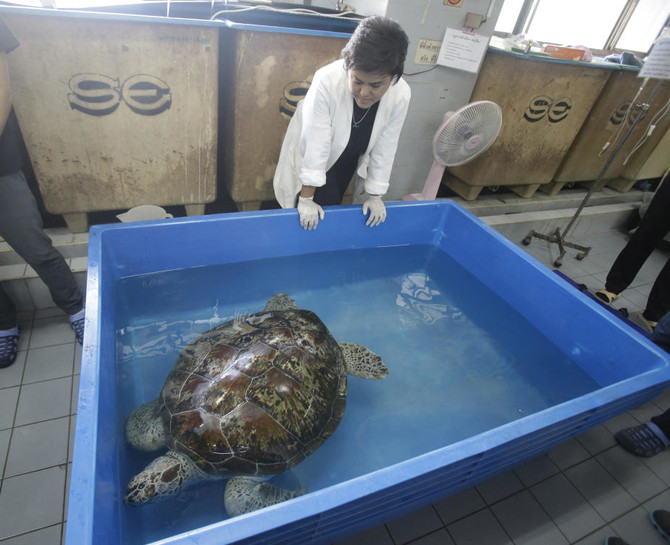
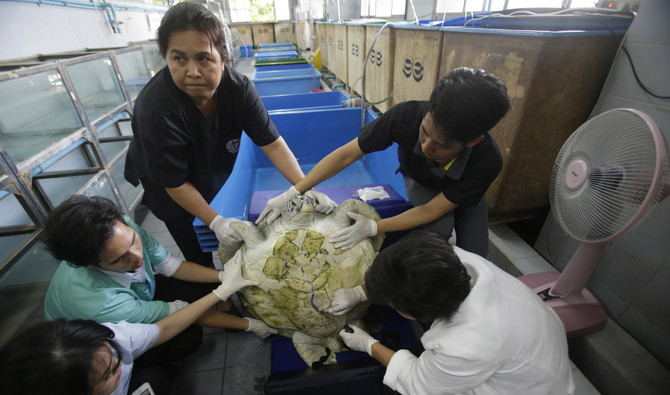
Head of Chulalongkorn University’s veterinary medical aquatic animal research center Nantarika Chansue injects saline solution as part of the rehabilitation treatment for 25-year-old green sea turtle “Bank” in Bangkok, Thailand. (AP)
2 / 5
Head of Chulalongkorn University’s veterinary medical aquatic animal research center Nantarika Chansue injects saline solution as part of the rehabilitation treatment for 25-year-old green sea turtle “Bank” in Bangkok, Thailand. (AP)
3 / 5
Head of Chulalongkorn University’s veterinary medical aquatic animal research center Nantarika Chansue injects saline solution as part of the rehabilitation treatment for 25-year-old green sea turtle “Bank” in Bangkok, Thailand. (AP)
4 / 5
Head of Chulalongkorn University’s veterinary medical aquatic animal research center Nantarika Chansue injects saline solution as part of the rehabilitation treatment for 25-year-old green sea turtle “Bank” in Bangkok, Thailand. (AP)
5 / 5
Head of Chulalongkorn University’s veterinary medical aquatic animal research center Nantarika Chansue injects saline solution as part of the rehabilitation treatment for 25-year-old green sea turtle “Bank” in Bangkok, Thailand. (AP)
Updated 21 March 2017
Follow

Thailand's coin-eating turtle dies of blood poisoning

BANGKOK : Tourists in eastern Thailand used to toss coins at a green sea turtle that lived in a pond in eastern Thailand, wishing for luck and longevity. But swallowing the shiny tidbits turned out to be a death sentence for the reptile.
After having nearly a thousand coins removed from its stomach in a four-hour operation two weeks ago, the turtle — nicknamed "Omsin," or "Piggy Bank," — died Tuesday.
Omsin, estimated to be 25 years old, had been rescued by Thai navy personnel who saw her visibly ailing in the seaside town of Sattahip. She was then examined by a veterinarian, who found the coins inside her stomach.
The story attracted international media attention, and a public clamor to ease Omsin's plight ensued. The weight of the money inside her had cracked her underside shell, and threatened a fatal infection.
The cause of death was intestinal obstruction that blocked Omsin's protein intake, while nickel toxicity from the coins damaged her immune system, said Dr. Roongroje Thanawongnuwech, dean of the veterinary school at Bangkok's Chulalongkorn University.
The turtle had appeared to be doing well after the operation, but a checkup Saturday revealed problems with her intestines. Doctors performed a second, 2 1/2 hour-operation, but Omsin never woke up and died Tuesday morning.
"She at least had the chance to swim freely and eat happily before she passed," said Dr. Nantarika Chansue, who led the team that removed 915 coins weighing 5 kilograms (11 pounds) from her stomach .


Makkah museum displays world’s largest Qur’an

Updated 04 February 2026
Follow

Makkah museum displays world’s largest Qur’an

MAKKAH: The Holy Qur’an Museum at the Hira Cultural District in Makkah is showcasing a monumental handwritten copy of the Holy Qur’an, recognized as the largest Qur’an of its kind in the world.

The manuscript measures 312 cm by 220 cm and comprises 700 pages, earning the museum recognition from Guinness World Records for displaying the world’s largest Qur’an, the Saudi Press Agency reported.

The manuscript is a magnified reproduction of a historic Qur’an dating back to the 16th century, the SPA stated.

The original copy measures 45 cm by 30 cm, with the chapters written primarily in Thuluth script, while Surah Al-Fatiha was penned in Naskh, reflecting the refined artistic choices and calligraphic diversity of the era.

The Qur’an is a unique example of Arabic calligraphy, gilding and bookbinding, showcasing Islamic art through intricate decorations, sun-shaped motifs on the opening folio, and elaborately designed frontispiece and title pages that reflect a high level of artistic mastery.

The manuscript was endowed as a waqf in 1883. Its original version is currently preserved at the King Abdulaziz Complex for Endowment Libraries, serving as a lasting testament to Muslims’ enduring reverence for the Qur’an and the richness of Islamic arts across the centuries.