North Korea tests newly developed high-thrust rocket engine

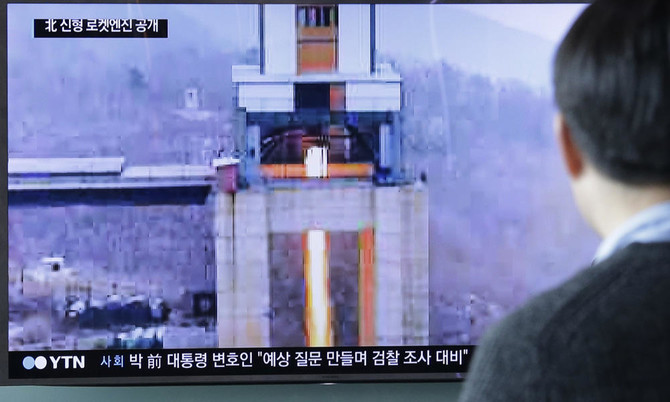
A man watches a TV news program showing an image that North Korea's Rodong Sinmun newspaper reports of a ground test of a new type of high-thrust rocket engine at Seoul Railway station in Seoul, South Korea, on Sunday. (AP Photo/Ahn Young-joon)
Updated 19 March 2017
Follow

North Korea tests newly developed high-thrust rocket engine

TOKYO: North Korea has conducted a ground test of a new type of high-thrust rocket engine that leader Kim Jong Un is calling a revolutionary breakthrough for the country’s space program.
Kim attended the test at the Sohae launch site, according to a report Sunday by the Korean Central News Agency, which said the test was intended to confirm the “new type” engine’s thrust power and gauge the reliability of its control system and structural safety.
The KCNA report said Kim called the test “a great event of historic significance” for the country’s indigenous rocket industry.
He also said the “whole world will soon witness what eventful significance the great victory won today carries” and claimed the test marks what will be known as the “March 18 revolution” in the development of the country’s rocket industry.
The report indicated the engine is to be used for North Korea’s space and satellite-launching program.
North Korea is banned by the United Nations from conducting long-range missile tests, but it claims its satellite program is for peaceful use, a claim many in the US and elsewhere believe is questionable.
North Korean officials have said that under a five-year plan they intend to launch more Earth observation satellites and what would be the country’s first geostationary communications satellite — which would be a major technological advance.
Getting that kind of satellite into place would likely require a more powerful engine than its previous ones. The North also claims it is trying to build a viable space program that would include a moon launch within the next 10 years.
The test was conducted as US Secretary of State Rex Tillerson is in China on a swing through Asia that has been closely focused on concerns over how to deal with Pyongyang’s nuclear and missile programs.
It’s hard to know whether this test was deliberately timed to coincide with Tillerson’s visit, but Pyongyang has been highly critical of ongoing US-South Korea wargames just south of the Demilitarized Zone and often conducts some sort of high-profile operation of its own in protest.
Earlier this month, it fired off four ballistic missiles into the Sea of Japan, reportedly reaching within 200 kilometers (120 miles) of Japan’s shoreline.
Japan, which was Tillerson’s first stop before traveling to South Korea and China, hosts tens of thousands of US troops.
While building ever better long-range missiles and smaller nuclear warheads to pair with them, North Korea has marked a number of successes in its space program.
It launched its latest satellite — the Kwangmyongsong 4, or Brilliant Star 4 — into orbit on Feb. 7 last year, just one month after conducting what it claims was its first hydrogen-bomb test.
It put its first satellite in orbit in 2012, a feat few other countries have achieved. Rival South Korea, for example, has yet to do so.


AI reshaping the battle over the narrative of Maduro’s US capture

Updated 7 sec ago
Follow

AI reshaping the battle over the narrative of Maduro’s US capture

  • Since the US captured Venezuelan leader Nicolas Maduro in early January, pictures and videos chronicling the events have been crowded out by those generated with artificial intelligence
CARACAS: Since the US captured Venezuelan leader Nicolas Maduro in early January, pictures and videos chronicling the events have been crowded out by those generated with artificial intelligence, blurring the lines between fiction and reality.
The endless stream of content ranges from comedic memes to dramatic retellings.
In one, a courtroom illustration of Maduro in a New York courthouse springs to life and announces: “I consider myself a prisoner of war.”
In another, an AI-generated Maduro attempts to escape a US prison through an air duct, only to find himself in a courtroom with US President Donald Trump, where they dance with a judge and an FBI agent to a song by American rapper Ice Spice.
Maduro was captured alongside his wife Cilia Flores during US strikes in the Venezuelan capital of Caracas on January 3.
They have since been taken to a prison in New York where they are being held on drug trafficking charges.
While some have celebrated Maduro’s ouster, the “Chavismo” movement he leads — named after his predecessor Hugo Chavez — has worked to reframe what his fall means for Venezuela’s future.
- ‘ Confuse, combat, and silence’ -
Leon Hernandez, a researcher at Andres Bello Catholic University, told AFP that with AI’s rapid creation of content, we see development of “disinformation labs” that flood social media platforms.
“There were things that circulated that were not real during the capture (of Maduro), and things that circulated which were real that generated doubt,” Hernandez said.
“That was the idea: to create confusion and generate skepticism at the base level by distorting certain elements of real things.”
The goal, he added, is for the content to overwhelm audiences so they cannot follow it.
Even legacy media such as the Venezuelan VTV television channel are in on it, with the broadcaster playing an AI-animated video narrated by a child recounting Maduro’s capture.
“AI has become the new instrument of power for autocrats to confuse, combat, and silence dissent,” said Elena Block, a professor of political communication and strategy at the University of Queensland in Australia.
- ‘Greatest threat to democracy’ -
Block pointed out the use of cartoons, specifically, had been a medium of propaganda used in both authoritarian and democratic states.
Long before his arrest, Maduro was depicted as the illustrated superhero “Super Bigote” or “Super Mustache,” donning a Superman-like suit and fighting monsters like “extremists” and the “North American empire.”
The cartoon’s popularity spawned toys that have been carried by Maduro’s supporters during rallies advocating for his return.
And much like his predecessor, Maduro continued a practice of “media domination” to stave off traditional media outlets from airing criticism of Chavismo.
“With censorship and the disappearance or weakening of news media, social media has emerged as one of the only spaces for information,” Block said.
Maduro is not the only leader to use AI propaganda — Trump has frequently posted AI-generated pictures and videos of himself with “antagonistic, aggressive, and divisive language.”
“These digital and AI tools end up trivializing politics: you don’t explain it, you diminish it,” Block said. “AI today is the greatest threat to democracy.”