BEIJING: The United States’ top diplomat will press a tougher new line on North Korea in talks with a wary China on Saturday, in a tense atmosphere after President Donald Trump accused Beijing of failing to rein in Pyongyang.
On a tour of Asia, Secretary of State Rex Tillerson has broken with years of strategic patience over North Korea, saying that approach had “failed” and that US military action against North Korea was possible if its threats escalated.
The sea change in US policy follows two North Korean nuclear tests last year and recent missile launches including a salvo earlier this month that Pyongyang described as practice for an attack on US bases in Japan.
Trump upped the pressure on China to get tough in a Friday Twitter blast accusing Beijing of failing to use its leverage as North Korea’s key diplomatic and trade partner to put a leash on Pyongyang.
“North Korea is behaving very badly. They have been ‘playing’ the United States for years. China has done little to help!” Trump said.
But Beijing is deeply reluctant to get too tough with its volatile neighbor lest it trigger a confrontation or a messy regime collapse on China’s front door.
China has hit back at the US, angrily accusing it of fueling tension by holding military exercises with its ally Seoul and deploying an anti-missile system in South Korea.
Beijing called this month for all sides to take steps to defuse the situation and avoid a “head-on collision,” calling for re-started diplomatic efforts to dismantle the North’s banned nuclear and missile programs.
Years of diplomacy, however, have failed to deter Pyongyang, and Washington has rebuffed the Chinese proposal.
China’s state-run Xinhua news agency said in an editorial on Saturday that “there is nothing new” in the harder stance outlined by Tillerson during meetings with allies in Tokyo and Seoul, saying that approach had “failed” in years past.
It rejected suggestions that Beijing was not doing enough.
“Positive results require effort and good faith from both sides. China has never fallen short of offering its fair share. It’s all up to Washington now,” it said.
Tillerson, a former Exxon oil executive who until now had adopted a low profile in office, was to meet Foreign Minister Wang Yi on Saturday afternoon. The two were to hold a press conference at 4 p.m. (0800 GMT).
Later, he was to meet China’s top foreign-policy official Yang Jiechi.
Plans also are in the works for Tillerson to meet Sunday with President Xi Jinping as Beijing and Washington negotiate a possible first summit with Trump — a frequent China critic — next month in the United States.
Beijing shares US concerns over Pyongyang’s nuclearization but appears to prefer the tense status quo over drastic action.
But China took one of its toughest steps yet in February, announcing it would halt all imports of North Korean coal, a key source of income for the impoverished state, for the rest of this year, citing UN sanctions over Pyongyang’s weapons programs.
The United Nations has imposed multiple sets of sanctions on the North but China is accused of not fully enforcing them.
China insisted Thursday its latest proposal — for North Korea to suspend nuclear and missile activities in return for the US and South Korea halting the military exercises — was the “only feasible plan” available.
Tillerson is yet to detail the harder new US line, but said in South Korea on Friday “we are exploring a new range of diplomatic, security, economic measures.”
Under the Obama administration, the US ruled out diplomatic engagement until Pyongyang made a tangible commitment to denuclearization, hoping that internal stresses in the isolated country would bring change.
North Korea says it needs to be able to defend itself, and conducted its first underground atomic test in 2006 despite global opposition. Four more test blasts followed.
Beijing also is upset over the US deployment of an anti-missile system to South Korea.
Washington and Seoul insist it is purely a defense against a possible North Korean attack.
But Beijing says the system undermines its own security and has reacted angrily, imposing a series of measures seen in South Korea as economic retaliation.


![]()
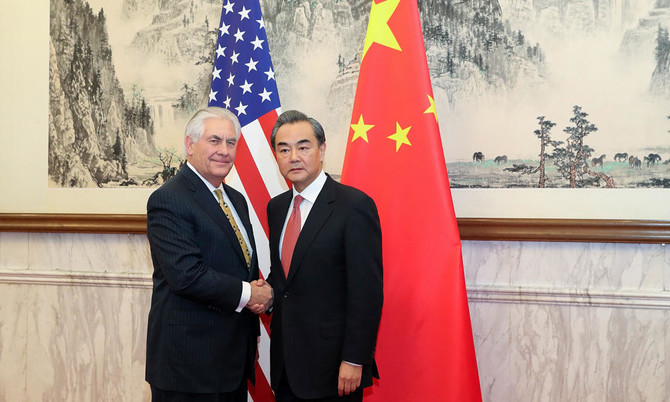
Tension as Tillerson brings tough N.Korea stance to China
Tension as Tillerson brings tough N.Korea stance to China
Latest updates


© 2026 SAUDI RESEARCH & PUBLISHING COMPANY, All Rights Reserved And subject to Terms of Use Agreement.