

Libya oil terminals retaken by Haftar

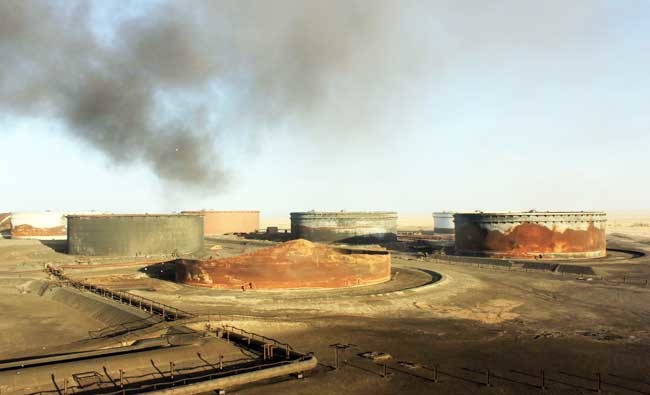
This file photo taken on January 08, 2016 shows smoke billowing from a petroleum storage tank after a fire was extinguished at Al-Sidra oil terminal, near Ras Lanuf in the so-called “oil crescent” along Libya’s northern coast. Troops commanded by Libyan military strongman Khalifa Haftar launched an assault on March 14, 2017 to seize two of the country’s key eastern oil terminals, a spokesman said. (AFP)
Updated 15 March 2017
Follow

Libya oil terminals retaken by Haftar

TRIPOLI: Troops commanded by Khalifa Haftar, Libyan military strongman, announced Tuesday the recapture of two key oil installations, as fighting raged in Tripoli where a rival government has struggled to assert its authority.

Libya has experienced years of violence and lawlessness since the 2011 NATO-backed ouster of Muammar Qaddafi, a longtime dictator, with rival parliaments and governments trading barbs and militias fighting over territory and the country’s vast oil wealth.

Forces loyal to Haftar mounted a daylong assault by land, sea and air to retake the oil export terminals of Ras Lanuf and Al-Sidra, after both sites were seized by a rival force earlier this month.

“The armed forces... have liberated the whole of the oil crescent,” said a spokesman for pro-Haftar forces. Gen. Meftah Al-Megaryef, head of the oil installation guards, also said the two terminals had been recaptured.

Basset Al-Shairi, a commander of the Benghazi Defense Brigades (BDB), which had seized the two sites on March 3, said Ras Lanuf had fallen without specifying the outcome in nearby Al-Sidra.

In September, pro-Haftar forces had already captured the terminals and two other eastern oil ports in a blow to the authority of the UN-backed unity government in Tripoli.

Haftar backs a rival administration in the country’s far east that has refused to cede power to the Government of National Accord (GNA) working in the capital since last year.

Oil accounts for more than 95 percent of Libya’s revenues.

Haftar’s forces, which call themselves the Libyan National Army (LNA), have battled extremists in second city Benghazi for more than two years.

In Tripoli, fresh fighting raged on between rival armed groups, authorities in the capital said, causing Martin Kobler, UN Libya envoy, to call for an “immediate cease-fire.”

“Civilians at grave risk in ongoing clashes,” he wrote on Twitter.

Gunfire and explosions could be heard in two neighborhoods west of the city center, witnesses said, and several key thoroughfares were blocked, leaving many trapped in their homes.


UN rights chief Shocked by ‘unbearable’ Darfur atrocities

Updated 18 January 2026
Follow

UN rights chief Shocked by ‘unbearable’ Darfur atrocities

  • Mediation efforts have failed to produce a ceasefire, even after international outrage intensified last year with reports of mass killings, rape, and abductions during the RSF’s takeover of El-Fasher in Darfur

PORT SUDAN: Nearly three years of war have put the Sudanese people through “hell,” the UN’s rights chief said on Sunday, blasting the vast sums spent on advanced weaponry at the expense of humanitarian aid and the recruitment of child soldiers.
Since April 2023, Sudan has been gripped by a conflict between the army and the paramilitary Rapid Support Forces that has left tens of thousands of people dead and around 11 million displaced.
Speaking in Port Sudan during his first wartime visit, UN Human Rights commissioner Volker Turk said the population had endured “horror and hell,” calling it “despicable” that funds that “should be used to alleviate the suffering of the population” are instead spent on advanced weapons, particularly drones.
More than 21 million people are facing acute food insecurity, and two-thirds of Sudan’s population is in urgent need of humanitarian aid, according to the UN.
In addition to the world’s largest hunger and displacement crisis, Sudan is also facing “the increasing militarization of society by all parties to the conflict, including through the arming of civilians and recruitment and use of children,” Turk added.
He said he had heard testimony of “unbearable” atrocities from survivors of attacks in Darfur, and warned of similar crimes unfolding in the Kordofan region — the current epicenter of the fighting.
Testimony of these atrocities must be heard by “the commanders of this conflict and those who are arming, funding and profiting from this war,” he said.
Mediation efforts have failed to produce a ceasefire, even after international outrage intensified last year with reports of mass killings, rape, and abductions during the RSF’s takeover of El-Fasher in Darfur.
“We must ensure that the perpetrators of these horrific violations face justice regardless of the affiliation,” Turk said on Sunday, adding that repeated attacks on civilian infrastructure could constitute “war crimes.”
He called on both sides to “cease intolerable attacks against civilian objects that are indispensable to the civilian population, including markets, health facilities, schools and shelters.”
Turk again warned on Sunday that crimes similar to those seen in El-Fasher could recur in volatile Kordofan, where the RSF has advanced, besieging and attacking several key cities.
Hundreds of thousands face starvation across the region, where more than 65,000 people have been displaced since October, according to the latest UN figures.