What to do, where to do it: A handy guide to Dubai’s Art Season

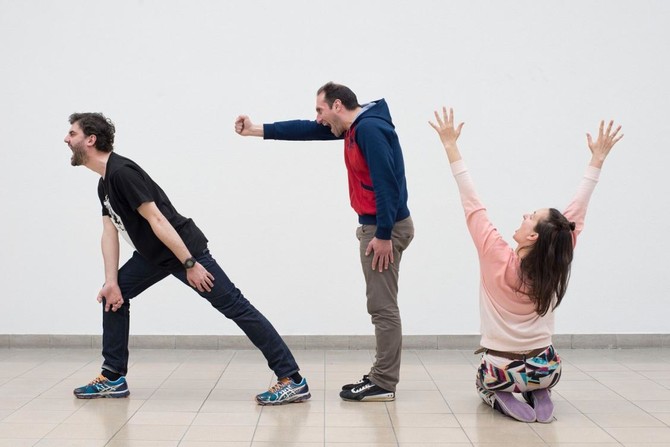
Art Dubai 2017 features a line-up of performance art. (Photo courtesy: Manuel Pelmus & Alexandra Pirici)
Updated 13 March 2017
Follow

What to do, where to do it: A handy guide to Dubai’s Art Season

DUBAI: As the world’s art glitterati descend upon the UAE for Art Dubai, the region’s largest art fair, visitors need not worry if they miss the creative event as it is one of a stellar line-up of upcoming cultural activities.
Supported by the Dubai Culture and Arts Authority, Art Season is set to run from March to April 2017 and will feature more than 350 events for every art lover.
Here are the highlights of this year’s creative season.
SIKKA Art Fair
Located in the Al Fahidi Historical Neighborhood from the 11th to the 21st of March, the SIKKA Art Fair showcases the creativity of GCC artists as well as GCC-based artists from all over the globe. With visual arts, performing arts, music and film there is something for people of all ages to enjoy.
Art Dubai 2017
Art Dubai is dubbed the most global art fair in the world, according to organizers, with the 2017 edition hosting 93 galleries from 43 countries showcasing the works of more than 500 artists.
The 11th edition of Art Dubai takes place between March 15-18, 2017, at Madinat Jumeirah, Dubai.
Design Days Dubai
Design Days Dubai is a fair dedicated to collectible furniture and objects presented by international and Middle East galleries.
The 6th edition of the fair is set to run between March 14-17 at Dubai Design District.
Dubai International Calligraphy Exhibition
The 9th edition of the bi-annual Dubai International Calligraphy Exhibition will take place at Wafi Shopping Center in Dubai and will celebrate the power and beauty of calligraphy. By offering workshops and exhibits, visitors will have opportunity to try their hand at this art form and discover its special position in Islamic heritage.
Sharjah Biennial 13
Running from March 10 – June 12, this year’s event is named “Tamawuj,” a noun in Arabic which is defined as a rising and falling in waves.
Sharjah Biennial is organized by the Sharjah Art Foundation and takes place across various venues in the in the city.


New book explores 12 masterpieces of Islamic manuscript art across centuries

Updated 22 January 2026
Follow

New book explores 12 masterpieces of Islamic manuscript art across centuries

  • William Greenwood discusses his new book on a dozen masterful Islamic manuscripts 

DUBAI: A new book exploring 12 extraordinary Islamic manuscripts has been published with the intention of making these richly illustrated masterpieces accessible to all. 

“Illuminated: Art, Knowledge, and Wonder in Twelve Islamic Manuscripts,” published by Empty Quarter Press, showcases a dozen of the finest manuscripts ever produced, including the medieval Arab classics “Maqamat al-Hariri,” “Kalila wa Dimna,” “Aja’ib Al-Makhluqat Wa Ghara’ib Al-Mawjudat,” and “Kitab Al-Diryaq,” as well as spectacular works spanning the 13th to 17th century Timurid, Safavid, and Mughal worlds.  

Its author, William Greenwood, is a specialist in Islamic art and culture. The featured manuscripts were valued as both vessels of knowledge and as artistic products in their own right. From medical treatises and celestial charts to epic poetry and fables, each manuscript reflects the diverse traditions of Islamic intellectual and artistic life. 

'Maqamat Al Hariri' (circa 1236-37). (Supplied)

For Greenwood, who has worked as a curator for more than 10 years, most recently at Zayed National Museum in Abu Dhabi, the featured manuscripts are important for several reasons. Firstly, they are incredible works of art. Secondly, each is “a snapshot of the time when it was made, in terms of the artistic styles and content, but also the historical context.” 

The first chapter of “Kitab al-Diryaq,” for example, has been attributed to mid-13th-century Mosul, and “is very much about glorifying the ruler,” Greenwood says. “Kitab Suwar al-Kawakib al-Thabita,” copied in 15th-century Samarkand, speaks to the flourishing of science during the Timurid Renaissance, while the Hamzanama, from 16th-century India, marks the beginning of a distinctively Mughal style of painting. 

“The third reason is that, as beautiful as the paintings and illumination are, these are almost always intended to enliven texts which in themselves are wonderful – whether they are national epics like the “Shahnameh,” encyclopaedic works like “Aja’ib al-Makhluqat,” or demonstrations of virtuoso linguistic skill like “The Maqamat of Al-Hariri.” 

For Greenwood, who has worked as a curator for more than 10 years, most recently at Zayed National Museum in Abu Dhabi, the featured manuscripts are important for several reasons. (Supplied)

Lastly, he says, they are “remarkable testaments to a multicultural and cosmopolitan Islamic world, absorbing, refining, and rethinking everything from Indian fables and classical astronomy into a coherent and distinctively ‘Islamic’ whole.”  

Greenwood’s interest in illuminated manuscripts was initially sparked by a mid-14th-century Mamluk copy of “Sulwan al-Muta’ fi ‘Udwan al-Atba’,” which he encountered while working at the Museum of Islamic Art in Doha.  

“It’s the only illustrated medieval copy of this text and was probably made for a royal patron,” explains Greenwood, who has also worked at the British Museum in London. “The mix of Byzantine, Persian, and Chinese elements within the painting appealed to my interest in cross-cultural encounters. The text itself is part of the ‘mirrors for princes’ genre, which is supposed to provide guidance for rulers; this was a very important type of writing, which is represented in ‘Illuminated’ by an early 14th-century Mamluk copy of ‘Kalila wa Dimna.’”  

'Kalila wa Dimna' (circa 1310). (Supplied)

However, it was not a single discovery or experience that prompted him to write the book, but rather a growing realization that, although the general public engages with illustrated and illuminated Islamic manuscripts, there were few general works on the topic.   

“There are lots of very detailed publications which deal either with specific manuscripts or particular design elements across them, but not much for an interested but non-academic audience. It was also quite exciting to think about having paintings from these very different manuscripts together in one publication. Here you can follow the evolution of styles and ideas from the 13th through to the 17th century, which is helpful for non-specialists.” 

The end result is a richly illustrated book written for a wide audience. Both a celebration of the artistic traditions of the Islamic book and an invitation to uncover its beauty and treasures, “Illuminated” brings together Islamic art, scholarship, and storytelling in an accessible and engaging form. 

“I hope that being able to see these works together in one publication will open readers’ eyes to how wonderful they are,” says Greenwood. “This is really intended for everyone, and if it sparks wider interest in the manuscripts featured, then that in itself brings a unique value. All of these works deal with learning and imparting wisdom in some way, and if this book can help to spread that a little further, then it has done its job.”