MANILA: Philippine President Rodrigo Duterte on Thursday pleaded for help from mayors in Muslim parts of the south to deal with Islamist militants, and threatened to impose martial law there if the problem is not tackled.
The largely Roman Catholic Philippines has been struggling to thwart two small but violent Daesh-linked groups behind kidnappings, piracy, bombings and the recent beheading of a German captive.
“I plead before you because I do not want the trouble in (the southern island of) Mindanao to spin out of control,” Duterte told mayors in a speech in Davao.
“Because then, as president, I will be forced, I will be compelled, to exercise the extra-ordinary powers.”
He added: “Help me. If not, you know, martial law, then I have to authorize the military just to arrest them, detain you.”
The Philippines is fighting Abu Sayyaf militants on two remote islands in the south. The government is seeking the support of separatists who are talking peace with the government to root out groups with extremist agendas.
After years of denials by the Philippines that Daesh is seeking a foothold in the country, Duterte's administration says it is now certain that local rebels are in contact with Middle East extremists and receiving funds.
Duterte has warned of a “contamination” and the possibility of Daesh fighters driven from Iraq and Syria taking refuge in the Philippines.
Defense Secretary Delfin Lorenzana said Abu Sayyaf’s kidnappings were a national embarrassment, with the number of hostages increasing to 31 from 18 captives when Duterte came to power on June 30.
“It’s giving me a headache,” he told reporters, adding the military’s deadline to eliminate the militants by June was unrealistic.
“Sometimes, I couldn’t sleep at night.”
He said the army would move an infantry division to Jolo island, an Abu Sayyaf stronghold where most of the captives are held. A marine and naval task force would be deployed to tackle piracy.
Lorenzana said the Philippines would jointly patrol southern seas with Indonesia and Malaysia from April, creating a sea lane for the merchant ships Abu Sayyaf has been intercepting.
Defense secretary suspicious
of Chinese activities
The Philippine defense minister on Thursday said he was “disturbed” by what he believes are survey missions by Chinese ships deep into its 200-nautical-mile exclusive economic zone (EEZ) and in an area designated as its continental shelf.
Lorenzana said Chinese ships had been monitored in recent months at various locations close to the Philippines. A warship was detected 70 miles off its Western coast in the South China Sea and survey ships were seen at the north and south of the eastern seaboard.
While Duterte has frequently praised China amid a warming relationship, Lorenzana has remained openly suspicious, noting that its fortification of manmade islands inside the Philippine EEZ has continued.
China claims most of the energy-rich waters through which about $5 trillion in ship-borne trade passes every year. Neighbors Brunei, Malaysia, the Philippines, Taiwan and Vietnam also have claims.
Lorenzana said that satellite imagery provided by allies had tracked Chinese vessels for three months last year in Benham Rise, a vast area declared by the UN as part of the Philippines’ continental shelf.
“I am disturbed by China’s presence there, it is annoying if they will claim the area,” he told Reuters.
Lorenzana earlier gave a presentation to media showing where Chinese vessels had been and said he was suspicious of its activities to the east, because China had never laid claim to those waters.
He told reporters he had received information suggesting China may have been surveying water depths to prepare submarine routes to the Pacific. He has told the navy to intercept vessels if they return.
The reported Chinese activity comes as the two countries seek to forge closer trade and investment ties under Duterte after years of bickering and mistrust, mostly over the South China Sea.


Duterte pleads with Muslim Mindanao mayors to stop extremists, threatens martial law in region
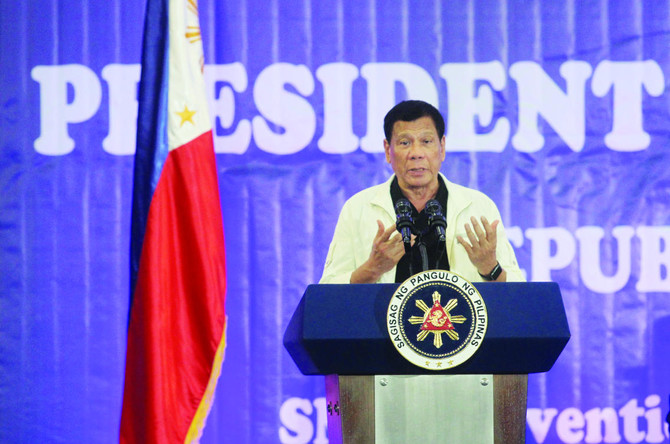
Duterte pleads with Muslim Mindanao mayors to stop extremists, threatens martial law in region

Geoeconomic confrontation tops global risks in 2026: WEF report
- Also armed conflict, extreme climate, public polarization, AI
- None ‘a foregone conclusion,’ says WEF’s MD Saadia Zahidi
DUBAI: Geoeconomic confrontation has emerged as the top global risk this year, followed by state-based armed conflict, according to a new World Economic Forum report.
The Global Risks Report 2026, released on Wednesday, found that both risks climbed eight places year-on-year, underscoring a sharp deterioration in the global outlook amid increased international competition.
The top five risks are geoeconomic confrontation (18 percent of respondents), state-based armed conflict (14 percent), extreme weather events (8 percent), societal polarization (7 percent) and misinformation and disinformation (7 percent).
The WEF’s Managing Director Saadia Zahidi said the report “offers an early warning system as the age of competition compounds global risks — from geoeconomic confrontation to unchecked technology to rising debt — and changes our collective capacity to address them.
“But none of these risks are a foregone conclusion.”

The report assesses risks across three timeframes: immediate (2026); short-to-medium term (next two years); and long term (next 10 years).
Economic risks show the largest overall increase in the two-year outlook, with both economic downturn and inflation jumping eight positions.
Misinformation and disinformation rank fifth this year but rise to second place in the two-year outlook and fourth over the 10-year horizon.
The report suggests this reflects growing anxiety around the rapid adoption of artificial intelligence, with adverse outcomes linked to AI surging from 30th place in the two-year timeframe to fifth in the 10-year outlook.
Uncertainty dominates the global risk outlook, according to the report.
Surveyed leaders and experts view both the short- and long-term outlook negatively, with 50 percent expecting a turbulent or stormy global environment over the next two years, rising to 57 percent over the next decade.
A further 40 percent and 32 percent, respectively, describe the outlook as unsettled across the two- and 10-year timeframes, while just 1 percent anticipate a calm global outlook in either period.
Environmental risks ease slightly in the short-term rankings. Extreme weather fell from second to fourth place and pollution from sixth to ninth. Meanwhile, critical changes to Earth systems and biodiversity loss dropped seven and five positions, respectively.
However, over the next decade, environmental threats re-emerge as the most severe, with extreme weather, biodiversity loss, and critical changes to Earth systems topping the global risk rankings.

Looking ahead over the next decade, around 75 percent of respondents anticipate a turbulent or stormy environmental outlook, making it the most pessimistic assessment across all risk categories.
Zahidi said that “the challenges highlighted in the report underscore both the scale of the potential perils we face and our shared responsibility to shape what comes next.”
Despite the gloomy outlook, Zahidi signaled a positive shift in global cooperation.
“It is also clear that new forms of global cooperation are already unfolding even amid competition, and the global economy is demonstrating resilience in the face of uncertainty.”
Now in its 21st year, the Global Risks Report highlights a core message: global risks cannot be managed without cooperation.
As competition intensifies, rebuilding trust and new forms of collaboration will be critical, with the report stressing that today’s decisions will shape future outcomes.
The report was released ahead of WEF’s annual meeting, which will be held in Davos from Jan. 19 to 23.


