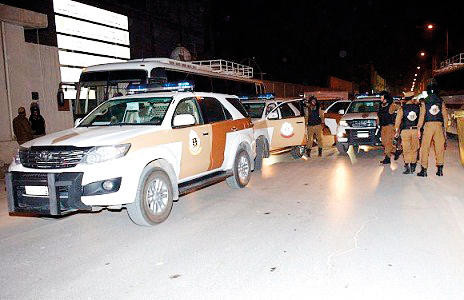
JEDDAH: Police officers in Riyadh have killed a suspected Daesh supporter and arrested his accomplice.
The incident occurred in a furnished apartment building in the Al-Rayyan district after a worker reported that one of the men had declared support for Daesh and accused the government of being composed of infidels.
Maj. Gen. Mansour Al-Turki, spokesman for the Ministry of Interior, said when police arrived at the apartment, the suspect resisted arrest and even pointed a pistol at them, prompting counter-action.
Al-Turki said no one else was injured and that the investigation is ongoing.
The accomplice of the deceased was seen fleeing the scene and was arrested. The police seized another pistol in the rented apartment and found out later that the car driven by the suspects was involved in a previous shooting case.

'Daesh supporter' killed in Riyadh after resisting arrest
Japanese researchers hope to restore coral from Saudi-made structures
- Coral skeletons made for Saudi Pavilion at Japan expo last year
- Results of Japanese study to be revealed at Riyadh Expo 2030
TOKYO: Japanese universities are seeking to restore coral reefs and marine ecosystems after receiving artificial structures that Saudi Arabia made and showcased at last year’s Osaka-Kansai Expo.
The coral skeletons were donated to the University of the Ryukyus in Okinawa and Kansai University in Osaka Prefecture, Kyodo News reported at the weekend.
The structures are made from calcium carbonate, a material on which corals are believed to grow more easily compared to artificial alternatives such as concrete or metal.
The skeletal structures were created using 3-D printers, with one piece produced a day during the expo, and displayed across an entire wall in the Saudi Arabia Pavilion, which had an area focusing on sustainable marine environments.
Coral reefs serve as habitats for much marine life, but over 40 percent of the world’s 892 species face possible extinction, according to the International Union for Conservation of Nature.
The University of the Ryukyus, which received about 150 of the artificial coral skeletons, will place them in waters off the eastern coast of Okinawa’s main island and then examine their impact on the ecosystem.
Kansai University has placed theirs in the sea around Kagoshima Prefecture’s Yoron Island to observe their growth after transplanting coral polyps onto the structures.
The results of the research are expected to be revealed at the Riyadh Expo in 2030.
“I had never imagined that Japan and Saudi Arabia would cooperate on coral research,” said Masato Ueda, a professor specializing in regenerative medicine at Kansai University.
Ueda said he wants to demonstrate to children that “humanity is attempting to restore the environment.”