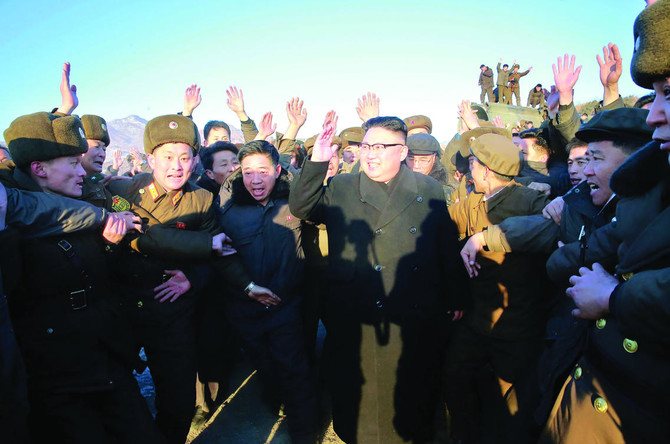
GENEVA: North Korea said on Tuesday its missile launches were “self-defense measures,” rejecting UN Security Council criticism of its weekend test, but the US demanded international action against Pyongyang’s weapons programs.
North Korea’s ballistic missile firing on Sunday was its first direct challenge to the international community since US President Donald Trump took office on Jan. 20.
The missile had a range of more than 2,000 kms, according to South Korea’s intelligence agency. It reached an altitude of about 550 km and flew about 500 km toward Japan before splashing into the sea east of the Korean peninsula.
The UN Security Council on Monday denounced the launch, urging members to “redouble efforts” to enforce sanctions against the reclusive state, but gave no indications of any action it might take.
Han Tae Song, the new Ambassador of the Democratic People’s Republic of Korea (DPRK) to the UN in Geneva, addressed the UN-backed Conference on Disarmament a day after taking up his post.
“The various test fires conducted by DPRK for building up self-defense capabilities are, with no exception, self-defense measures to protect national sovereignty and the safety of the people against direct threats by hostile forces,” Han told the 61-member-state forum.
“My delegation strongly rejects the latest statement of the UN Security Council and all UN resolutions against my country.”
US Ambassador Robert Wood said: “All efforts to advance North Korea’s nuclear weapons and ballistic missile capabilities must cease,” adding: “If ever there were a situation that called for international collective action to ensure our mutual security, it is this.”

N. Korea defends missile launch, US demands action
NATO wants ‘automated’ defenses along borders with Russia: German general
- That zone would act as a defensive buffer before any enemy forces advanced into “a sort of hot zone,” said Lowin
- The AI-guided system would reinforce existing NATO weapons and deployed forces, the general said
FRANKFURT: NATO is moving to boost its defenses along European borders with Russia by creating an AI-assisted “automated zone” not reliant on human ground forces, a German general said in comments published Saturday.
That zone would act as a defensive buffer before any enemy forces advanced into “a sort of hot zone” where traditional combat could happen, said General Thomas Lowin, NATO’s deputy chief of staff for operations.
He was speaking to the German Sunday newspaper Welt am Sonntag.
The automated area would have sensors to detect enemy forces and activate defenses such as drones, semi-autonomous combat vehicles, land-based robots, as well as automatic air defenses and anti-missile systems, Lowin said.
He added, however, that any decision to use lethal weapons would “always be under human responsibility.”
The sensors — located “on the ground, in space, in cyberspace and in the air” — would cover an area of several thousand kilometers (miles) and detect enemy movements or deployment of weapons, and inform “all NATO countries in real time,” he said.
The AI-guided system would reinforce existing NATO weapons and deployed forces, the general said.
The German newspaper reported that there were test programs in Poland and Romania trying out the proposed capabilities, and all of NATO should be working to make the system operational by the end of 2027.
NATO’s European members are stepping up preparedness out of concern that Russia — whose economy is on a war footing because of its conflict in Ukraine — could seek to further expand, into EU territory.
Poland is about to sign a contract for “the biggest anti-drone system in Europe,” its defense minister, Wladyslaw Kosiniak-Kamysz, told the Gazeta Wyborcza daily.
Kosiniak-Kamysz did not say how much the deal, involving “different types of weaponry,” would cost, nor which consortium would ink the contract at the end of January.
He said it was being made to respond to “an urgent operational demand.”