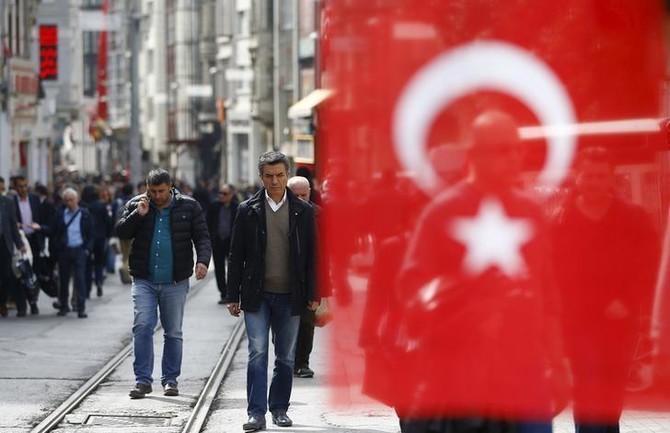
ANKARA: Turkey tourism revenues fell almost 30 percent in 2016, the country’s statistics office said Tuesday, after visitors stayed away following multiple terror attacks and a failed coup.
In 2016 income from tourism fell by 29.7 percent compared to the previous year, falling to $22.1 billion (19.7 billion euros), the Turkish Statistics Institute (TUIK) said on its website.
The country has been hit by a spate of attacks blamed on Islamic extremists and Kurdish militants while tourists were further spooked by the attempted overthrow of President Recep Tayyip Erdogan in the July 15 failed coup and the subsequent crackdown.
For the whole of last year, over 31 million visitors came to Turkey, TUIK said, compared to nearly 42 million in 2015.
The statistics include Turkish residents who live abroad.
Tourism is a key economic sector in Turkey, accounting for some five percent of GDP, and the slowdown in the sector has contributed to a deterioration in growth.
The economy in the third quarter contracted for the first time year-on-year since 2009, shrinking 1.8 percent.
Tourists have been put off in particular by attacks in locations frequented by foreign visitors blamed on jihadists.
In June 2016, 47 people were killed in a triple suicide bombing and gun attack at Istanbul’s Ataturk airport, with authorities pointing the finger at Daesh jihadists.
And just 75 minutes into 2017, an Daesh-linked militant killed 39 people in an elite nightclub in Istanbul as New Year celebrations were in full swing.
But Turkish officials are still hoping for better times in 2017, pinning expectations on an upsurge in tourism from key market Russia after a deal to normalize ties.
In August, visitor numbers to Turkey from Russia fell 83.63 percent compared with the same month in 2015.
For the whole of 2016, Turkey saw foreign visitor arrivals drop by 30 percent, the tourism ministry said.
“God willing, 2017 will be better than 2016, and 2018 will be better than 2017,” said Tourism Minister Nabi Avci, quoted by the state Anadolu agency.
“Turkey is a perfect destination, everyone should absolutely see it,” UN World Tourism Organization Secretary General Taleb Rifai said.
“And it’s important for this second reason, traveling to Turkey is the best response to give to terrorism,” he added.

Turkey tourism income slumps after attacks, coup
Reforms target sustained growth in Saudi real estate sector, says Al-Hogail
RIYADH: The Real Estate Future Forum opened its doors for its first day at the Four Seasons Riyadh, with prominent global and local figures coming together to engage with one of the Kingdom’s most prospering sectors.
With new regulations, laws, and investments underway, 2026 is expected to be a year of momentous progress for the real estate sector in the Kingdom.
The forum opened with a video highlighting the sector’s progress in the Kingdom, during which an emphasis was placed on the forum’s ability to create global reach, representation, as well as agreements worth a cumulative $50 billion
With the Kingdom now opening up real estate ownership to foreigners, this year’s Real Estate Future Forum is placing a great deal of importance on this new milestone and its desired outcomes and impact on the market.
Aside from this year’s forum’s unique discussions surrounding those developments, it will also be the first of its kind to launch the Real Estate Excellence Award and announce its finalist during the three-day summit.
Minister of Municipalities and Housing and Chairman of the Real Estate General Authority Majed Al-Hogail took to stage to address the diverse audience on the real estate market’s achievements thus far and its milestones to come.
Of those important milestones, he underscored “real estate balance” as a key pillar of the sector’s decisions to implement regulatory tools “with the aim of constant growth which can maintain the vitality of this sector.” He pointed to examples of those regulatory measures, such as the White Land Tax.
On 2025’s progress, the minister highlighted the jump in Saudi family home ownership, which went from 47 percent in 2016 to 66 percent in 2025, keeping the Kingdom’s Vision 2030 goal of 70 percent by the end of the decade on track.
He said the opening of the real estate market to foreigners is an indicator of the sector’s maturity under the leadership of Crown Prince Mohammed bin Salman. He said his ministry plans to build over 300,000 housing units in Riyadh over the next three years.
Speaking to Arab News, Al-Hogail elaborated on these achievements, stating: “Today, demand, especially local demand, has grown significantly. The mortgage market has reached record levels, exceeding SR900 billion ($240 billion) in mortgage financing, we are now seeing SRC (Saudi Real Estate Refinance Co.) injecting both local and foreign liquidity on a large scale, reaching more than SR54 billion”
Al-Hogail described Makkah and Madinah as unique and special points in the Kingdom’s real estate market as he spoke of the sector’s attractiveness.
“Today, the Kingdom of Saudi Arabia has become, in international investment indices, one that takes a good share of the Middle East, and based on this, many real estate investment portfolios have begun to come in,” he said.
Al-Ahsa Gov. Prince Saud bin Talal bin Badr Al-Saud told Arab News the Kingdom’s ability to balance both heritage sites with real estate is one of its strengths.
He said: “Actually the real estate market supports the whole infrastructure … the whole ecosystem goes back together in the foundation of the real estate; if we have the right infrastructure we can leverage more on tourism plus we can leverage more on the quality of life … we’re looking at 2030, this is the vision … to have the right infrastructure the time for more investors to come in real estate, entertainment, plus tourism and culture.”