PARIS: Bernie Ecclestone, ousted as Formula One chief by its new American owner, transformed grand prix racing into one of the most profitable sports and made himself a billionaire powerbroker.
A former second-hand car salesman, Ecclestone, now 86, ran Formula One with an iron fist for more than four decades, building it into a global empire with a cut-glass brand.
His rule came crashing down Monday when Liberty Media completed its multi-billion-dollar takeover of the sport and appointed American Chase Carey as chairman and chief executive, elbowing Ecclestone aside with title of “chairman emeritus.”
Typically forthright, Ecclestone saw through the corporate smokescreen, saying bluntly “I was dismissed today.”
Ecclestone was the flamboyant figure at the center of Formula One since the 1970s, crafting it into one of the world’s most glamorous and best known sports.
But his career has not been without controversy.
Ecclestone paid $100 million to German authorities to end a high-profile bribery trial in 2014, which was linked to the sale of Formula One’s rights in 2006 and 2007.
Although he had faced a possible 10-year prison sentence if found guilty, many in the F1 paddock remained loyal.
“F1 is what it is thanks to Bernie Ecclestone, to the way he has built this sport over the past 35 years,” Christian Horner, team principal at Red Bull, said at the time. “I think that without him we would have big problems.”
Dubbed “Napoleon” due to his 1.59-meter (five foot three inch) stature and autocratic control, the fortune of Ecclestone is valued by Forbes magazine at $2.9 billion (2.7 billion euros, 2.3 billion pounds).
“I prefer strong leaders,” he said, stoking up controversy in 2009 by claiming that Adolf Hitler was a man who “was able to get things done” and that democracy had not worked out for Britain.
He was also in the spotlight in late 1997 over a donation of 1.5 million pounds to the British Labour Party under Tony Blair, whose goverment subsequently authorized the continued use of tobacco advertising by the sport.
Holder of a chemistry degree from Woolwich Polytechnic in southeast London, Ecclestone, known for his grey mop-top hairstyle, began his career selling cars and motorcycles in the capital, and also briefly drove race cars himself.
His own modest career was cut short following a series of accidents and he turned to the business side of racing.
He was a manager of promising British F1 driver Stuart Lewis-Evans, who died in a fiery crash in 1958. A decade later he managed Austrian Jochen Rindt, who was killed in a crash in 1970 and is the only driver to posthumously win the F1 world title.
In 1971 Ecclestone bought the Brabham team, becoming a member of the Formula One Constructors’ Association, the group that represented teams against what became the International Automobile Federation (FIA).
Ecclestone’s influence increased as he took over responsibility for negotiating television rights for Formula One, which until then was done on a race-by-race basis.
One of the first to recognize the potential in sponsorship, he became the exclusive manager of F1 rights, taking the helm of Formula One Management, negotiating with circuits, advertisers and television stations.
“The contracts he negotiated, the circuits and the countries to which he brought F1, are remarkable,” Horner said.
Ecclestone’s fortune has been little dented despite having had to pay out one billion euros ($1.3 billion) to divorce his wife Slavica — the mother of two of his children, Tamara and Petra.
In 2012, he remarried for a third time, to Brazilian Fabiana Flosi, 46 years his junior and whom he met at the South American country’s grand prix.
His family was in the headlines again last year when his 67-year-old mother-in-law Aparecida Schunck Flosi Palmeira was kidnapped, with a ransom of $36.5m demanded.
Brazilian police tracked her down and arrested a helicopter pilot who worked for the British billionaire’s family.


![]()
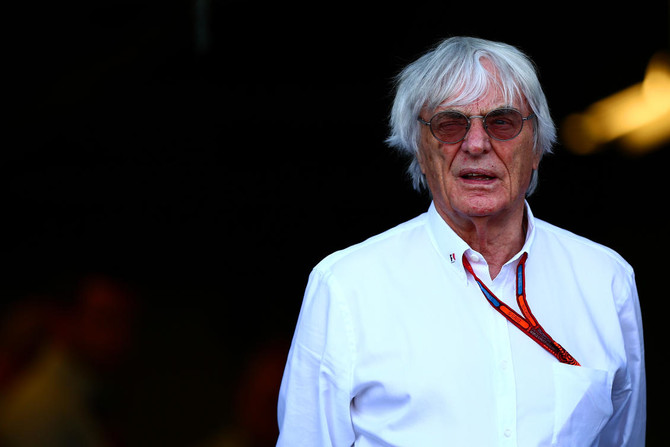
Formula One: Ecclestone, the racing Napoleon, forced into exile
Formula One: Ecclestone, the racing Napoleon, forced into exile
Latest updates


© 2026 SAUDI RESEARCH & PUBLISHING COMPANY, All Rights Reserved And subject to Terms of Use Agreement.