Saudi Food & Hotel and Hospitality Expo 2013 has been hailed as a major success as it concluded a four-day run in Jeddah.
Organizers said the next edition will take place on April 13-16 at the Jeddah Center for Forums and Events.
They said said this year’s show attracted 18,000 visitors and saw millions of riyals worth of trade transactions.
Around 400 exhibitors from 18 countries took part in the event.
While there were on-the-spot deals between the overseas participants and their local partners to the tune of more than SR 200 million.
“The exhibition had set new standards with record attendance and unprecedented business volumes,” said Zahoor Siddique, vice president for exhibitions, ACE.
“We are glad to meet the needs of the industry by providing a platform for restaurants, hotels, retailers and businesses to network, gather the latest industry information, and forge new business opportunities,” said Siddique.
Joao Paulo Paixao, international business executive at Arab Brazil Chamber of Commerce, said: “The fair, provided an excellent opportunity for us to introduce our products and services to the wider Saudi Arabia market.”
He said: “The visitor turnout was notable. The exhibition allowed us to make new contacts and further our goals in establishing our brand in Saudi Arabia and the region.”
He said the Arab Brazilian Chamber of Commerce encourages and supports both Brazilian and Saudi organizations to strengthen ties between these partners.
“As a result of this support we were able to increase Brazil’s bilateral trade with Saudi Arabia to reach $ 15 billion,” he said.
Mohammed Khalid Abbasi Abdul Razak, consul general of Malaysia, said: “Eleven Malaysian companies were taking part in a big way at the Saudi Food & Hotel and Hospitality exhibition showcasing their goods and services in various food products such as processed canned food, chocolates products, healthy food and beauty products, nutraceutical and functional food related products, pre-instant mixed coffee and variety of buns, bread and biscuits.”
Taking part at exhibition for the fifth year, Dieter Fiebelkorn, GM, Kaechele, Germany, said: “Varieties of hotel linen had received a number of inquiries. We see great demand here for our linen— different varieties and qualities of tablecloth, chair cover, curtain and uniform.”
He added: “The Saudi market is big and difficult but participating in this exhibition made things easy for us to meet partners.”
The office of Agriculture Affairs at the Embassy of the US in Riyadh introduced its products that are known worldwide for their variety and quality.
Hassan Ahmed, agriculture attache, commented “It is a great opportunity for us to introduce the variety of agriculture products here in the Saudi market which is considered as a good market for us.”
He pointed out that the trade volume between Saudi Arabia and US in agriculture and food had reached $ 1.3 billion and added that the opportunities for trade between the two countries will continue to grow because the Saudi economy is growing rapidly and both countries enjoy robust bilateral trade relationship.
The expo was organized by Al-Harithy Company for Exhibitions (ACE).
The event, which was double the size of last year’s exhibition, attracted thousands of visitors with a major influx of specialized and business visitors in the last couple of days.
Mohammed Cheettih, assistant director of Algerian Agency Trade Promotion Exterior, emphasized the importance in taking part of such fairs to promote his country’s products.
“We have around seven companies who came to Jeddah to showcase their products and I hope it is time to expand our bilateral trade relationship with Saudi Arabia and other regional states,” he said.


Jeddah food and hotel expo sets new standards

Jeddah food and hotel expo sets new standards

Education spending surges 251% as students return from autumn break: SAMA
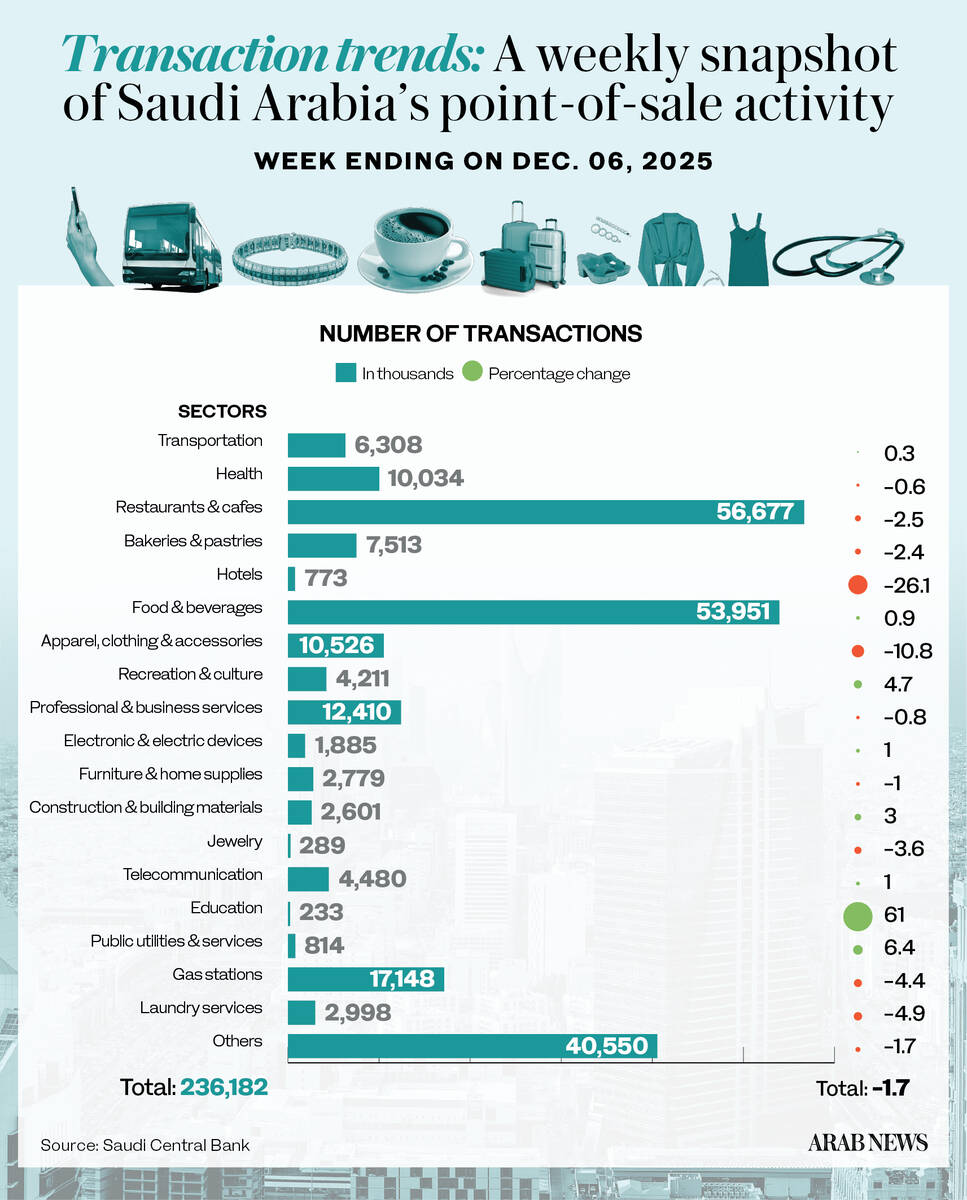
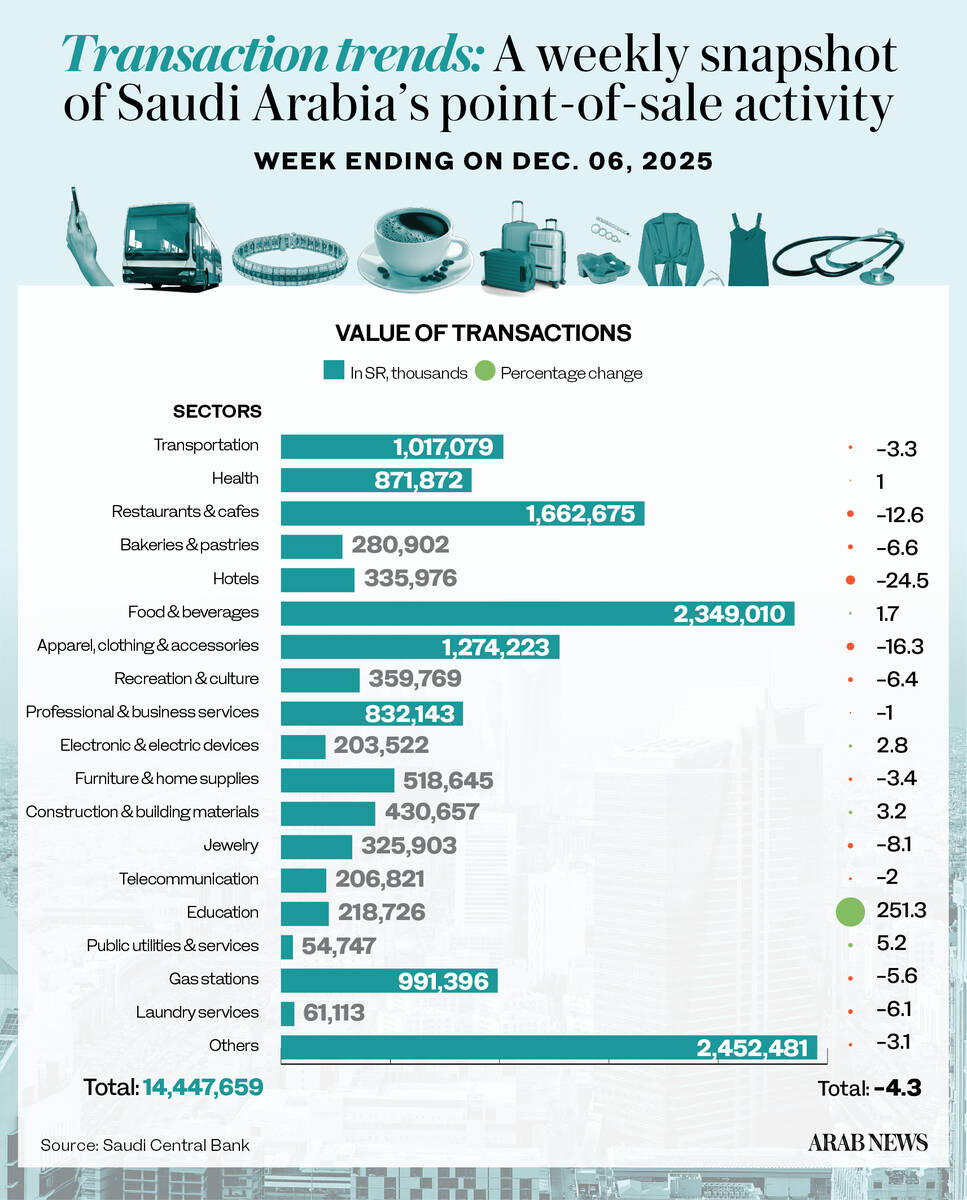
RIYADH: Education spending in Saudi Arabia surged 251.3 percent in the week ending Dec. 6, reflecting the sharp uptick in purchases as students returned from the autumn break.
According to the latest data from the Saudi Central Bank, expenditure in the sector reached SR218.73 million ($58.2 million), with the number of transactions increasing by 61 percent to 233,000.
Despite this surge, overall point-of-sale spending fell 4.3 percent to SR14.45 billion, while the number of transactions dipped 1.7 percent to 236.18 million week on week.
The week saw mixed changes between the sectors. Spending on freight transport, postal and courier services saw the second-biggest uptick at 33.3 percent to SR60.93 million, followed by medical services, which saw an 8.1 percent increase to SR505.35 million.
Expenditure on apparel and clothing saw a decrease of 16.3 percent, followed by a 2 percent reduction in spending on telecommunication.
Jewelry outlays witnessed an 8.1 percent decline to reach SR325.90 million. Data revealed decreases across many other sectors, led by hotels, which saw the largest dip at 24.5 percent to reach SR335.98 million.
Spending on car rentals in the Kingdom fell by 12.6 percent, while airlines saw a 3.7 percent increase to SR46.28 million.
Expenditure on food and beverages saw a 1.7 percent increase to SR2.35 billion, claiming the largest share of the POS. Restaurants and cafes retained the second position despite a 12.6 percent dip to SR1.66 billion.
Saudi Arabia’s key urban centers mirrored the national decline. Riyadh, which accounted for the largest share of total POS spending, saw a 3.9 percent dip to SR4.89 billion, down from SR5.08 billion the previous week.
The number of transactions in the capital settled at 74.16 million, down 1.4 percent week on week.
In Jeddah, transaction values decreased by 5.9 percent to SR1.91 billion, while Dammam reported a 0.8 percent surge to SR713.71 million.
POS data, tracked weekly by SAMA, provides an indicator of consumer spending trends and the ongoing growth of digital payments in Saudi Arabia.
The data also highlights the expanding reach of POS infrastructure, extending beyond major retail hubs to smaller cities and service sectors, supporting broader digital inclusion initiatives.
The growth of digital payment technologies aligns with the Kingdom’s Vision 2030 objectives, promoting electronic transactions and contributing to the nation’s broader digital economy.