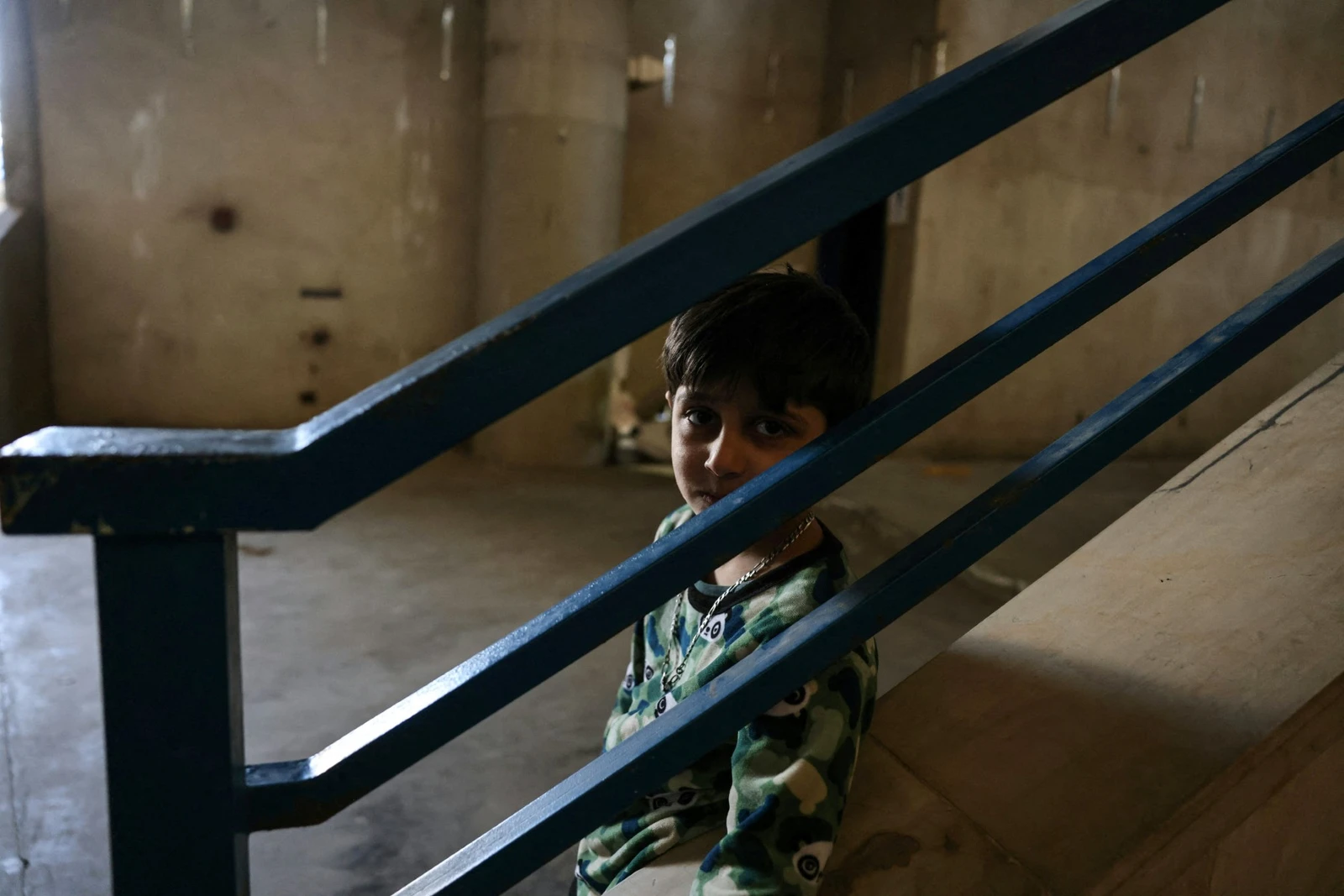
BEIRUT: Nine-year-old Abbas Sadraha sits at a discarded school desk in the corridor of Ras Al-Nabaa Public School in Beirut and sighs.
“I wish I could go back to school,” he says.
He is already in a school building — but not as a pupil. He is one of thousands of children displaced from their homes in southern Lebanon who have been living with their families in public schools converted into temporary shelters.
His family fled their home in Arnoun Al-Shaqif, near the city of Nabatieh, on March 3 when Hezbollah fired six rockets and Israel responded with heavy strikes on villages in the south. Their displacement took them first toward Beirut’s southern suburbs and later to a Lebanese University facility in the capital.
After the ceasefire agreement in June, and with only four families still living at the facility, electricity and water supplies were cut, forcing Abbas and his family to leave and once again search for somewhere to shelter.
His mother, Daad, said keeping her two children in education was now her priority.
“Our home in Arnoun Al-Shaqif was bulldozed by the Israelis,” she said. “I don’t want my children to lose a year of education on top of everything they have already suffered because of the war.”
She said she might now be forced to risk returning with them to Nabatieh so they are close to their old school.
The children completed the previous academic year through online learning, with Daad paying for the internet connection herself. “I can’t afford that anymore,” she said.
Her husband works as a painter but has been unable to find employment in Beirut.
“He doesn’t know anyone here,” Daad said. “He feels like a stranger and is depressed. He spends his days sleeping and cursing the circumstances that left us homeless.”
The family of four currently occupies a corner of a classroom divided by curtains into a makeshift living space shared by three families and their belongings. Families in classrooms on each floor share a single bathroom and a refrigerator placed in the corridor.
“There is no taste to food anymore and no comfort in sleep,” Daad said. “We are people of the south. Our homes used to be full of supplies and we would help anyone in need. Today, we cannot find anyone to stand by us.”
She said her family was affiliated with neither Hezbollah nor the Amal Movement.
“We feel abandoned,” she added. “Nobody asks about us. We borrow $10 just to survive below even the minimum.”
The fragile ceasefire agreement in June prompted thousands of displaced people to leave the tents and shelters in which they were living in places such as Sidon, Beirut, Mount Lebanon, Tripoli and Akkar. Those whose homes remained intact were able to return but about 350,000 people are still displaced, according to reports, including residents of villages on the front lines of the fighting between Israel and Hezbollah that were destroyed, and communities that continue to face Israeli strikes, incursions or gunfire.
About 21,000 displaced people continue to live in public schools the Lebanese state converted into shelters seven months ago.
With the new academic year due to start this month, the Ministry of Education is trying to balance the requirements of displaced families with the need to return classrooms to pupils. Families in several shelters have started to pack their belongings for yet another move as authorities consolidate the remaining displaced population into a smaller number of designated centers.
Layal Al-Fata, the director of a public school in Beirut, told Arab News that the number of displaced families living at her school had fallen from 77 to 22. Those who remain will be transferred to another nearby school designated as a shelter, she said, allowing other schools that have been used as shelters to be repaired and prepared for the return of students.
But clearing classrooms is only one of the challenges the ministry faces. It must also find ways to educate students from the 340 schools that have been damaged to varying degrees during the war, and arrange alternatives for children whose schools are still inaccessible or located near villages that continue to be affected by tensions arising from the conflict.
Open-source reports suggest that more than 100 schools were destroyed or severely damaged. For many low-income, displaced families, public schools provided the cheapest — and in some cases only — option for shelter.
Wissam Atwi, who was displaced with his daughters and mother from the southern town of Shaqra, said the family spent nine days sleeping on the roadside before finding shelter in a Beirut school.
“We don’t know anyone in Beirut who could take us in,” he said.
Atwi was visiting public schools in an attempt to register his daughters for the coming academic year. Having exhausted his savings, he said he could no longer afford their education, even within the public system.
He was also struggling to keep another daughter enrolled in an engineering program at the Lebanese University, despite its relatively low fees.
“No one is helping me. No one has called me,” Atwi said. “I am not affiliated with Hezbollah or Amal. I am Shiite and my own community is not checking on me. That is the truth. We have been abandoned.”
Atwi said that when his home in Shaqra was damaged during a previous conflict, he paid for the repairs himself but received compensation for only about 15 percent of the cost.
“This time, no one has even said they are prepared to compensate us — or help us stay alive,” he added
At Al-Basta Public School in Beirut, the silence in the classrooms is broken by young children playing in the schoolyard as their families pack for another relocation. Women move between classrooms and the courtyard carrying bags of belongings and household items, uncertain where they will go next.
Rima Karami, the minister of education and higher education, acknowledged that the start of the academic year was likely to be challenging.
“The launch of the new school year may not be complete and it will be difficult, but we will be able to restore regularity and return our children to their classrooms,” she said.
The ministry was faced with needs that far exceed the available funding, she added, describing the ability of Lebanon’s education system to continue to function at all under current conditions as “almost a miracle.”
Karami said: “There are teachers who have already taught and whom we have still not been able to pay. I do not want to make commitments to any teacher before I am able to pay their salary and give them their rights.”
She also warned that there could be delays in securing all necessary educational materials.
“There is no education professional anywhere in the world doing what educators in Lebanon are doing under these circumstances,” Karami said.
She praised Education Ministry staff and regional education officials in southern Lebanon and Nabatieh, and said their work demonstrated extraordinary commitment despite the difficulties.
The ministry decided to merge some struggling public schools and secondary schools as part of a broader reform plan designed to reduce expenditure and waste while improving the allocation of human and financial resources.
These measures are in line with Finance Ministry requirements, and recommendations from donors and the World Bank, amid concerns that the cost of public education in some cases had risen above that of the private sector.
But the effects of years of crisis, displacement and conflict are already clear among the children of Lebanon. An assessment by the Arab Center for Research and Policy Studies warned of a “lost generation” whose education had been severely disrupted.
Its report found that reading and writing levels among some sixth-grade pupils was equivalent to only about 4.5 years of schooling. More than half of first-grade pupils lacked basic math skills, and eight out of 10 sixth-grade students had not mastered division.
It also found that more than half of displaced children were not enrolled in primary education and 60 percent of displaced adolescents were not attending high school. Seven in 10 children showed symptoms associated with anxiety, and six in 10 displayed symptoms linked to depression.
Children have borne a particularly heavy burden as a result of the conflict. During the first month of the latest escalation alone about 400,000 children were among about 1 million people forced from their homes and places that once offered them their greatest sense of security.
With the school year about to begin in Lebanon, where will displaced families go?