LONDON: Renewed fighting in Syria’s southern Sweida province has underscored how fragile the country’s post-Assad political settlement remains and how far Damascus still has to go to establish its authority over the Druze heartland.
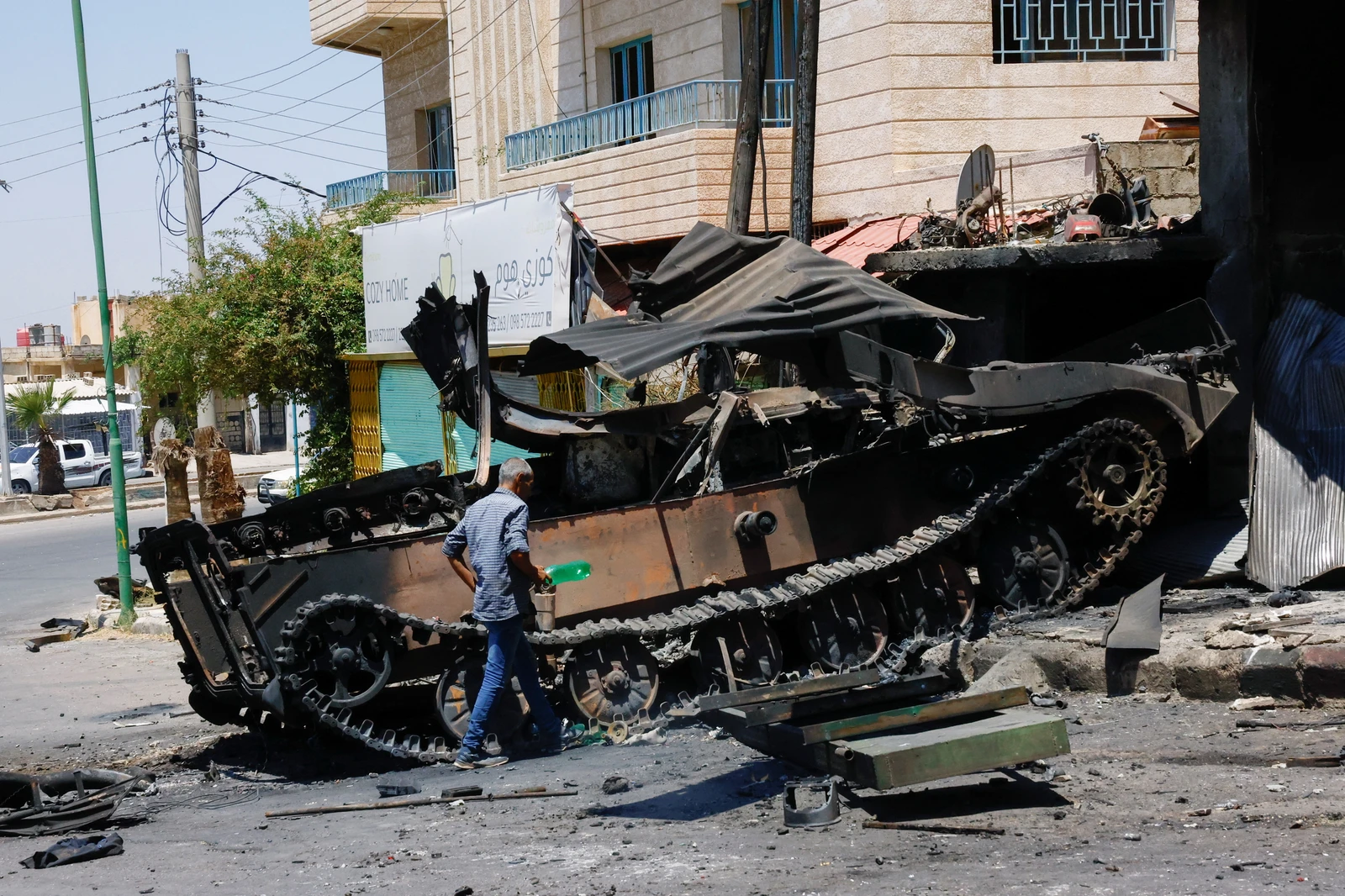
At least 10 members of Syria’s Internal Security Forces were wounded on Monday during clashes with local armed groups in the western countryside of Sweida, according to Syrian state media. The fighting followed the deaths of two civilians in clashes west of Sweida city.
The violence is the latest manifestation of a conflict that has simmered since the fall of Bashar Assad in December 2024. Sweida city and much of the surrounding province remain outside the full control of Syria’s new authorities.
Among the most powerful forces operating there is the so-called National Guard, a Druze-dominated armed group affiliated with Sheikh Hikmat Al-Hijri, one of the community’s most influential religious leaders.
The confrontation goes to the heart of one of the most difficult questions facing Syria’s new government: How can Damascus build a unified state when communities that have spent years protecting themselves remain unwilling to surrender their weapons and accept central authority?
“During the later years of the Assad regime, the Druze enjoyed some degree of autonomy,” Arman Mahmoudian, a research fellow at the University of South Florida’s Global and National Security Institute, told Arab News.
“They had local Druze militias that were responsible for much of their own security, operated checkpoints, and exercised a certain level of control over the area.”
That arrangement meant the new government did not inherit a province under full central control when Assad fell.
“There was essentially an unspoken social contract between the Assad regime and these militias,” Mahmoudian said. “So, by the time Ahmad Al-Sharaa and his government came to power, there was already an established degree of semiautonomy in Sweida.”
For the Druze, giving up that autonomy has proved difficult. For Damascus, tolerating armed groups outside the state’s command structure is equally problematic. The result has been a prolonged standoff.
The roots of the confrontation stretch back well before the creation of the National Guard. Sweida is the heartland of Syria’s Druze minority, a small, close-knit religious community whose members also live in significant numbers in Lebanon and Israel.
The province has historically enjoyed a degree of local autonomy, while its armed factions have often acted as the primary guarantors of security. After Assad’s fall, fears over security and representation quickly resurfaced.
Sectarian violence that erupted around Damascus in April and May 2025 spread south to Sweida, killing more than 100 people. The crisis escalated dramatically in July, when fighting between Druze and Bedouin groups drew in Syrian government forces and allied tribal fighters.
At least 1,700 people were killed and tens of thousands displaced during the violence, according to the UN, nongovernmental organizations and local accounts.
For many Druze in Sweida, the July bloodshed confirmed their fears that surrendering their weapons could leave them vulnerable.
“The issue is trust,” Mahmoudian said. “Druze minorities across the Middle East have historically been targeted by radical Islamist militias.
“Many of them worry that if they surrender and hand over their weapons, which remain their primary means of self-defense, they could once again become vulnerable to attacks.”
That distrust has made integration into the Syrian state considerably harder. The July 2025 violence also fundamentally altered the balance of power inside Sweida. In the aftermath of the fighting, Druze armed factions reorganized themselves.
The National Guard was formally established in August 2025 under the de facto leadership of Al-Hijri, bringing together the majority of the province’s armed groups under a common structure.
It divided Sweida into military sectors, established an internal security apparatus and took responsibility for the front lines facing government-held territory.
The force is presented by Al-Hijri’s camp as a defender of Sweida and its civilian population. In practice, it has also become a parallel security structure, exercising considerable control over movement and daily life in parts of the province.
Tensions within the community have also surfaced in recent weeks after Druze students in Sweida were initially prevented from traveling to government-held areas to sit their exams. The local administration later allowed them to leave the province to take the examinations.
Syrian journalist Ghassan Ibrahim, editor-in-chief of the Global Arab Network, accused Al-Hijri’s forces of deliberately escalating tensions.
“Militias of the ‘National Guard’ affiliated with Hisham Al-Hijri continue their escalation in Sweida, targeting sites of the Internal Security Forces with heavy machine guns on the western axes,” Ibrahim wrote in a message posted on social media site X.
He accused Al-Hijri’s media operation of seeking to “twist the facts and manufacture a new victimhood narrative” and said the leader was attempting to regain popular support after losing some of his previous standing.
The accusation reflects the view of Damascus that the National Guard is not a legitimate local security force but an armed challenge to the authority of the state.
In the eyes of Al-Hijri’s supporters, however, the group is a necessary shield against a government they do not trust. That fundamental disagreement has left the two sides trapped in a cycle of confrontation.
“I believe what the latest round of violence reveals, first and foremost, is that the ceasefire reached in July 2025 did not resolve the conflict; it merely froze it,” Mahmoudian said.
The dispute is not simply over security. At its core is a fundamental disagreement about Sweida’s political future.
Damascus wants the province brought under the authority of the central government. Al-Hijri has increasingly advocated some form of self-rule, while at various points raising the possibility of an independent Druze entity or a protected arrangement outside direct Syrian sovereignty.
His rhetoric has become increasingly explicit. In August, Al-Hijri described Syria’s Druze as an “integral part of the State of Israel,” praised Israel’s state-building model, and referred to religious and ideological common ground.
The remarks represented a striking escalation in his public positioning. They also highlighted the increasingly important role Israel has played in the Sweida crisis.
Israel intervened militarily during the July 2025 violence, launching airstrikes against Syrian government forces and saying it was acting to protect the Druze and prevent hostile forces from approaching its border.
For Al-Hijri’s camp, Israel’s intervention reinforced the argument that an external power could provide the security guarantees Damascus has failed to offer. For Damascus, the relationship is profoundly threatening.
Mahmoudian said Israel’s involvement reflects two overlapping interests, the first of which is the protection of its own Druze population.
Israel has a significant Druze community whose members are deeply integrated into Israeli society, including the military and other state institutions. That has created a domestic political interest in the fate of Druze communities elsewhere, particularly in neighboring Syria.
The second is Israel’s broader security strategy.
“Since the Oct. 7, 2023, attack, we have seen a persistent Israeli policy of trying to establish buffer zones between itself and territories that it perceives as potential security threats,” Mahmoudian said. “A similar pattern appears to be emerging in Syria.”
Israel, he argued, is interested in preventing the militarization of southern Syria, particularly close to the Golan Heights.
“As long as Sweida maintains a degree of autonomy and Damascus does not establish a significant military presence there, Israel may view the presence of Druze militias as a form of de facto buffer between Israeli-controlled territory and Syrian government forces.”
Al-Hijri’s increasingly warm language toward Israel is controversial even within the broader Druze community. His comments have been interpreted by critics as evidence of a political project that goes beyond protecting Sweida and toward a redefinition of its relationship with Syria.
Al-Hijri has spoken of creating an independent “State of Bashan” — a historical name for the region — and has suggested that its future could involve independence, protected status or association with another country.
His public statements about Israel have further raised questions over whether his camp ultimately seeks autonomy within Syria or a much more fundamental break.
That creates a dilemma for Damascus. Trying to impose central authority by force risks reigniting sectarian bloodshed. But allowing an autonomous armed enclave to persist risks undermining the government’s claim to sovereignty.
For now, Mahmoudian does not believe Sweida itself poses a direct threat to Syria’s territorial integrity. The wider picture, he argues, is actually somewhat more encouraging, particularly after the Kurdish-led Syrian Democratic Forces agreed to integrate into the Syrian state.
But Sweida could still have a broader impact.
“One issue is that it could set a precedent for autonomy and signal to other minorities that feel threatened, such as the Alawites and Christians, that if they remain persistent and find a foreign guarantor, they may be able to secure privileges similar to those enjoyed by the Druze,” Mahmoudian said.
That could generate new demands for autonomy or contribute to instability elsewhere. The greater danger, however, is the internationalization of the conflict.
“If the conflict escalates and the new Syrian government adopts a much more aggressive approach toward the Druze in Sweida, resulting in a full-scale armed confrontation between Damascus and local Druze forces, Israel could become directly involved,” Mahmoudian added.
“If Israel chooses to become more directly involved, this could lead to the outbreak of a broader conflict between Israel and Syria.”
That is what makes Sweida so disproportionately important to Syria’s future.
Why Syria’s Sweida remains a flashpoint for Damascus and the Druze