LONDON: In the months leading up to the Hamas-led attack on Israel in October 2023, Israeli soldiers stationed at surveillance posts close to the Gaza border repeatedly warned their superiors that militants on the other side of the fence were preparing for something major.
It was the job of the tatzpitaniyot, the all-female lookouts of the Israel Defense Forces, known as “the eyes of the army,” to operate and monitor the sensors and security cameras installed along the 65-km-long high-tech “Iron Wall” around Gaza.
Throughout September, they watched as militants stepped up training, flying drones against a mock-up of IDF towers armed with remote-controlled machine guns, rehearsing attacks on armored vehicles and even digging holes in which to plant explosives along the fence.
All this they reported to their superiors, but their warnings were reportedly ignored.
The attack they feared was coming began at 6:31 a.m. on Oct. 7, 2023. The Nahal Oz observation post was quickly overrun, and many of the tatzpitaniyot based there were among the first to die.
The Hamas-led attack, in which 1,200 Israelis were killed and more than 240 taken hostage, appeared to take Israel’s military and intelligence apparatus by surprise.
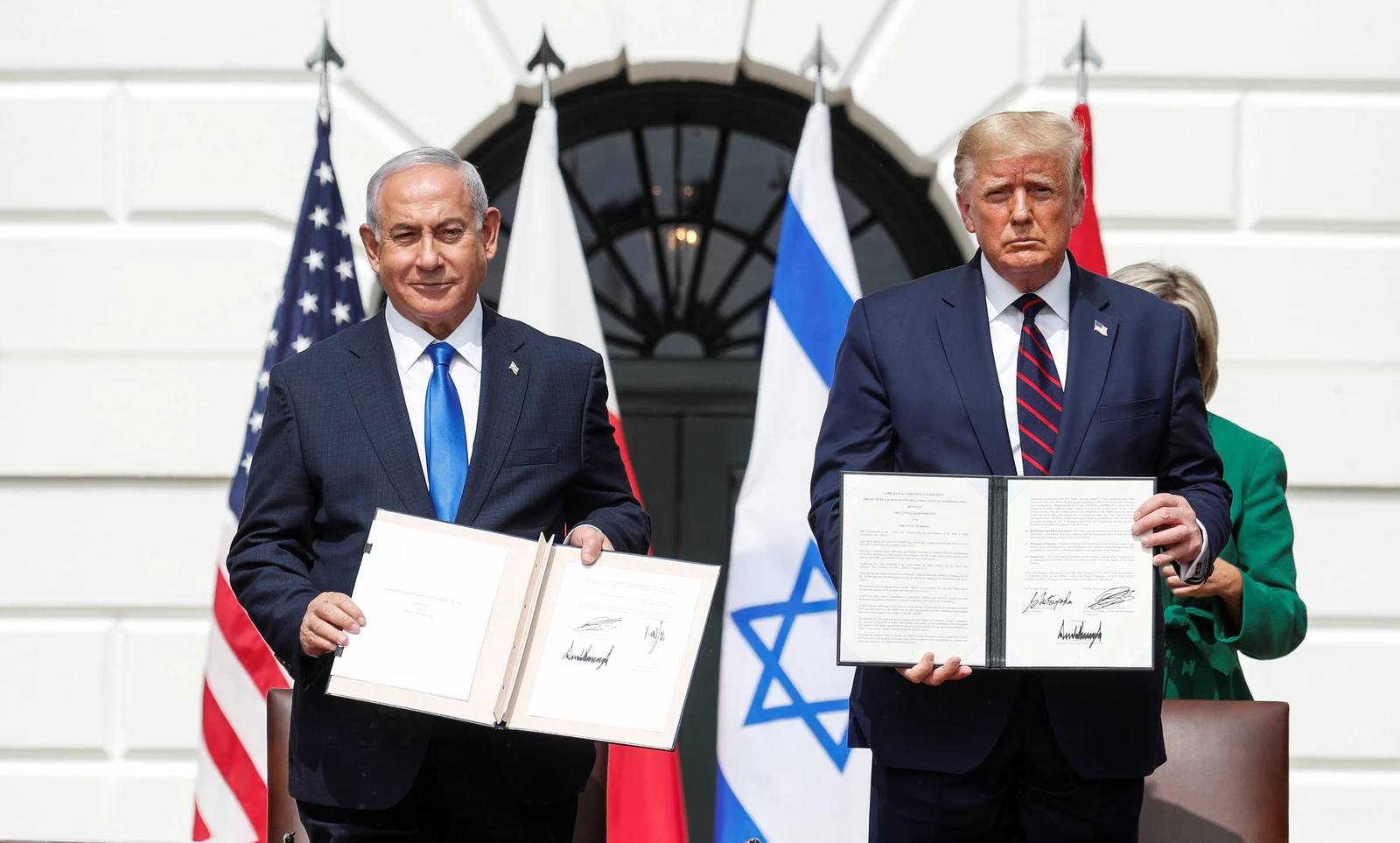
As recriminations flew in the wake of the massacre, Prime Minister Benjamin Netanyahu was quick to reject responsibility for the perceived failure.
His many accusers included former Israeli Prime Minister Ehud Olmert, who laid the blame for the security disaster on Netanyahu’s courtship of Hamas — part of his policy designed to undermine the Palestinian Authority and frustrate the possibility of a two-state solution.
Thanks to that, Olmert told Politico in November 2023: “We all thought we could flirt with Hamas, that they would behave according to our expectations of them. And it all blew up in our faces.”
In an interview with CNN some weeks after the attack, Netanyahu declined to accept responsibility. There would be time for such questions, he said, when the war was over.
Almost three years on, the war is still not over and Netanyahu, facing Israel’s first elections since the attack and with his vote-winning reputation as “Mr. Security” wearing thin, is still not taking responsibility.
Now, as polls show the prime minister’s coalition of right-wing parties losing ground to Gadi Eisenkot’s centrist Yashar party, Netanyahu appears to be doubling down on making the blame game over Oct. 7 the defining issue of the election — with anyone but him in the dock.
In remarks on Tuesday, Netanyahu claimed that senior IDF and security officials had deliberately failed to wake him on the morning of the Hamas attack.
Had he been alerted, he said on Instagram, he would have canceled the Nova music festival, at which hundreds of Israelis were killed or abducted, and “woken up all the communities, woken up all the security coordinators and told the air force to be ready to strike and kill anyone approaching the fence.”
Only later, facing a backlash, did he back away from the implication that he — and, by inference, Israel — had been betrayed.
In a further sign that Netanyahu fears that Israel’s Oct. 27 election will be a referendum on his handling of Oct. 7, his wife Sara voiced a conspiracy theory during an appearance on Israel’s Channel 14 TV station.
She claimed that opposition politician Yair Golan, leader of the Democrats and a former major-general in the IDF, had been aware of the Hamas plans ahead of the attack.
Golan, who on the day of the attack had rushed to the scene of the Nova festival massacre and personally saved the lives of half a dozen people, was an unlikely target for such a slur.
Sara Netanyahu’s attack, Golan posted on X, was “a false conspiracy in an attempt to rewrite Oct. 7, turning those who went out to save lives into traitors and those who abandoned Israel’s security into victims.”
Speaking on Wednesday on an Israeli podcast, Golan went further.
“I simply see what’s happening on the networks, what elements within the Likud, within the coalition, have been saying about me since Oct. 7,” he said. “This is not some slip of the tongue; it’s a planned move.”
Netanyahu’s real intention, he added, “is to dismantle the norms of Israeli society. It is to dismantle the values of Israeli society. It is to turn good into evil, to turn straight into crooked, to turn the proper and the moral into corrupt.”
Eisenkot, likely Netanyahu’s No. 1 rival in the upcoming elections, accused Sara Netanyahu of a “mad conspiracy of betrayal.”
The strategy may be working. A poll carried out for Israeli TV’s Channel 13 last month found that 63 percent of supporters of Netanyahu’s coalition believe that some form of treason lay behind the success of the Hamas attack — a belief shared by 40 percent of all Israelis.
“For Netanyahu, losing the forthcoming election would be a disaster,” Ahron Bregman, a former major in the IDF, political scientist and senior teaching fellow at the Department of War Studies at King’s College London, told Arab News.
“His corruption trial is not going well, and he could end up in jail. A new government will appoint a national inquiry into Oct. 7, in which he’s likely to be criticized for the debacle and he is a wanted war criminal, who can hardly travel the world.”
The attack on Iran, which Netanyahu and US President Donald Trump launched on Feb. 28, also “did not go well,” he said, having failed in its objectives and triggered regional and global repercussions.
“He must, as he sees it, stay in power, and the best way to do so is to have war, or to emphasize the external threat. Netanyahu is more dangerous than before. For him it is all about personal survival, and war, so he believes, could save him.”
A survey carried out in July for the Israel Democracy Institute found that 72 percent of Israelis think Israel should maintain a permanent security zone in south Lebanon, while confidence in President Trump’s concern for the country’s security fell from 44 to 28 percent in one month.
The poll also found that Israelis were almost equally divided between those who believed Israel’s security situation had improved since the start of Operation Roaring Lion in February (38 percent) and those who thought it had worsened (36 percent).
Israeli society appears to be in the grip of what one former Knesset MP has described as “besieged citadel syndrome.”
“War has become an end in itself,” Ofer Shelah, an analyst at the Institute for National Security Studies at Tel Aviv University, told “Le Monde” recently. “Israelis believe that these wars cannot bring better results, yet they still want to continue them.”
He added: “They are not bloodthirsty, they are desperate. They feel there is no other way out. For them, the military remains a safe haven.”
Bregman said Israelis have felt “besieged” before, but this time is different.
“In the post-Oct. 7 era, most Israelis look at the world through rifle sights, and Netanyahu tries to take advantage of it, hoping Israelis will trust him even after the disasters — Gaza, Iran — he has inflicted on them, and vote for him,” he told Arab News.
Oct. 7, he believes, “changed Netanyahu. Until then he was careful with the use of military force. Now, he’s reckless and not because he believes that force could solve anything, but instead to keep him in power.”
The problem, he added, “is that the endless talk of war, and identifying enemies behind every tree, real or imaginary, is likely to normalize the state of war, making it a permanent reality.”
The “old Israel,” he said, “used to hold a rifle in one hand, and stretch out the other hand, or at least pretend to do so, in a gesture of peace. They don’t bother doing it any more.”
Apart from the sheer cost of prolonged war, Israel itself is paying a steep price, according to Shira Efron, Israel policy chair and a senior fellow at RAND, a US policy think tank.
“Israel’s international isolation is deepening fast — a fact showing up in polls, social media, widening boycotts and the way a new generation around the world has come to instinctively view Israel mainly as part of a story about occupation and Palestinian suffering,” she wrote in a recent RAND analysis.
The upcoming elections, she added, offered the clearest opportunity for change.
“A new governing coalition could signal that Israel intends to answer its global critics by curbing settler violence, halting de facto annexation of West Bank land, facilitating a plan to reconstruct Gaza, restoring workable ties with Palestinian institutions and re-establishing predictable, democratic governance.
“That combination of assuring Israelis at home while offering concrete gestures abroad is the only realistic path to halt the drift into deep isolation, a dangerous state from which Israel will find it extraordinarily difficult to recover.”
Why Netanyahu is making Oct. 7 responsibility an issue in Israel’s election