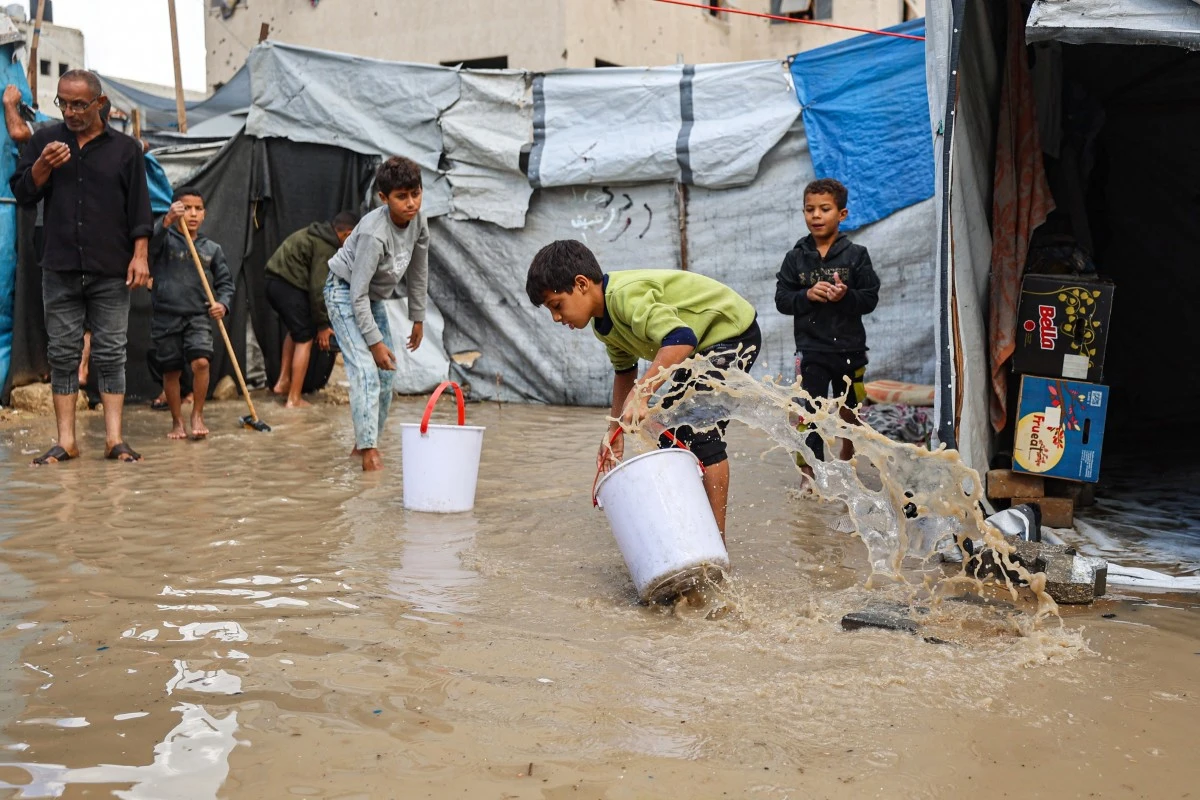
- First winter storm floods 70,000 tents in 12 hours, Gaza authorities say
- Civil Defense says it cannot cope without fuel, pumps and spare parts
DUBAI: Asmaa Odeh did not sleep on Saturday night. She stood inside her tent in a Gaza displacement camp holding a broom, pushing out the rainwater and sewage that kept coming in, while her five children’s clothes, mattresses and blankets soaked through.
“Our tent flooded. The water came in, and the sewage and the well overflowed onto us,” she told Arab News. “We couldn’t do anything. All we could do was hold a broom and push the water and sewage out, so we wouldn’t drown.”
Odeh’s husband was killed in the war, and she now provides for their five children alone. When the storm passed, nothing dry was left. “My children’s clothes were all soaked,” she said. “My son had nothing to wear. He stayed like that the whole day.”
A night of 1,500 calls for help
Her family is one of tens of thousands caught in the first major storm of the winter. The Hamas-run Gaza government media office said at least 70,000 tents were flooded within 12 hours, injuring some people but causing no deaths, Reuters reported.
Mahmoud Basal, spokesperson for the Civil Defense in Gaza, described to Arab News “very difficult” hours in which residents lived through “a tragic and catastrophic reality.
“Civil Defense crews received more than 1,500 calls for help in a few hours,” he said. “The crews could not fully do their job, because they don’t have the capacity or the tools to deal with this storm.”
Pumps, fuel and spare parts
Basal said Israel had destroyed the pumps his teams use to drain water from flooded tents and shelters. He added that Israel still refuses to let in engine oil, batteries, tires and spare parts for Civil Defense vehicles. “This will certainly affect the service we provide to citizens,” he said.
Municipal officials also said fuel shortages and damaged equipment had left them unable to cope with the storm, and that Israel had destroyed hundreds of vehicles during the war, including bulldozers and vehicles used to pump water, Reuters reported. Hamas blamed Israel for blocking shelters and construction materials, according to Reuters.
Israel rejects accusations that it is restricting aid. COGAT, the Israeli Defense Ministry body that oversees aid to Gaza, said in April that more than 650,000 tents and tarpaulins and 6,500 trucks of winter supplies had entered since the ceasefire. “There is no limit to the amount of aid that can enter Gaza,” it said at the time.
The US-brokered ceasefire last year called for Gaza to eventually be rebuilt, but little progress has been made, Reuters reported. The war displaced most of the territory’s more than 2 million residents and left much of it in ruins.
Fears for the winter ahead
For Basal, the greater worry is the season still to come. “The bigger disaster is what lies ahead,” he said. “What if stronger, harsher storms hit? How will Civil Defense teams cope? If things stay as they are, we are facing a real disaster, for the population and for the service system inside Gaza.”
He urged the international community to provide fuel, oil, batteries, tires, spare parts and humanitarian equipment so crews can “do their role fully. Otherwise, the disaster will be harder and more severe,” he said.
For Odeh, this is the second winter in a tent, and she fears the wind as much as the rain. “God knows what we will do when the storms and the wind come,” she said. “The tent could tear open, and I won’t know what to do.”
A message to the world
She asks for proper tents, tarps and to be seen. “Our message to the world is to come and see our camp,” she said. “No one asks about us, and no one comes looking for us.”
Then she widened the circle. “It is not just us. Everyone suffered in this war. Everyone lost their homes.”