ISTANBUL. Turkey: Turkish President Tayyip Erdogan said Russia must be held accountable for the people it has killed in Syria, saying Moscow and Damascus were together responsible for 400,000 deaths there, Dogan News Agency reported on Friday.
Speaking at a joint press conference with his Senegalese counterpart while on a state visit to the West African country, Erdogan also said Russia was engaged in an invasion of Syria and accused it of trying to set up a “boutique state” for its longtime ally President Bashar al Assad.
“Russia must be held accountable for the people it has killed within Syria’s borders,” Dogan quoted him as saying. “By cooperating with the regime, the number of people they have killed has reached 400,000.”
NATO's secretary general said that Russian airstrikes in Syria that mainly target opposition forces are "undermining efforts to find a political solution to the conflict."
Jens Stoltenberg says that increased Russian air force activity in Syria also is leading to increased violations of Turkish airspace.
Stoltenberg said Friday that "this creates risks, heightened tensions and is of course a challenge for NATO because they're violations of NATO's airspace."
He was speaking on the sidelines of an informal meeting of European Union defense ministers in Amsterdam.
A Turkish fighter jet downed a Russian bomber at the border with Syria on Nov. 24, the first time in more than half a century that a NATO member had shot down a Russian plane.
Turkey said another Russian warplane violated its airspace a week ago, and Turkish President Erdogan warned Moscow that it would be forced to "endure the consequences" if its jets continue to violate Turkish airspace.
'Let them in"
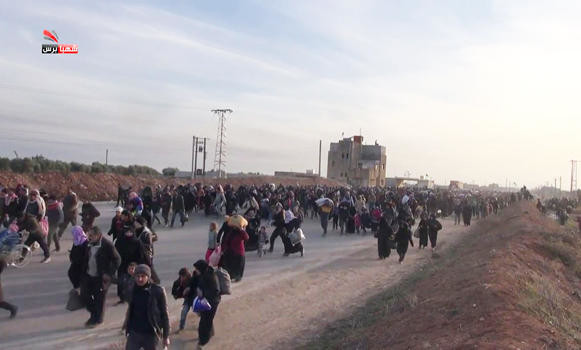
Turkey's Prime Minister Ahmet Davutoglu said some 15,000 Syrians fleeing Syrian and Russian bombings of Aleppo, Syria's largest city, have reached Turkey's borders, adding that tens of thousands more could also be on the way.
In a televised speech Friday, Davutoglu promised that Turkey would not leave the displaced "without food or shelter" but did not say whether the country intended to let them in.
The border gate between Syria and Turkey was closed on Friday and no refugee has been admitted, prompting the human rights advocacy group Amnesty International to call on Turkey to allow those who have massed at the border to cross in.
Amnesty's Global Issues Director Sherif Elsayed-Ali says Turkey "must not close its doors to people in desperate need of safety."
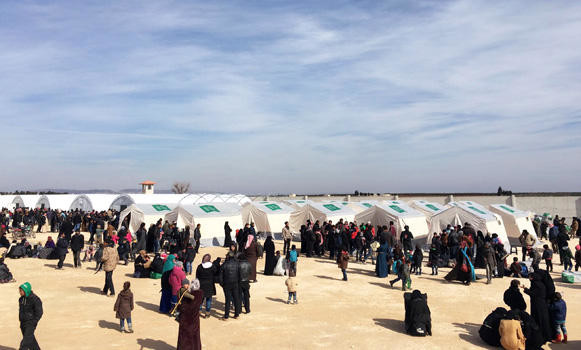
A Turkish charity said 50,000 people fleeing intense fighting in northern Syria have arrived at a Syrian-Turkish border crossing.
Serkan Nergis of the Islamic charity IHH says displaced Syrians began streaming toward the Bab al-Salam border crossing Thursday.
Nergis said Friday that the group is setting up tent camps in Syria near the crossing to provide temporary shelter. The charity runs about 10 camps for displaced Syrians along the frontier.
Earlier this week, Syrian troops backed by allied militias and intense Russian air strikes launched an offensive in northern Syria. It appears aimed at eventually encircling the contested city of Aleppo, Syria's largest.
Iranian troops
Iran's supreme leader, meanwhile, said Iranian forces must fight the Daesh group in Syria and Iraq to prevent the militant organization spreading to Iran.
Ayatollah Ali Khamenei's comments, which were reported by Tasnim news agency Friday, closely followed the announced death of a senior Iranian Revolutionary Guard commander in Syria.
Iranian officials have said that Iranians have an "obligation" to protect Syrian Shiite shrines.
Iran, a longtime ally of Assad, acknowledges that Iranian officers are providing an advisory role in Syria, but denies sending combat troops.
Several Iranian troops, including high-ranking officers, have been killed in Syria. On Saturday Iran will hold a funeral for Gen. Mohsen Ghajarian, a senior commander killed in recent fighting.


![]()
![]()
![]()
Erdogan: Russia must be held accountable for Syria killings

Erdogan: Russia must be held accountable for Syria killings
Latest updates




© 2026 SAUDI RESEARCH & PUBLISHING COMPANY, All Rights Reserved And subject to Terms of Use Agreement.