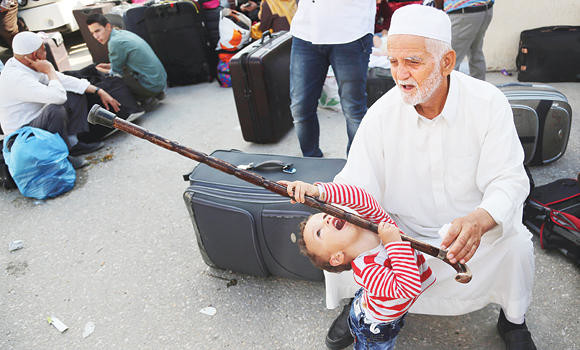
Egypt opens Rafah crossing into Gaza

Updated 13 June 2015
Follow

Egypt opens Rafah crossing into Gaza

GAZA: Egypt opened the Rafah border crossing on Saturday to allow Palestinians to travel in and out of the Gaza Strip for the first time in three months, in a possible sign of easing tension between Cairo and Gaza’s dominant Hamas movement.
Gaza, a small impoverished coastal enclave, is under blockade by neighboring Israel, and Egypt has kept its Rafah crossing largely shut since Cairo’s president was toppled by the army in 2013.
A Palestinian official said seven trucks with building materials for the private sector entered Gaza on Saturday, the first time since 2007 that Egypt has allowed a commercial shipment via Rafah, which is mainly for passengers and humanitarian aid.
Two weeks ago, Egypt reopened Rafah for three days but only in one direction — for Palestinians stranded outside Gaza to return home. But Saturday’s move, allowing travel in both directions, might signal a cautious improvement in relations between Cairo and Hamas after two years of high tension.
Local residents said an initial bus with passengers had crossed into Egypt and a source at Cairo airport said Palestinians were flying in to set out overland for Gaza.
Border officials said the new opening would last for three days and some Palestinian sources said it could be extended, although there was no immediate Egyptian confirmation about any possible extension.


Drone strike at Sudan’s Ethiopia border kills one

Updated 4 sec ago
Follow

Drone strike at Sudan’s Ethiopia border kills one

  • Attack in army-controlled Kurmuk in Blue Nile state also injures 8 and destroys 16 homes
  • Meanwhile, UN confirms a drone strike on a displacement camp in Kordofan killed at least 15 children on Monday
KHARTOUM: A drone attack blamed on paramilitary forces killed one person Thursday in the Sudanese town of Kurmuk, on the border with Ethiopia, authorities said.
“One person was killed, eight injured and 16 houses destroyed,” a government source told AFP by phone from Kurmuk, a border town controlled by the army in Sudan’s Blue Nile state.
In a statement, Kurmuk governor Abdelaty Mohamed Al-Fiky blamed the strike on the paramilitary Rapid Support Forces (RSF), at war with the army since April 2023, and their allies, a faction of the Sudan People’s Liberation Movement-North (SPLM-N).
Blue Nile state is the latest front in nearly three years of devastating war, now being fought mainly with deadly drone strikes.
The fighting has left tens of thousands dead and around 11 million displaced, creating the world’s largest hunger and displacement crises.
In February of last year, the RSF announced a surprise alliance with the SPLM-N faction led by Abdelaziz Al-Hilu, securing access to experienced fighters, land and border areas.
The SPLM-N this month advanced on army positions in Blue Nile, where the faction controls southern areas bordering both Ethiopia and South Sudan.
Yabus, some 70 kilometers (43 miles) south of Kurmuk, is the SPLM-N’s local stronghold and birthplace of their deputy commander Joseph Tuka.
Their last known position earlier this month was 20 kilometers south of Kurmuk.
The same local official, who requested anonymity to speak to AFP, said a drone had struck a school in Kurmuk on Wednesday night, but did not cause casualties.
The war has effectively split the country in two, with the army holding the center, north and east of Sudan, while the RSF and its allies dominate the west and parts of the south.
The southern Kordofan region, where the SPLM-N has its other foothold in the Nuba Mountains, is currently the war’s fiercest battleground.
A drone strike on a displacement camp in that region killed at least 15 children earlier this week, the United Nations reported late on Wednesday.
"On Monday 16 February, at least 15 children were reportedly killed and 10 wounded after a drone strike on a displacement camp in Al Sunut, West Kordofan," the UN children's agency said.
"We are seeing the same disturbing patterns from Darfur – children killed, injured, displaced and cut off from the services they need to survive," UNICEF's Executive Director Catherine Russell said of the Kordofan violence.