- Ibrahim Olabi tells UN Security Council that Israel hit Abu Al-Duhur airbase 8 times, and incursions and ‘acts of aggression’ continue, including abductions, shelling and other violations
- Syria ‘at pivotal moment’ as millions of displaced people finally go home, UN deputy emergency relief coordinator says, but ‘return does not mean end of humanitarian need,’ he cautions
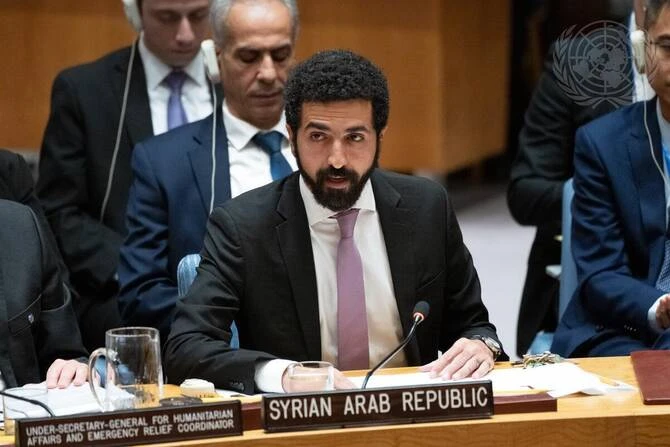
NEW YORK CITY: Israeli military strikes and incursions are pushing the region toward catastrophe, Syria’s permanent representative to the UN, Ibrahim Olabi, told the UN Security Council on Thursday.
“The entire region is standing at a threshold of a regional war that would spare no one,” he said, because of “the narrow electoral calculations of the Israeli prime minister.”
His remarks came as senior UN officials briefed the council on the humanitarian situation in Syria and the progress of its post-Assad political transition.
Israel has carried out eight airstrikes against Abu Al-Duhur airbase, continued its incursions into Syrian territory, and persisted in “acts of aggression, including abductions, shelling and violations” that “do not stop,” Olabi said.
He criticized “the irresponsible display” by the Israeli defense minister, Israel Katz, when he visited Israeli troops on the Syrian side of Mount Hermon this week and said they would remain there indefinitely, describing this as “blatant defiance of international legitimacy and the resolutions of this council.”
He said Syria was engaging seriously in US-sponsored diplomatic efforts aimed at reducing the escalation, but warned that “all international and regional efforts that have been made for months to achieve security and stability in the region are now threatened to be blown away by the delusions that exist only in the imagination of a reckless and extremist government.”
Israeli attacks “will not change our path,” Olabi added, or “Syria’s choice for stability,” which he said can only be achieved by Israel ending its attacks, halting its incursions, complying fully with the 1974 disengagement agreement, and withdrawing from territory it has occupied since Dec. 8, 2024.
Turning to the occupied Golan, Olabi cited Security Council Resolution 497, adopted in 1981, and quoting its finding that Israel’s “decision to impose its laws, jurisdiction and administration in the occupied Syrian Golan” was “null and void, and with no international legal effect.”
He noted that a General Assembly resolution this month reaffirming this principle drew support from 123 states, an increase from 97 previously.
Olabi set out a vision of what he framed as a turning point for Syria. He pointed in particular to three milestones this month. Firstly, the visit by UN Secretary-General Antonio Guterres to Damascus, which he said ended “an era of tension between the United Nations and Syria” in favor of “a new phase … whose title is partnership.”
Secondly, a visit by the UN High Commissioner for Refugees that marked what he called the end of “the era of displacement and refugees” and the start of an era of “return,” with more than 3 million Syrians already having returned home.
And thirdly, a visit by Rafael Grossi, director general of the International Atomic Energy Agency, which he said opened “a new phase of broader cooperation” after “the era of ambiguity.”
Olabi also welcomed the US decision this week to remove Syria from its list of state sponsors of terrorism after 47 years, and thanked President Donald Trump.
He cited warming ties with Russia, China and Pakistan, and highlighted the completed integration and dissolution of the Syrian Democratic Forces into the Syrian Arab Army as evidence of “a genuine process of national integration … based on equality among citizens and not sectarian quotas.”
He cited a string of economic signs of recovery in Syria: the resumption of international flights, to Germany; new electronic payment systems; preparations to exit the Financial Action Task Force’s “gray list” of nations with acknowledged weaknesses in their efforts to tackle money laundering and other financial crimes; and the reopening of the Damascus International Fair commercial exhibition.
To Syrians, “restoring a direct flight or opening a bank account … these are not minor details; rather, these are signs of the return of life itself,” Olabi said.
He also noted that courts had issued rulings against Syria’s former president, Bashar Assad, his brother Maher and other members of the former regime over crimes committed against Syrian citizens, and thanked Lebanon for extraditing a wanted former officer.
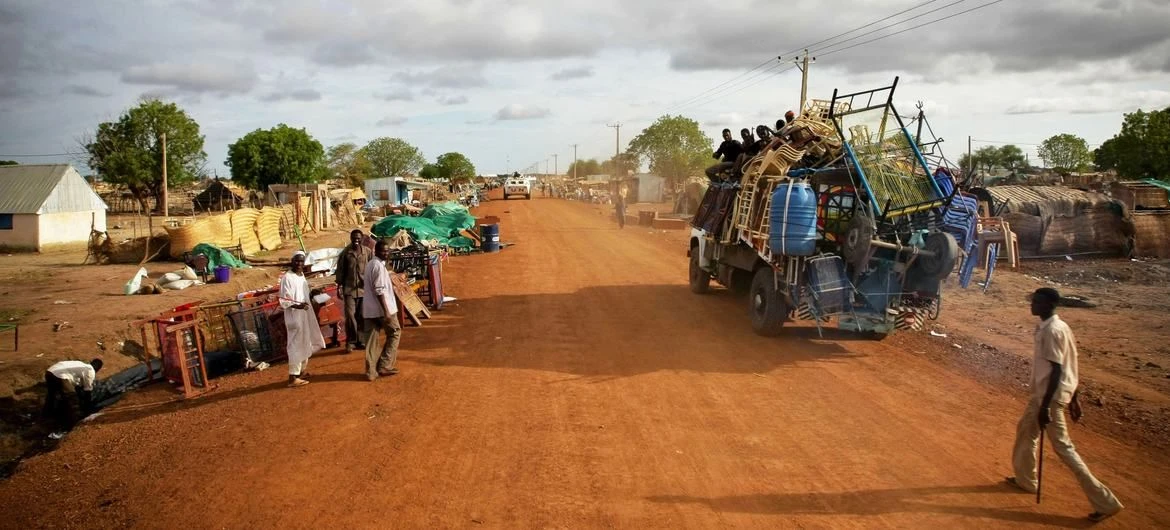
Briefing the Council on the humanitarian situation in Syria, Indrika Ratwatte, the acting assistant secretary-general and deputy emergency relief coordinator, said the country was “at a pivotal moment,” with nearly 2 million internally displaced people and more than 1.7 million refugees having returned home since the fall of the Assad regime in December 2024.
But he cautioned that “return does not mean the end of humanitarian need,” noting that more than 5.5 million people remain internally displaced, including 833,000 living in more than 1,200 camps.
He said that explosive ordnance had caused more than 2,400 casualties, including 865 deaths, since December 2024, and that the international humanitarian appeal for Syria remains only 30 percent funded.
“This is precisely the moment when investment can turn fragile progress into lasting recovery,” Ratwatte said as he called for sustained funding, support for returnees, and efforts to “prevent Syria from being drawn into regional conflict.”
The deputy special envoy for Syria, Claudio Cordone, speaking from Damascus, welcomed the US decision to rescind Syria’s terrorism designation, and cited an International Monetary Fund projection that predicted “double-digit growth in 2026” for the country.
However, he warned that “widespread poverty and renewed inflation mean conditions remain very difficult for most Syrians.”
Cordone also raised concern about continuing Israeli military activity in southern Syria, “including repeated ground incursions, house searches and the destruction of private and agricultural property,” and said the Israel’s presence east of the ceasefire line “violates Syria’s sovereignty and territorial integrity.”
He condemned an Aug. 18 Israeli strike on Abu Al-Duhur airbase in Idlib governorate, and welcomed “recent direct Israel-Syria contacts and talks in Jordan,” as well as US mediation efforts. He also flagged a number of domestic concerns, including reports of deaths in custody and disappearances, and urged Syrian authorities to establish “a moratorium on all executions.”