LONDON: As Israel’s right-wing politicians compete for headlines and votes ahead of next month’s elections, an increase in political rhetoric is to be expected.
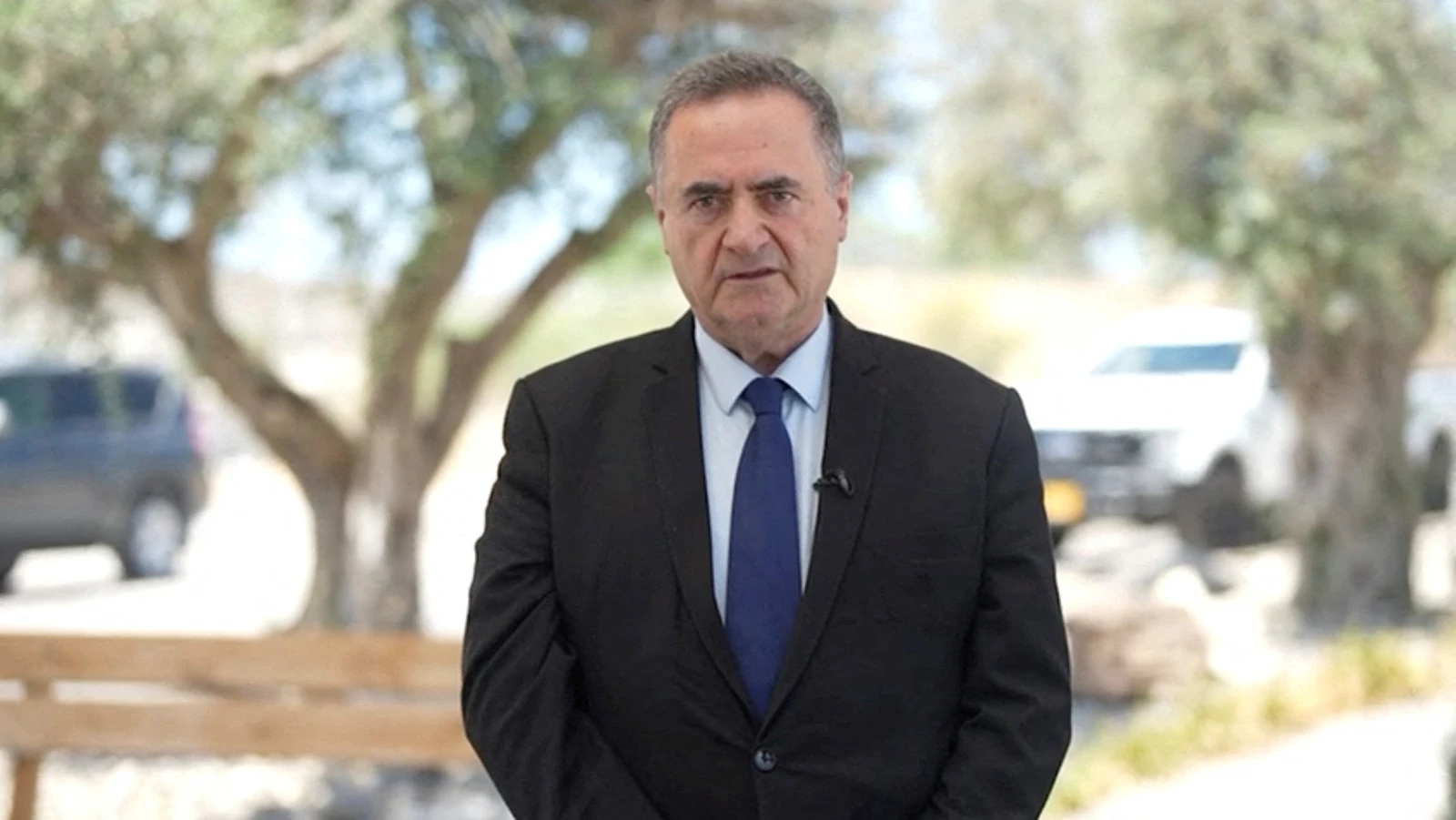
But the claim on Wednesday by Israel’s Defense Minister Israel Katz that Benjamin Netanyahu’s government is actively seeking US support to revive a plan to remove all Palestinians from Gaza is drawing international attention.
Only last year, this was the plan that President Donald Trump proposed for Gaza, prompting widespread condemnation.
Katz was recorded speaking at a pre-election conference, “Decision Time: Democracy and Society,” organized by the centrist Israeli newspaper Yedioth Ahronoth.
“There is no real solution for Gaza in the end without this migration,” he said.
Katz said plans to remove Palestinians from Gaza had simply been “frozen” by Trump and were still under consideration — a statement that appears to contradict current publicly stated US policy.
But Katz’s suggestion is being taken seriously by US Democrats, including Senator Chris Van Hollen, who released a report last year criticizing Israel’s actions in Gaza as ethnic cleansing.
On Thursday, Senator Van Hollen took to social media to highlight Katz’s comment, which he said “confirmed that’s the goal.” The US, he added, “must end our complicity.”
Van Hollen’s report was published jointly with Senator Jeff Merkley on Sept. 11, 2025, after the pair visited Israel, the West Bank and Gaza’s border with Egypt.
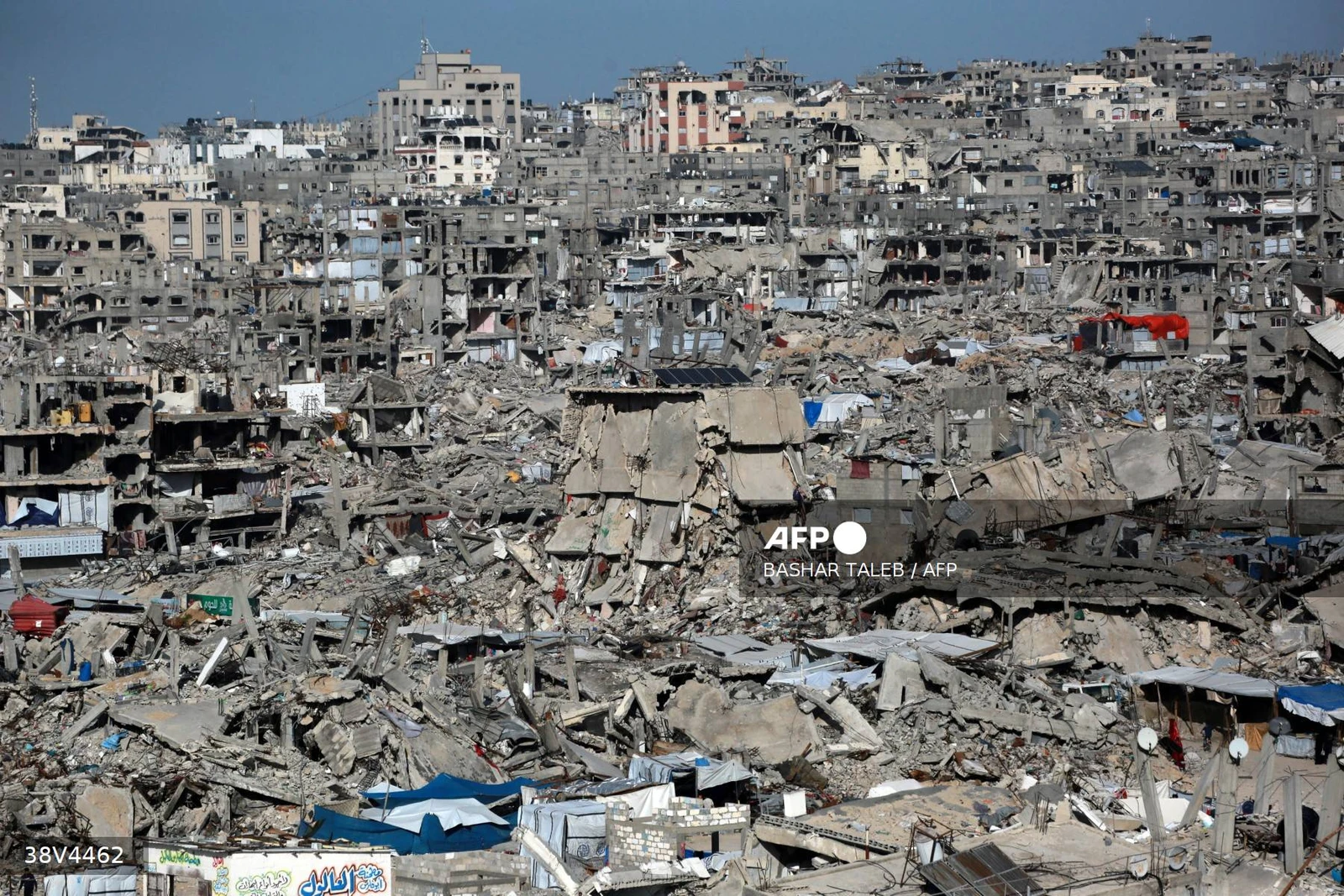
In it, they said the Netanyahu government was “implementing its goal (of ethnic cleansing) through the near-total destruction of civilian infrastructure and its use of food as a weapon of war.”
These policies, it added, were “part of a calculated effort to drive Palestinians out of Gaza by making it impossible for them to live there.”
In February 2025, President Trump, during a joint news conference in Washington with Netanyahu, announced that “the US will take over the Gaza Strip ... we’ll own it.”
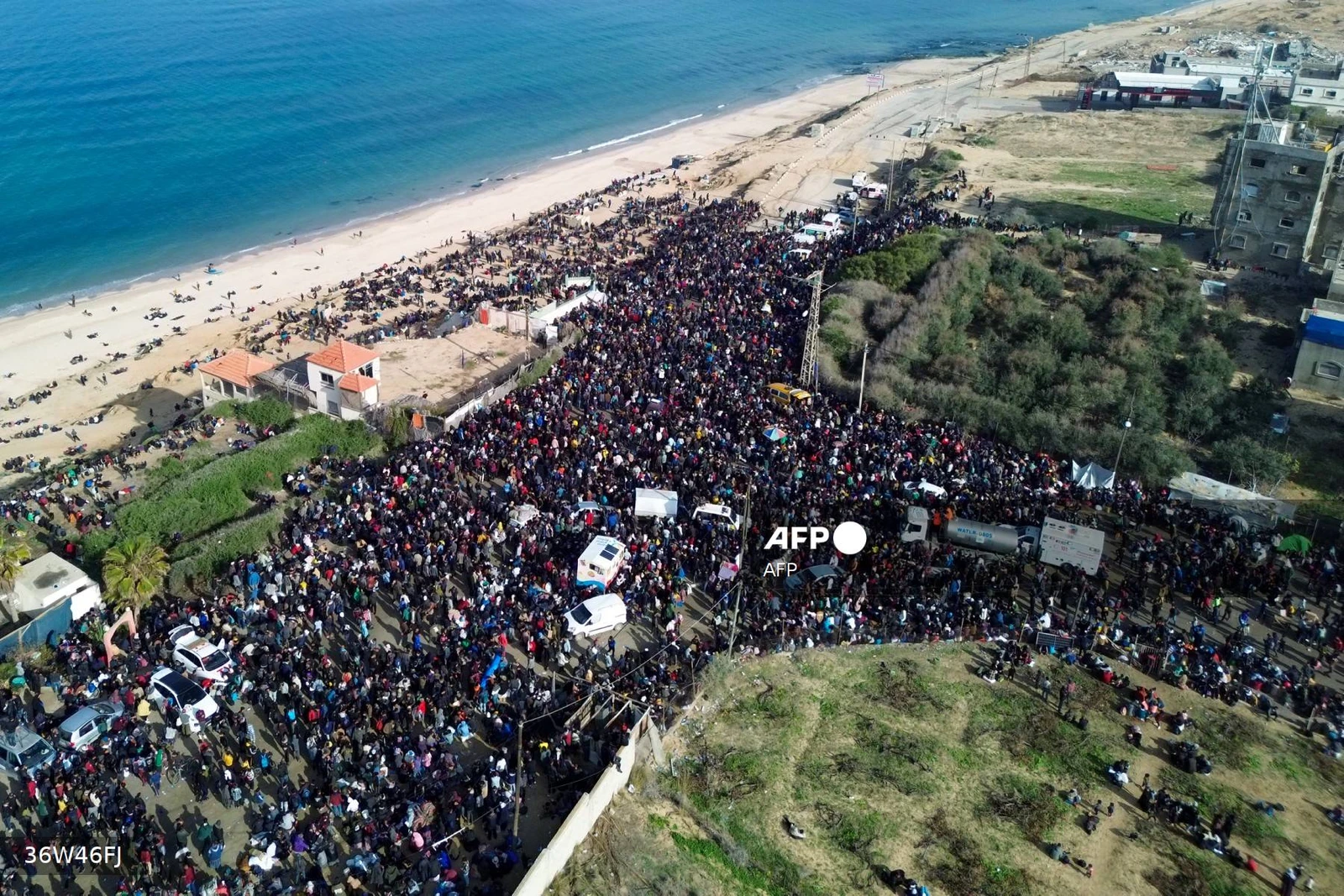
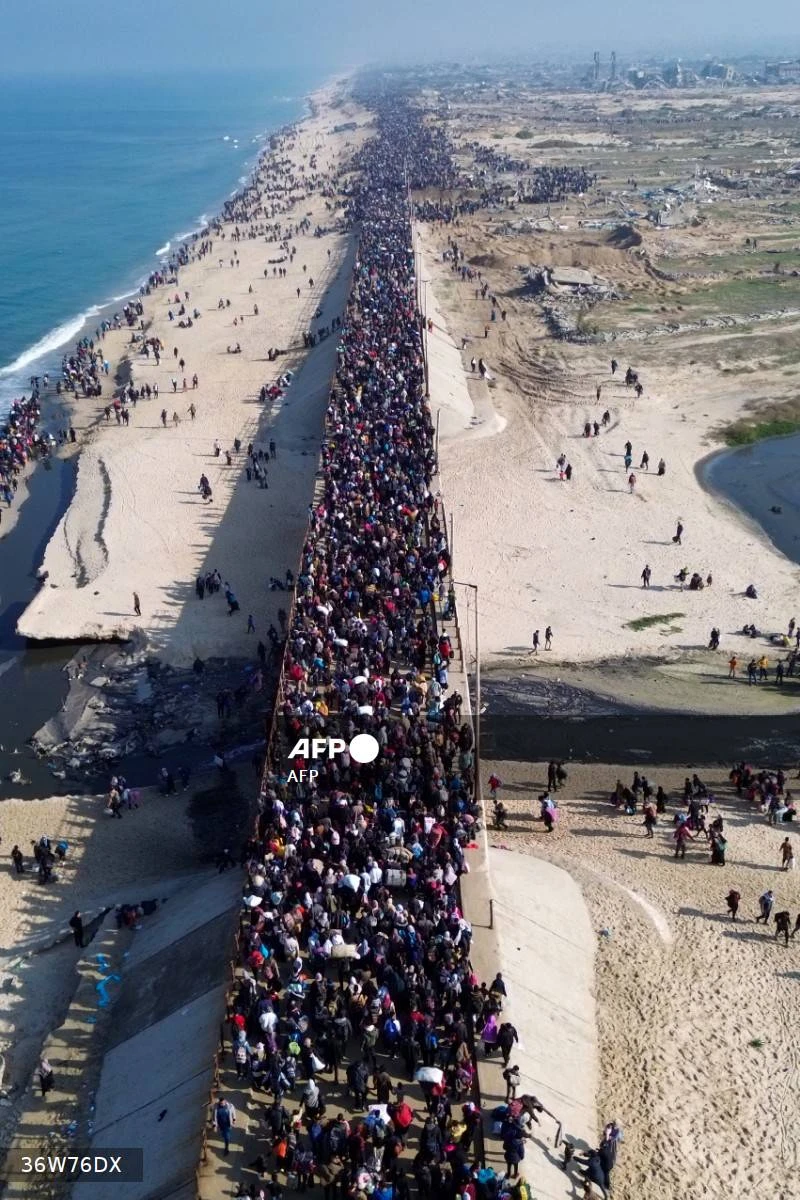
The US, he said, would “level the site,” permanently displace its residents and transform Gaza into “the Riviera of the Middle East.”
A few weeks later, Trump posted an AI-generated video on his Truth Social account, in which Gaza was depicted as a destination for the wealthy, complete with skyscrapers, yachts and a giant golden statue of Trump.
In one scene, Trump and Netanyahu, clad only in bathing trunks, are shown lounging by a pool, sipping drinks.
It later emerged that the video, which prompted international criticism, had been produced by an Israeli-born filmmaker based in Los Angeles.
On Feb. 5, the day after Trump revealed his plan, countries around the world, from those in the region to China, condemned it. At the UN, Secretary-General Antonio Guterres said it was “essential to avoid any form of ethnic cleansing.”
As Trump pressed ahead with his “Riviera” plan, he tried to persuade countries in the region to take in the Gazans he planned to displace. At one point, he threatened to withdraw aid from Egypt and Jordan if they failed to support the proposal.
One week after Trump unveiled his plan, during a visit to the White House on Feb. 11, 2025, King Abdullah of Jordan sat alongside the president, listening to him tell reporters that the US was going to take Gaza.
As for the people who lived there, Trump said, “we’re moving them to a beautiful location where they can have new homes, where they can live safely, where they can have doctors and medical and all of those things.”
He added: “I believe we’ll have a parcel of land in Jordan. I believe we’ll have a parcel of land in Egypt.”
After the meeting, King Abdullah took to social media to make clear that Jordan was opposed to “the displacement of Palestinians in Gaza and the West Bank.” This, he added, “is the unified Arab position.”
Israel has continued working behind the scenes to lay the groundwork for the potential displacement of Palestinians from Gaza.
In March last year, the Associated Press, citing Israeli and American officials, reported that the US and Israel “have reached out to officials of three East African governments to discuss using their territories as potential destinations for resettling Palestinians uprooted from the Gaza Strip under President Donald Trump’s proposed postwar plan.”
The three governments in question were said to be those of Sudan, Somalia and the breakaway Somaliland. Sudan said it had rejected the proposal, while Somaliland and Somalia said they had heard nothing about it.
Later, Somalia’s Foreign Minister Ahmed Moallim Fiqi said his country would categorically reject “any proposal or initiative, from any party, that would undermine the Palestinian people’s right to live peacefully on their ancestral land.”
Within days, however, Katz announced that Israel’s Security Cabinet had established a “Voluntary Emigration Bureau,” under the control of his defense ministry, “to prepare for and facilitate the safe and supervised passage of Gazans for voluntary exit to third-party countries.”
Katz said the directorate would be bound by Israeli and international law and would operate in coordination with international organizations.
In June, anonymous Israeli officials told Israel’s Channel 13 news that security agencies were working on reviving the plan to remove Palestinians from Gaza.
The plan had originally been framed as “voluntary migration,” a term that drew international opposition. Now, it is being described as a “plan for free movement.”
According to The Times of Israel, officials were hoping the new approach would persuade countries that had previously refused to receive Gazans to reconsider and to “recruit other countries” to the plan.
In July 2025, Israeli media began reporting that Israel had reached agreements with five countries that were prepared to take Gazan migrants, including Ethiopia, Libya and Indonesia.
Citing Israeli officials, one report said that Netanyahu had “accelerated plans to encourage voluntary migration ... in an effort to keep … Itamar Ben-Gvir in the government.”
The development linked Katz’s approach to Gaza with the government’s broader settlement policy in the West Bank, which critics say could undermine prospects for a two-state solution.
Ben-Gvir, himself a settler, is one of the prominent figures in the settler movement.
This July, he and fellow right-winger Finance Minister Bezalel Smotrich marched toward Gaza with thousands of settlers to demand the reinstatement of 21 Israeli settlements that were unilaterally shut down by the Israeli government in 2005, as part of a peace initiative by Prime Minister Ariel Sharon.
At the rally, Ben-Gvir told the crowd: “If someone had said three years ago that we would control 70 percent of the Gaza Strip, no one would have believed it. So today I say: there will be Jewish settlement throughout Gaza.”
Israel, he demanded, must “encourage voluntary migration” of Palestinians.
Israel’s settlement expansion in the West Bank, which has been endorsed and funded by the government, is continuing.
Last month, the UN Office for the Coordination of Humanitarian Affairs reported that in the year to July, there had been more than 1,380 settler-related incidents across 250 Palestinian communities resulting in casualties, property damage or both. More than 2,300 Palestinians had been displaced.
The Israeli Security Cabinet has approved dozens of additional settlements this year. According to Israeli settlement watchdog Peace Now, there are currently 146 settlements and 360 outposts in the West Bank, in addition to 15 settlements in East Jerusalem.
In August, Israel opened tenders for the construction of 1,200 settlement homes in the area east of Jerusalem designated “E1,” a plan long opposed by the international community.
The move prompted a joint statement on Aug. 20 from the leaders of 22 European countries and the EU, describing the decision as “unacceptable.”
They urged the Israeli government to abandon plans that would “undermine the prospect of the two-state solution by driving a wedge through the West Bank and harming the territorial contiguity of the Palestinian Territories.”
Following the launch of the US-led Comprehensive Plan to End the Gaza Conflict in September 2025, plans to remove Gazans from the territory appeared to have been set aside. Instead, the text of the peace plan spoke of encouraging people to stay, offering them “the opportunity to build a better Gaza.”
In contrast to the opposition that greeted Trump’s earlier plan to relocate the population of Gaza, in Oct. 2025 the peace plan was welcomed in a joint statement by the foreign ministers of countries including Saudi Arabia, Jordan, Qatar, the UAE and Egypt.
But the statement set out their expectations for the plan clearly.
The ministers, it said, “welcome the announcement by President Trump regarding his proposal to end the war, rebuild Gaza, prevent the displacement of the Palestinian people and advance a comprehensive peace, as well as his announcement that he will not allow the annexation of the West Bank.”
When the charter of Trump’s Board of Peace was formally ratified in Davos three months later, in January 2026, there was again no mention of displacement. Rather, as a White House press release put it, this was the beginning of a “path to hope and dignity for Gazans.”
But now, as Arab News reported on Aug. 28, the Gaza peace plan is facing difficulties, stalled in a dispute between Israel, which refuses to withdraw from Gaza until Hamas disarms, and Hamas, which says it will not disarm until the Israeli military leaves.
And there appears to be no immediate prospect of that. As Katz was speaking on Wednesday, Netanyahu was visiting an Israeli military outpost near the Yellow Line in the Gaza Strip. It was his first visit to the area since the start of the ceasefire in Oct. 2025.
“We control the area and we remain on this line,” he said. “We are doing everything to reach our goal — the disarmament of Hamas and the demilitarization of Gaza.”
He added: “Gaza will no longer pose a threat to Israel.”
On Wednesday, Katz suggested that a lack of progress on the peace plan could clear the way for a return to the policy of “voluntary emigration.”
This would, he said, start “when it becomes clear that Hamas is not fulfilling its commitment” under the peace plan.
He also suggested that the main obstacle to implementing the migration plan was the reluctance of other countries to open their doors to migrants from Gaza. Should that change, he said, Israel “is organized and prepared to get them out — by sea, by air, by every way possible.”
All that was missing, he added, was Trump’s backing. The plan, he insisted, had not been canceled.
He added: “It is being discussed all the time, including now, and I think there is no other solution in the end that is in everyone’s interest.”
The US State Department did not respond to a request for comment.
Is Israel preparing to revive plans to displace Gaza’s Palestinians?