- Gulf Cooperation Council’s secretary-general, Jasem Mohammed Albudaiwi, also warns that poorer nations face risk of famine as result of Tehran’s actions in Strait of Hormuz
- He urges Security Council to take action to enforce resolutions, restore freedom of maritime navigation and ensure Tehran pays reparations to victims of its actions
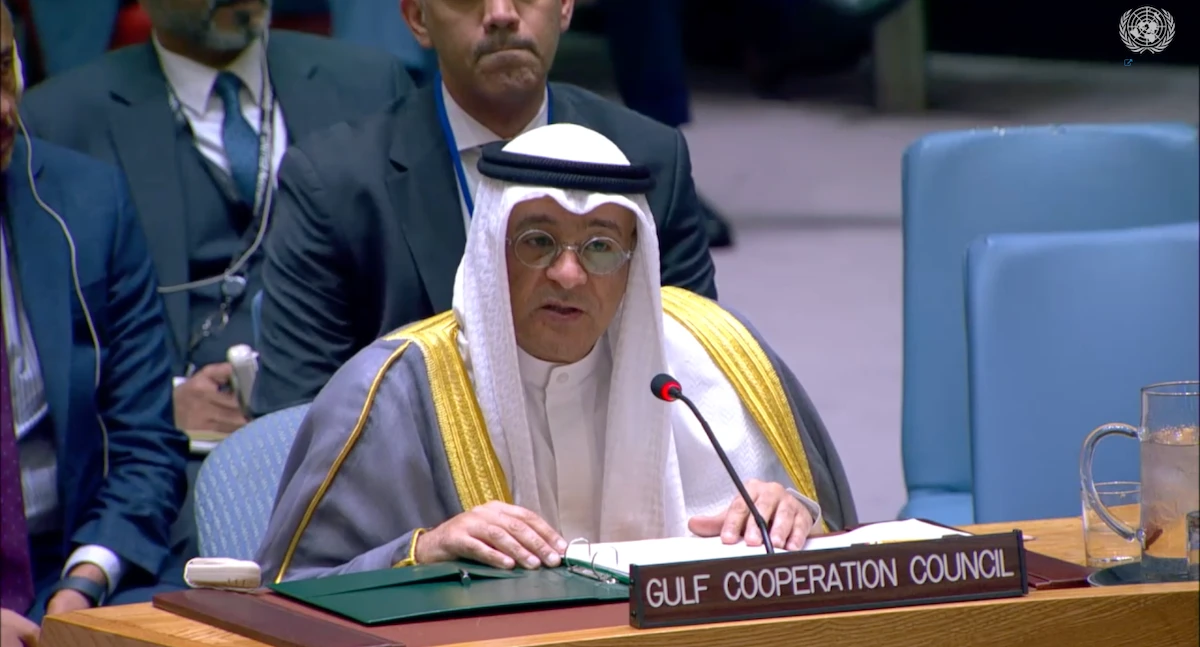
NEW YORK CITY: Iran has fired more than 7,000 missiles and drones at Gulf Cooperation Council member states since Feb. 28, the organization’s secretary-general told the UN Security Council on Friday.
Jasem Mohammed Albudaiwi also warned that disruptions to commercial shipping in the Strait of Hormuz were choking the vital supplies of fertilizers on which developing countries depend, increasing the risk of famine.
Locations hit by the Iranian strikes over the past eight months included airports, seaports, oil and gas facilities, power stations, desalination plants and residential areas in all six GCC member states, Albudaiwi said. The attacks resulted in deaths and injuries, extensive damage to infrastructure, and serious harm to the waters of the Arabian Gulf.
“We are addressing your council today with a unified Gulf voice,” he told council members. The attacks were “a flagrant violation of the sovereignty and territorial integrity of GCC member states,” he added, calling on the council to take action “to ensure their cessation (and) to prevent their recurrence.”
The meeting was requested by Bahrain to discuss heightened tensions in the region and threats to maritime security in the Gulf, and it was convened by Latvia, which holds the rotating presidency of the council this month.
Albudaiwi said the consequences of disruptions to shipping in the Strait of Hormuz had now gone beyond economic in nature to also encompass “a serious humanitarian dimension.” As global supply chains have been disturbed, supplies of food and other essential goods were interrupted and dwindling, including the fertilizers and ammonia “upon which global food security depends.”
He cited a prior warning from the UN secretary-general, Antonio Guterres, about rising global inflation and the risk that “the developing and most vulnerable countries could be facing famine and acute food insecurity due to fertilizer shortages.”
Albudaiwi added: “Disruption of navigation in a single corridor affects factories, businesses and consumers across continents.”
Regarding the attacks against Gulf states, he said the GCC held Tehran “fully responsible.” He rejected Iran’s justifications for targeting countries he said “were not party to the war but instead exerted intensive diplomatic efforts to spare the region from escalation.”
He welcomed the council’s adoption in March of Resolution 2817, which condemned the Iranian attacks on GCC states and Jordan, demanded that they stop and denounced the action of Tehran to close the Strait of Hormuz. He said that by adopting the resolution, the council now had “the responsibility to follow up on its implementation.”
Albudaiwi also cited UN Human Rights Council Resolution 61/1, which similarly condemned the Iranian attacks, and also called on Iran to provide “full, effective and prompt reparations” to the victims.
“The security of the GCC states is indivisible, and any attack against one member state is an attack against all,” he said. Member states remained committed to their right to self-defense under Article 51 of the UN Charter, he added.
Turning to the escalating Houthi campaign of attacks against Saudi Arabia, he said the “Iranian-backed Houthi terrorist militia” in Yemen had targeted the areas around the Two Holy Mosques, pilgrims, civilian airports and oil facilities. He highlighted in particular a deadly strike on King Khalid International Airport in Riyadh in October that killed 14 people.
“We affirm our full solidarity with the Kingdom of Saudi Arabia,” Albudaiwi said. “We stand united alongside the Kingdom and support the measures it takes to safeguard its sovereignty.”
He welcomed a presidential statement by the Security Council on Oct. 15 that affirmed Saudi Arabia’s right to self-defense. He also welcomed a resolution adopted unanimously by the council on Nov. 12 that condemned the recent Houthi escalation, demanded an immediate end to the militia’s attacks, and condemned weapons shipments to the group in breach of an arms embargo.
Albudaiwi condemned the Houthis’ treatment of UN employees and humanitarian workers, after years of abductions and enforced disappearances. He noted that a UN member of staff recently died while detained by the militia, and that others had been referred for trial on “fabricated charges carrying the death penalty.” He urged the council to take “a firm position” on these “unprecedented crimes against UN personnel.”
He also reminded members that the UN Convention on the Law of the Sea guaranteed freedom of navigation through international waters and straits and stated that safe passage “shall not be impeded or suspended.”
He rejected any attempt to close the Strait of Hormuz, which has effectively been blocked by Iran throughout the conflict with the US, or to impose “unlawful restrictions or transit fees” on international shipping.
He called on the council to ensure the immediate and unconditional end to attacks by Iran, direct or through its proxies; an end to attacks by the Houthis and the enforcement of the arms embargo on the militia; the return of the conditions for shipping in Hormuz to the situation that existed before Feb. 28; and accountability for the attacks that have taken place, including compensation in full by Iran.
Any regional or international deal with Tehran must address Gulf security concerns, Albudaiwi said, including Iran’s nuclear program, its ballistic missiles and drones, and its support for proxies.
Better regional relations, he added, required that Iran reciprocated “through clear actions, including ending attacks and threats (and) ceasing support for armed militias.”
He also restated the GCC’s support for an independent Palestinian state based on June 4, 1967, borders, with East Jerusalem as its capital, and for the sovereignty of Lebanon and Syria.
“The security of the Arabian Gulf is an integral part of international security, and protecting the sovereignty and stability of its states is a test for the effectiveness of the collective security system,” Albudaiwi said.