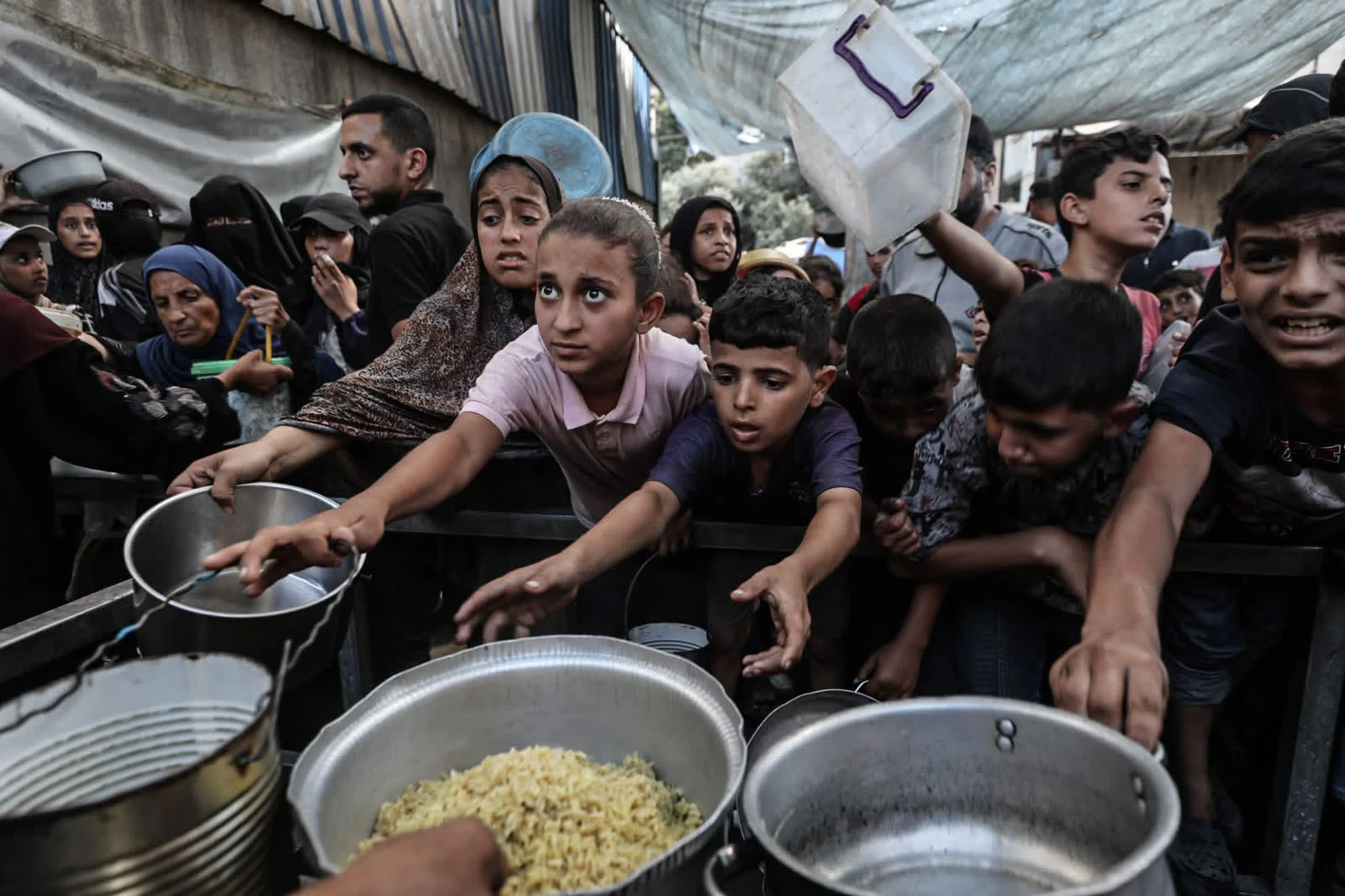
DUBAI: Hundreds of people gather, pushing toward the front with their arms outstretched, holding empty plates and containers in the hope of securing a meagre meal that may be all they eat that day. They wait for food parcels that have become part of daily life, with no guarantee of when the next distribution will come, if it comes at all, or whether there will be enough to feed everyone at home. Parents forgo meals as their children cry out in hunger, their stomachs still gnawing with pain. This has become daily life in Gaza.
Tamer Nahed, a journalist from Gaza, has witnessed the effects of dwindling aid on families struggling to survive. He is also part of a volunteer team that distributes food and water to people in need every day.
“When a child gets hungry, the mother is forced to pacify them with whatever she has on hand,” Nahed said. “This happens right in front of me every day. She might give him a bag of chips, for example, or a small piece of biscuit to hold him off to the next day.”
“There is nothing regular at all, literally. People here are living on a day-to-day eating system … today they might manage to get food, but tomorrow they won’t be able to,” he added.
According to Nahed, the main sources of food are free provisions distributed in camps and meals prepared by individuals or organizations. These often amount to a single meal, usually without bread, served through what Palestinians call a tekke, or community soup kitchen.
“There is no adapting, no one is adapted to life here. People are forced to (adapt),” he said. “In the end, I am forced to eat just one meal, it’s better than eating no meal at all.”
The situation is expected to worsen. Humanitarian organizations have been forced to scale back their operations amid funding shortages. The UN World Food Programme announced on Monday that a lack of funding had forced it to reduce food assistance in Gaza by about one-third, leaving half a million people set to lose access to critical support.
“We just run out of funding, literally,” said Claire Nevill, WFP’s communications officer for Palestine. “It’s not because of the need coming down or a reduction in needs. It’s not because of a lack of access. It’s because we simply don’t have the funds to continue at that level.”
The cuts mark a sharp change from last year. After a ceasefire was announced in October 2025, the WFP was able to reach around 90 percent of families in Gaza with food assistance.
“Humanitarian assistance has been a lifeline and we know that we were able to push back famine last year and meet the most immediate food needs of the population,” Nevill said.
Since then, however, a range of factors has contributed to the food insecurity now gripping Gaza.
“There are many competing global crises at the moment. Our donor governments are scaling back … a lot of domestic, fiscal interests are taking over and we have, what we call in the sector, a kind of donor fatigue,” Nevill said.
During the first two years of the crisis, governments, private donors and the private sector helped sustain the humanitarian response. Now, Nevill said, shifting domestic priorities are making it increasingly difficult to secure funding.
The WFP has been forced to halve its food rations. Families receiving assistance will now get one food parcel instead of two, along with a smaller bag of wheat flour. But distributions are inconsistent and less frequent, making it harder for families to stretch their supplies.
For those unable to make up the shortfall, buying food is increasingly out of reach. A sack of flour costs between 250 and 300 shekels — just under $100 — according to Nahed.
He said the halt in commercial truck entries through the Kerem Abu Salem crossing was further restricting supplies entering Gaza. Although trucks continue to bring in some goods, including cleaning supplies, clothing and coal, Nahed said sufficient quantities of commercial goods, particularly food, were not reaching the strip.
On Thursday, far-right protesters from the Tsav 9 movement blocked aid trucks at the crossing, demanding a halt to deliveries. Knesset member Yulia Malinovsky also joined the blockade, according to Haaretz.
As supplies dwindle and assistance shrinks, families have fewer options to make up the shortfall.
“We already know that people are resorting to negative ways of coping,” Nevill said, describing how parents skip meals so their children can eat, while families borrow food, buy on credit or sell what little they have left.
Malnutrition remains a major concern in Gaza, particularly among children and pregnant and breastfeeding women. Nevill said addressing the crisis requires not only more aid, but also a greater variety of food.
“It’s not about the number of trucks that enter. It's like what is on those trucks,” she said, calling for more fresh produce, fruit, vegetables and protein sources to help stabilize prices and make nutritious food more affordable.
More than 80 percent of Gaza’s population is unemployed, according to the UN. Even when protein-rich foods and fresh produce are available, many people cannot afford them.
As assistance becomes more limited, Nevill said, the WFP is having to prioritize families with malnourished children, people with disabilities and female-headed households with multiple children.
Women and children are among those bearing the brunt of the crisis. Pregnant and breastfeeding women have higher nutritional needs, yet some are skipping meals so their children can eat, Nevill said.
People living close to the Yellow Line are also particularly vulnerable, she added, as access to basic services and markets can be severely restricted. The Yellow Line is a military demarcation inside Gaza that divides the strip, with one part under Israeli military control.
The approaching winter is expected to compound these difficulties. Nevill said most of Gaza’s population live in makeshift tents or bomb-damaged buildings.
“The water and sanitation conditions are abysmal and you have open sewage everywhere,” she said, warning that poor sanitation and a lack of clean water could have a “disastrous impact” on people’s health and well-being, with knock-on effects for food security.
A shortage of cooking gas has also forced families to turn to unsafe alternatives, including burning plastic and waste to prepare food, exposing them to harmful fumes.
The WFP says it needs $450 million to sustain its operations in Gaza and the West Bank over the next six months.
“We, as part of this call for funding, are urging people, donors, the international community, not to look away, not to forget the people of Gaza or the people in Palestine who still continue to need immediate humanitarian support,” Nevill said.
For Nahed, however, the crisis cannot be measured in funding shortfalls or aid figures alone. It is also about the uncertainty he faces every day: when the next meal will come, and whether there will be enough.
“My message to the world is to look back at the news from Gaza; the war hasn't stopped for a single day, even for us,” he said. “They must understand that the war is not just bombing, there is a war of living and a war of survival every single day.”
Gaza’s worsening food crisis is ‘a war of survival every day’