Once an OFW, always an OFW.
That has been a mantra of Ateteng, a former Overseas Filipino Worker, as she constantly entertained thoughts of returning to the UAE, three years after initially deciding to settle for good in the Philippines upon finishing her contract.
Prospects for re-engaging with her Abu Dhabi-based employer grew stronger as exchanges of messages with former colleagues and bosses, discussing the possibility for her return, became more frequent.
But then Feb. 28 happened.
“After the war erupted, there has been a huge question whether former OFWs like me could still return to the UAE,” Ateteng told Arab News, highlighting a sentiment seemingly shared by Filipinos who seek overseas employment.
The US-Israeli military action against Iran set off a fierce wave of regional violence, disrupting not only individual lives, but also broader, vital cogs in the economic activities of Middle Eastern nations — usually dependent on migrant labor — due to widespread airspace closures, flight disruptions and intensified security risks.
“Our deployments had a 35 percent decrease to the Middle East. At this time last year, around 507,000 were deployed, but only 332,374 were deployed (in the same period this year),” Hans Leo J. Cacdac, secretary of the Philippines’ Department of Migrant Workers, told Arab News.
It was even worse, according to Cacdac, during the first few months of the conflict, when OFW deployment to the Middle East region plummeted by as much as 64 percent.
Six-month government data shows total deployment of land-based OFWs fell steeply by 33.5 percent to 127,447 in Saudi Arabia; almost 25 percent to 118,563 in the UAE; almost one-third to 46,713 in Qatar and by a staggering 64.5 percent in Kuwait to 19,520.
“There was a slight decrease in job orders, particularly household service workers, due to a slow normalization in Middle East countries … and in Dubai a visible slowdown was noticed due to slow recovery of the economy and tourism,” recruitment and migration expert Emmanuel Geslani told Arab News.
An estimated 2.4 million Filipinos are in the Middle East, many concentrated in Saudi Arabia and the UAE, and mostly employed in households, healthcare, hospitality, services and retail.
The Filipino diaspora is embedded in the country’s economy through remittances, property and the households that OFW income supports, according to Boston Consulting Group Manila.
“The OFW is one of the family’s most important forms of insurance, strengthening the family against fragility by leaving it,” the global consulting firm said in a report, adding that a stint in the Middle East is seen as something to offer the family: education, stability in medical expenses and building up savings for the future.
But the conflict in the Middle East has caused some Filipinos to second-guess working abroad, as safety and job stability become bigger concerns.
One in every 14 Filipino families has an OFW, and the funds they send home are a vital linchpin in the Philippine domestic consumption machinery: cash to pay mostly for basic needs, education, healthcare or property.
The $35.6 billion OFW remittances in 2025 ranked among the Philippines’ top sources of foreign currency inflows — contributing 7 percent of gross domestic product — next to electronics and BPOs.
However, remittance levels are being weighed this year by uncertainties stemming from the Middle East conflict, with the January to June aggregate of $17.14 billion raising concerns from analysts that the money being sent home may be plateauing.
“Lingering uncertainties arising from the Middle East conflict have weighed on labor deployment and raised concerns over employment prospects for some OFWs in the region,” UnionBank chief economist Ruben Carlo Asuncion said.
“Higher living costs in several host economies may have also limited the amount available for transfer.”
No alert level issuance, only increased vigilance
The migrant workers department, in an advisory right after the conflict broke out, directed private recruitment agencies with deployed or scheduled-for-deployment OFWs to Bahrain, Israel, Iran, Jordan, Saudi Arabia, Kuwait, Lebanon, Qatar and the UAE to maintain active coordination with employers and foreign placement agencies, proactively monitor OFWs, as well as submit monitoring reports, deployment lists and evacuation protocols, among other requests.
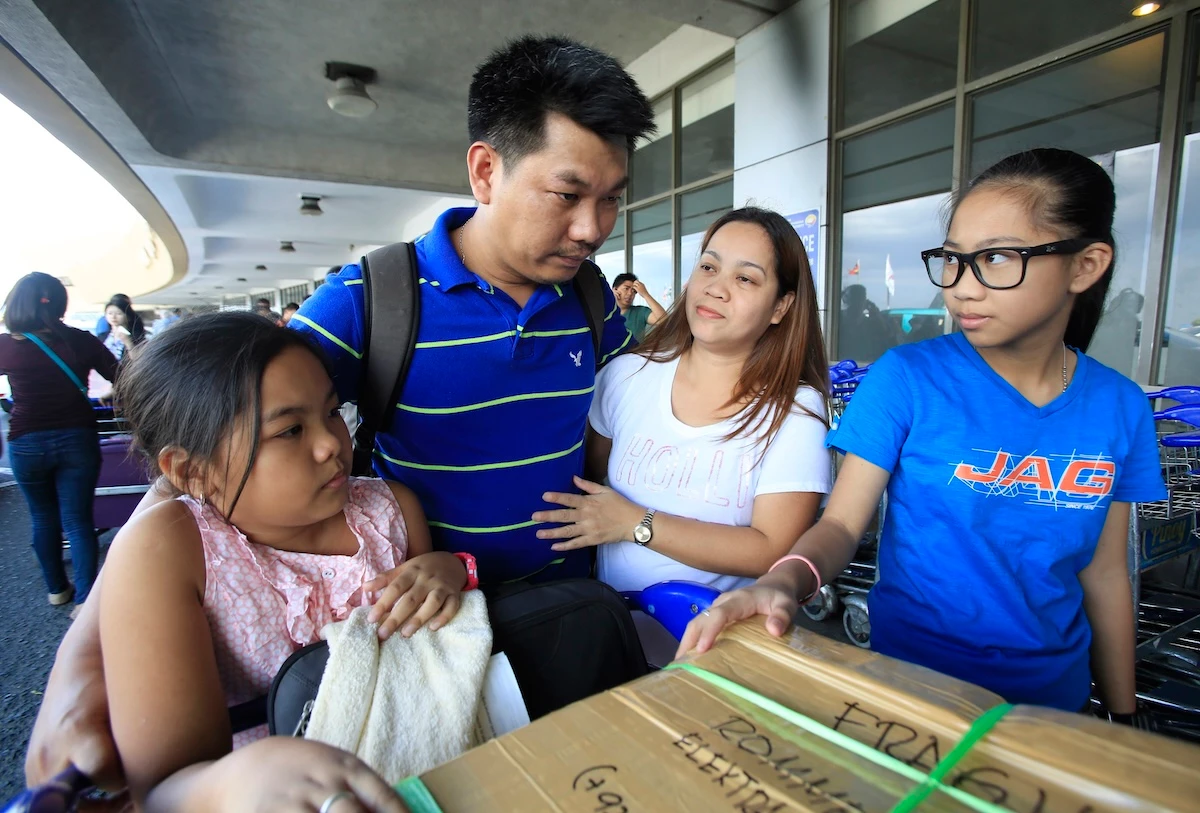
“To those who did not manage to leave due to air restrictions, closures of airspace and closures of airports, and got stuck in our airports, there was cooperation with the private sector stakeholders to help them return to their provinces and homes,” Cacdac said.
The government also strongly advised private recruitment agencies to temporarily refrain from processing workers bound for Bahrain, Qatar, the UAE and Kuwait due to airspace closures.
“Of course, for the safety of the OFWs only destinations outside of the Middle East were allowed to leave,” Geslani said, adding that the pause allowed airlines to calibrate their flights via safer routes.
Flights to Saudi Arabia were able to resume faster, compared to Dubai, Kuwait, Bahrain, which were paused until the last week of March, Geslani added.
“We did not raise alert levels (for Gulf countries) because we saw with our own two eyes the protection, defense systems and stability of the host countries and host country governments. That’s why we are thankful to the Kingdoms and heads of state in the Gulf in terms of providing protection to our countrymen,” Cacdac said.
The Philippine government maintains a four-level crisis alert system to monitor overseas security, health or environmental threats and guide emergency responses, travel advisories and deployment restrictions for overseas Filipinos.
An Alert Level One triggers advice for Filipinos to take necessary precautions, monitor local news and avoid non-essential movement; an Alert Level Two calls for Filipinos to shelter in place, avoid high-risk areas and restrict non-essential travel; Alert Level Three activates voluntary evacuation procedures, while under Alert Level Four the Philippine government begins mandatory repatriation.
“We continue to monitor the situation. I went to the Gulf at least five times and met with my labor minister counterparts and in all cases, I have thanked them for their protection and continuing provision of programs and services for our OFWs as well as continuing strong labor relations with them. This will continue and hopefully the situation will improve,” Cacdac said.
OFW deployment would definitely bounce back, Cacdac added, after being asked to draw comparisons with the post-pandemic period, when the number of Filipinos employed overseas eventually reached about 2.5 million.
“One notable thing here was that the loss of jobs was not widespread. In fact, we hardly saw OFWs who lost their jobs due to the conflict,” Cacdac said.
“That was due to the stable political economic situation in the affected countries, most notably in the Gulf states.”
The government instituted almost 20 job and livelihood fairs since Feb. 28 and offered upskilling and retraining programs for returnees, some of whom were eventually deployed as hotel workers in Europe, particularly Croatia.
“Although we saw alternative job orders in Asia, Europe and America, we can also see that there will be resumption and more job orders from the Middle East,” Cacdac said.
Geslani agreed: “Positive outlook for OFW deployment remains especially in Saudi Arabia … a heavy deployment of skilled and unskilled OFWs and household service workers is foreseen as the Kingdom’s economy is ready to absorb migrant workers.
“The UAE will slowly rise again if the war ends today.”
And it is this shared optimism that Ateteng clutches on to her hope — rather dream — of returning to what she calls her second home: “I really want to go back to work in the UAE so I can provide for my family.”
Flight or plight: Middle East conflict puts OFWs’ welfare at the forefront