LONDON: Seven aid workers were killed in Gaza after the Israeli military labeled them targets through guilt by association, an investigation has found.
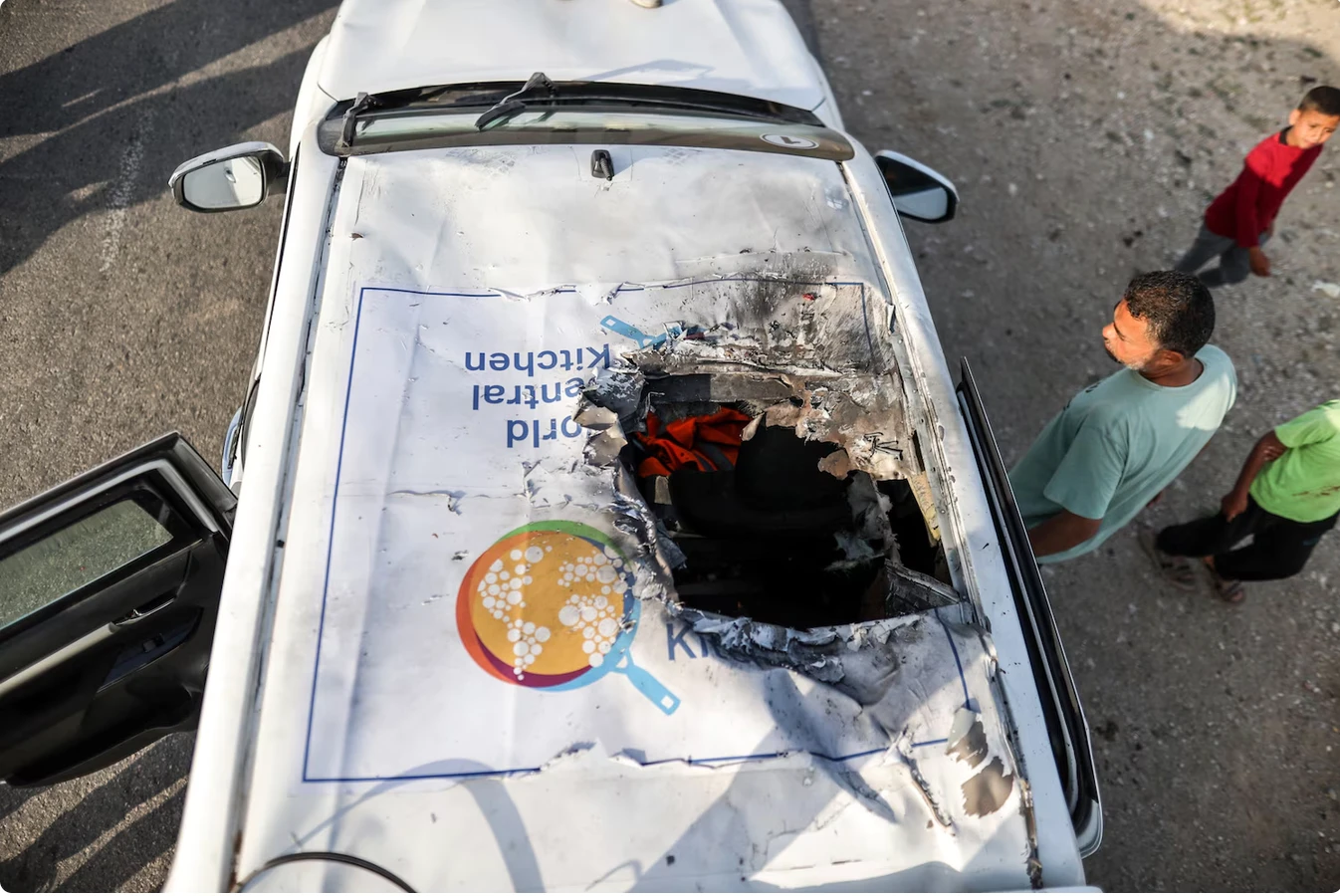
The seven World Central Kitchen workers were killed when their clearly marked vehicles were targeted by an Israeli drone in April 2024 after they had escorted a food convoy in the Palestinian enclave.
The Israeli military claimed that the strike happened after a series of mistakes were made by several officers, and that the convoy had hired armed guards and “deviated” from its agreed route, which contributed to their deaths.
Last month, an Israeli military prosecutor said no criminal charges would be brought against any of the officers.
But a series of interviews by The Guardian of Israeli officers involved with or aware of the investigation suggests that the incident involved a common Israeli practise of grouping people together when assessing targets.
The practise, called haflala, meaning “incrimination,” gives Israeli officers broad scope to determine who is defined as an enemy combatant in the field.
The Guardian said Nochi Mendel, a reserve colonel who oversaw the strikes, admitted that the WCK workers had become targets because of their interaction with their armed guards, which were assumed to be Hamas members.
Mendel said the WCK workers were “mixed together” with the guards, which he believed “certainly” made the convoy a legitimate target. “They were not innocent because they were connected to Hamas,” he added.
Mendel, who is the only senior officer of his rank to have been dismissed by the military for his actions in the war in Gaza, said his unit had been praised by senior officers in the past for intervening against what were perceived to be Hamas militants trying to steal food aid.
He claimed that the only issue in this instance was that foreigners — three Britons, an Australian, a Pole and a US-Canadian national — were killed in the strike. “They applauded us and were pleased with our action,” he said.
Mendel, who is from a settler family, was portrayed by military briefings as a rogue operator in Gaza who may have been politically motivated.
He was also reportedly a signatory of a letter from January 2024 calling on the military to restrict aid into Gaza.
Despite this, another officer told The Guardian that due to the loose nature in which interpretations of commands are passed down verbally in the Israeli military, in similar circumstances many other officers would likely act in the same way.
“There were armed men next to them,” the officer told the newspaper. “If you took qualified people and put them on the call, in 90 percent of cases this is what would have happened.
“In my guess, 99 percent of the time the first bomb would have been dropped; 90 percent of the time the second; 80 percent of the time the third.”
Another senior officer, Reserve Brig. Gen. Oren Solomon, said a mistake had been made when an armed man was falsely believed to have entered a vehicle in the WCK convoy. However, once that mistake occurred, it made sense that the strike would take place.
“If I incriminated this vehicle beforehand as Hamas — anyone who escapes from it and enters another vehicle: death comes,” Solomon said. “Together with him they will die. That meets the incrimination rules, no problem.”
Another officer involved in the initial investigation into the attack, though, said Mendel had overstepped in conducting strikes against so many people. “You can’t incriminate 20 people if there’s one armed,” he said.
“You struck someone you suspected, a vehicle you suspected had an armed man in it. The moment two people came out, nobody with a weapon, the second and third strikes are contrary to orders because you don’t know whom you’re striking.”
As well as the practise of haflala, another element that may have contributed to the deaths of the seven aid workers — as well as countless others in Gaza — is the official position of the Israeli government for its troops to destroy Hamas’s control of the enclave, making anyone deemed to be assisting the group a potential target.
One element of that control was the widely reported claim that Hamas was intercepting aid in order to monopolize its distribution in Gaza amid widespread hunger. This made armed men seen in the vicinity of aid convoys suspicious to the Israeli military.
“I remind you that part of our mission was to crush Hamas’s ability to govern,” Mendel said. “Part of the mission was to hit (Hamas-controlled aid deliveries), and we hit it.”
Despite the claim that Hamas was stealing the majority of aid sent into Gaza, which officers confirmed to The Guardian circulated widely among Israeli troops, later analysis showed that it was unfounded, with Israeli military officials admitting to a lack of evidence in July 2025.
An Israeli officer said designating armed men seen near convoys as “terrorists” is commonplace.
“How you define that it’s Hamas — he’s in proximity to weapons, and because he touches the trucks, and because he does all sorts of things that look as if he’s going to take over the trucks,” the officer added.
Mendel said he had no qualms about his actions. “If such an event came before me again, I would do exactly the same thing,” he added. “I came to defeat Hamas.”
The killings of the foreign aid workers was “an idiotic side event,” he said. “It really isn’t a serious event.”
The WCK called the decision of the Israeli prosecutor not to pursue charges “inconsistent with the full truth and deeply offensive.”
It told The Guardian: “At the time of the lethal attacks, our team in Gaza was unarmed and posing a threat to nobody. The IDF (Israel Defense Forces) had full visual clarity on our clearly marked humanitarian vehicles during the extended, multiple airstrikes. It knew our team’s movements, identities and activities in advance.”
The decision was also condemned by the British, Canadian and Australian governments, who called it “shameful” and insisted they would “continue to seek answers.” The UK opened an inquest into the deaths of its three citizens.
Aid workers in Gaza killed by Israel due to guilt by association: Probe