- The Saudi-born filmmaker has completed production on his second feature, ‘Walakin’
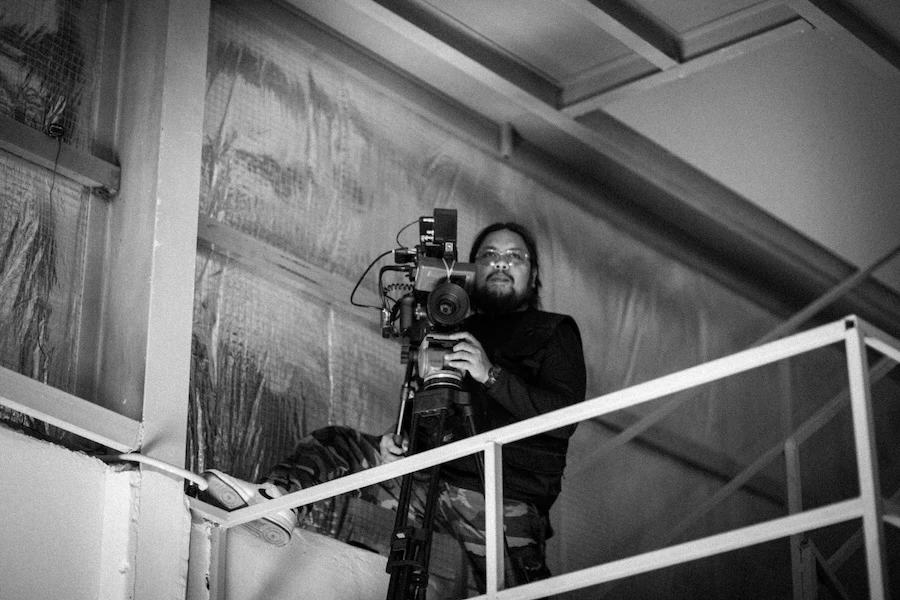
Saudi-born Filipino filmmaker Ayman Tamano has wrapped production on his second feature, “Walakin” — a supernatural thriller exploring “grief, guilt, trauma and forgiveness.”
Following the cancellation of this year’s Red Sea International Film Festival, at which Tamano hoped “Walakin” would premiere, he is now targeting next year’s Saudi Film Festival.
Shot in Jeddah, “Walakin” is a true indie film: made with little-to-no budget, a screenplay that wasn’t complete when filming started, and without the backing of a major production company, relying instead on improvisation, collaboration and community support.
“‘Walakin’ began with a simple question: Could we make a feature film without the usual things a film is supposed to have?” Tamano tells Arab News. “What made Walakin possible was collaboration. Locations, vehicles, accommodation, cast, crew, and countless other resources came from people and local businesses willing to support the project.”
The film tracks two interconnected narratives. In one, Mohsin, a property rep struggling with depression, is sent to inspect one of his company's beach houses. But what begins as an ordinary work trip takes a disturbing turn when strange events interrupt his sleep. As Mohsin investigates, he encounters a mysterious boy connected to a past he believed he had left behind. Meanwhile, Khaled, a man living in isolation and besieged by guilt, meets Jouri, an “unpredictable young woman.” His attempt to escape his past becomes increasingly complicated by the appearance of Sophia, a supernatural presence who forces him to confront memories he has tried to suppress.
Another character, Alaa, carries knowledge of a traumatic event connecting the two men.
For Tamano, the film's unusual production process became as important as the story itself. The director began filming while writers Heba Abdullah and Areeba Naeem were still working on the story. Musician Hajer Al-Harbi, making her acting debut, plays Jouri, and contributed much to her character's storyline.
“We gave the actors detailed character bibles and a story, and before each scene they were given an emotional arc and an objective, key points that needed to happen, and where their character journey was in the overall story arc,” Tamano says. “The dialogue was improvised, and we made adjustments as we went.”
The approach allowed actors to develop their characters through their own interpretations, creating conversations and emotional responses that emerged naturally during filming. Ahmad Mohsin, a Saudi filmmaker more accustomed to working behind the camera, plays Mohsin. “He wanted to represent a specific demographic of Saudis that have Asian lineage,” Tamano explains.
Munther Kabli, a veteran theater actor (and “brilliant performer” Tamano says), plays Khaled in his first leading film role.
Bilal L. Khan, a Jeddah-based producer, helped guide the project, finding practical solutions to the challenges of making a feature without conventional financial backing.
“Bilal, the crew, the cast and I were constantly adapting, solving problems, and discovering the film as we made it,” Tamano says. “There was never a perfect roadmap, and I think that was part of what made the experience special.”
While Tamano is not Saudi, he was born and raised in Jeddah, and the Kingdom has shaped his identity and creative perspective.
“I lived my whole life in Jeddah, and a big part of me identifies with Saudi culture,” he says. “Naturally, my stories and the way I create and express will reflect that.”
His award-winning debut feature, “Madayen,” was billed as Saudi Arabia’s first horror movie. That project began in 2016 when producer Hakeem Jomah approached Tamano with the script. Securing financial support proved difficult, with potential investors questioning its commercial value, but rather than altering the story to attract funding, the pair decided to persevere with their original idea.
“There’s a lot we (as filmmakers) are allowed to sell or provide as a service, but vision is sacred,” Tamano says. “Compromising our creativity for financial gain was never an option. In business, profit is the number one priority. In filmmaking, you will always have to circle back to storytelling.”
In the 10 years since work began on “Madayen,” Saudi filmmakers have increasingly gained access to production opportunities, professional crews and platforms to present their work. Tamano says the Kingdom’s cinema industry has “grown exponentially,” creating possibilities that were difficult to imagine when he started out.
His career has brought him into contact with international filmmakers, including Hollywood directors Eddie Barbini and Billy Sprague Jr., and Emirati director Nayla Al-Khaja.
“The most important lesson I took away from Eddie and Nayla is this: My time in this world as a storyteller is very short, so I must get started with everything today,” he says.
That philosophy also shapes his advice to emerging filmmakers, particularly those hoping to secure large production budgets before beginning their projects. “To become a master, you’re going to have to create a lot of low-budget films first,” he says.
As the Saudi cinema industry continues to grow, Tamano remains focused on the principle that has guided his career: protecting the story and the creative vision behind it. He sees plenty of potential in the Kingdom.
“There’s still a lot to be explored,” he says. “There’s so much to tell, so much we can all learn from, be entertained by, and feel something from.”