

WASHINGTON/BOSTON: Seven Iranian hackers conducted a coordinated cybertattack on dozens of US banks, causing millions of dollars in lost business, and tried to shut down a New York dam, the US government said on Thursday in an indictment that for the first time accused individuals tied to another country of trying to disrupt critical infrastructure.
It said the seven accused were believed to have been working on behalf of Iran’s government and the Islamic Revolutionary Guard. Those named live in Iran and the Iranian government is not expected to extradite them. There was no immediate comment from Tehran.
At least 46 major financial institutions and financial sector companies were targeted, including JPMorgan Chase , Wells Fargo and American Express, the indictment said. AT&T also was targeted.
The hackers are accused of hitting the banks with distributed-denial-of-service attacks on a near-weekly basis, a relatively unsophisticated way of knocking computer networks offline by overwhelming them with a flood of spammed traffic.
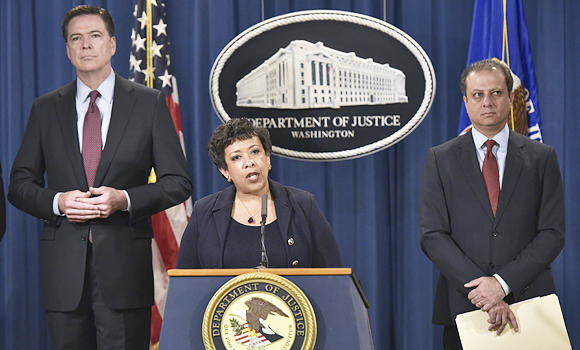
“These attacks were relentless, they were systematic, and they were widespread,” US Attorney General Loretta Lynch told a Washington news conference.
The indictment from a federal grand jury in New York City said the attacks occurred from 2011 to 2013. Washington has previously accused military officers from China and the North Korean government of cybertattacks against US businesses.
The attack on the Bowman Avenue Dam in Rye Brook, New York, was especially alarming, Lynch said, because it represented a known intrusion on critical infrastructure. A stroke of good fortune prevented the hackers from obtaining operational control of the flood gates because the dam had been manually disconnected for routine maintenance, she said.
The Bowman hack was a “game-changing event” for the US government that prompted investigators to uncover other systems vulnerable to similar attacks, said Andre McGregor, a former FBI agent and a lead case investigator on the dam intrusion.
“The investigation’s discovery of many more exposed computer systems with vulnerable management consoles is a constant reminder that basic cyber hygiene remains at the forefront of the battle against cybertattacks,” said McGregor, now director of security at Tanium, a Silicon Valley cyber security firm.
“We must step up our counter-hacking game ASAP to deal with threats from places like Iran and would be terrorists,” said New York Senator Chuck Schumer in a statement.
Cyber security experts and US intelligence officials have grown more alarmed in recent months by the possibility of destructive hacks of critical infrastructure such as dams, power plants and factories. Some have said a December cybertattack on the Ukraine’s energy grid that caused a temporary blackout of 225,000 should serve as a wake-up call.
LONG MEMORIES
The defendants were identified as Ahmad Fathi, Hamid Firoozi, Amin Shokohi, Sadegh Ahmadzadegan, Omid Ghaffarinia, Sina Keissar and Nader Seidi, all citizens and residents of Iran. They are accused of conspiracy to commit computer hacking while employed by two Iran-based computer companies, ITSecTeam and Mersad Company.
Firoozi also is charged with obtaining and abetting unauthorized access to a protected computer.
The indictments are the latest attempt by the Obama administration to more publicly confront cybertattacks carried out by other countries against the United States.
The campaign began two years ago when the Justice Department accused five members of China’s People’s Liberation Army with hacking several Pennsylvania-based companies in an alleged effort to steal trade secrets. It continued with President Obama’s vow to “respond proportionally” against North Korea for the destructive hack against Sony Pictures.
“An important part of our cyber security practice is to identify the actors and to attribute them publicly when we can,” Lynch said Thursday. “We do this so that they know they cannot hide.”
US officials largely completed the investigation more than a year ago, according to two sources familiar with the matter, but held off releasing the indictment so as to not jeopardize the landmark 2015 nuclear deal with Iran or a January prisoner swap.
Even though Iran is not expected to extradite the suspects, FBI Director James Comey vowed to pursue justice.
“The world is small and our memory is long,” he said at the news conference with Lynch.
Dmitri Alperovitch, chief technology officer with cyber security firm CrowdStrike, said, “This sends an important message to Iran and other governments that these people cannot operate anonymously.”
The US and Israel launched a cybertattack against Iran in 2010, now famously known as the Stuxnet worm, in order to disable Iran’s nuclear centrifuges. Some security researchers and officials have long suspected the attacks against US banks and the dam were done in part as retaliation.
Separately, the US Treasury Department blacklisted two Iranian companies on Thursday for supporting Iran’s ballistic missile program and also sanctioned two British businessmen it said were helping an airline used by Iran’s Revolutionary Guards.
(Additional reporting by Jonathan Stempel in New York, Susan Heavey, Megan Cassella and Julia Edwards in Washington)


