BRUSSELS: More than two dozen suspects have been arrested in Belgium, France and Germany in continuing searches for suspected terrorists, authorities said Friday.
Thirteen people were detained in Belgium and two arrested in France in an anti-terror sweep following a firefight in which two suspected terrorists were killed, and more suspects are being sought, Belgian authorities said.
French and German authorities arrested at least 14 other people Friday suspected of links to the Islamic State group, and a Paris train station was evacuated, with Europe on alert for new potential terrorist attacks.
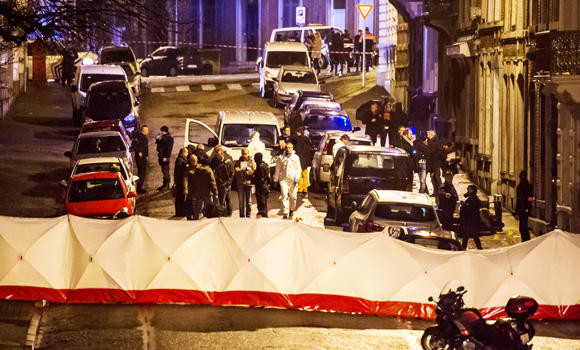
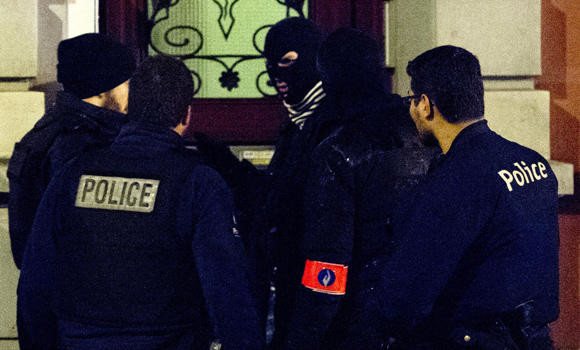
On Thursday, Belgian police moved in on a suspected terrorist hideout in the eastern city of Verviers, killing two suspects and wounding and arresting a third.
Eric Van der Sypt, a Belgian federal magistrate, said Friday the terrorists were within hours of implementing a plan to kill police on the street or in their offices.
More than a dozen searches had led to the discovery of four military-style weapons including Kalashnikov assault rifles, Van der Sypt told a news conference.
“I cannot confirm that we arrested everyone in this group,” he addeid.
Visiting a scarred Paris on Friday, US Secretary of State John Kerry met French President Francois Hollande and visited the sites of the city’s worst terrorist bloodshed in decades. Twenty people, including the three gunmen, were killed last week in attacks on a kosher supermarket and the offices of satirical newspaper Charlie Hebdo and on police.
Hollande thanked Kerry for offering France support, saying, “You’ve been victims yourself of an exceptional terrorist attack on Sept. 11. You know what it means for a country. ... We must find together appropriate responses.”
Paris is at its highest terrorism alert level, and police evacuated the Gare de l’Est train station Friday after a bomb threat. The station, one of several main stations in Paris, serves cities in eastern Paris and countries to the east.
The Paris prosecutor’s office, meanwhile, said at least 12 people were arrested in anti-terrorism raids in the region, targeting people linked to one of the French gunmen, Amedy Coulibaly, who claimed ties to the Islamic State group. Police officials earlier told The Associated Press that they were seeking up to eight to 10 potential accomplices.
In Berlin, police arrested two men Friday morning on suspicion of recruiting fighters for the Islamic State group in Syria.
Across Europe, anxiety has grown as the hunt continues for potential accomplices of the three Paris terrorists, and as authorities try to prevent attacks by the thousands of European extremists who have joined Islamic State extremists in Syria and Iraq.
Hollande said France is “waging war” against terrorism and will not back down from international military operations against Islamic extremists despite recent deadly attacks.
“It is not a war against religion, it’s a war against hate,” Hollande said in a speech to leading diplomats.
The Belgian raid on a former bakery was another palpable sign that terror had seeped deep into Europe’s heartland as security forces struck against militants some of who may be returnees from holy war in Syria.
After the gun smoke lifted, police continued with searches in Verviers and the greater Brussels area, seeking more clues in a weeks-long investigation that started well before the terrorism rampage in France last week. The Belgian operations had no apparent link to the attacks in France.
And, unlike the Paris terrorists, the suspects in Belgium were reportedly aiming at hard targets: police installations.
“They were on the verge of committing important terror attacks,” federal magistrate Eric Van der Sypt told a news conference in Brussels.
Belgian authorities had moved swiftly in the rustbelt town of Verviers Thursday to pre-empt what they called a major attack by as little as hours.
“As soon as I opened the window, you could smell the gunpowder,” said neighbor Alexandre Massaux following a minutes-long firefight with automatic weapons and Kalashnikovs that was also punctuated by explosions.
“As soon as they thought special forces were there, they opened fire,” federal magistrate Van der Sypt said.
“It shows we have to be extremely careful,” Van der Sypt said. The Verviers suspects “were extremely well-armed men” equipped with automatic weapons, he said. Some of the individuals “were in Syria and had come back,” he added.
Authorities have previously said 300 Belgian residents have gone to fight with extremist Islamic formations in Syria; it is unclear how many have returned. Thousands of European extremists have also fought in Syria.
Belgian authorities had said earlier that they were looking into possible links between a man they arrested in the southern city of Charleroi for illegal trade in weapons and Coulibaly, who killed four people in a Paris kosher market last week.
Several other countries are also involved in the hunt for possible accomplices to Coulibaly and the other gunmen in the French attacks, brothers Cherif and Said Kouachi.
The Kouachi brothers claimed allegiance to Al-Qaeda in Yemen, and Coulibaly to the Islamic State group.
A senior Iraqi intelligence official told The Associated Press on Friday that Iraqi intelligence warned French intelligence about two months ago that a group linked to Khorasan in Syria was plotting an attack in Paris. The official spoke anonymously as he is not authorized to brief media. It was impossible to verify how serious or advanced the claims of a plot were. Iraq’s prime minister also warned in September of possible attacks in New York and Paris.
France’s Parliament voted this week to extend airstrikes against Islamic State extremists in Iraq.
___
Casert reported from Brussels. Associates Press writers David Rising in Berlin, John-Thor Dahlburg, Greg Keller, Jamey Keaten, Angela Charlton, Sylvie Corbet, Lori Hinnant, Matthew Lee and Nicolas Vaux-Montagny in Paris and Qassim Abdul-Zahra in Baghdad contributed to this report.


15 arrested in anti-terror sweep across Europe
15 arrested in anti-terror sweep across Europe

Bangladesh readies for polls, worry among Hasina supporters
- The Muslim-majority nation of 170 million people will hold elections on February 12, its first since the uprising
- Hasina was sentenced to death for crimes against humanity in Nov. and her former ruling party has been outlawed
Gopalganj: Bangladesh is preparing for the first election since the overthrow of Sheikh Hasina, but supporters of her banned Awami League (AL) are struggling to decide whether to shift their allegiance.
In Gopalganj, south of the capital Dhaka and a strong bastion of Hasina’s iron-grip rule, residents are grappling with an election without the party that shaped their political lives for decades.
“Sheikh Hasina may have done wrong — she and her friends and allies — but what did the millions of Awami League supporters do?” said tricycle delivery driver Mohammad Shahjahan Fakir, 68, adding that he would not vote.
“Why won’t the ‘boat’ symbol be there on the ballot paper?” he said, referring to AL’s former election icon.
The Muslim-majority nation of 170 million people will hold elections on February 12, its first since the uprising.
Hasina, who crushed opposition parties during her rule, won landslide victories in Gopalganj in every election since 1991.
After a failed attempt to cling to power and a brutal crackdown on protesters, she was ousted as prime minister in August 2024 and fled to India.
She was sentenced to death in absentia for crimes against humanity by a court in Dhaka in November, and her former ruling party, once the country’s most popular, has been outlawed.
Human Rights Watch has condemned the AL ban as “draconian.”
“There’s so much confusion right now,” said Mohammad Shafayet Biswas, 46, a banana and betel leaf seller in Gopalganj.
“A couple of candidates are running from this constituency — I don’t even know who they are.”
As a crowd gathered in the district, one man shouted: “Who is going to the polling centers? We don’t even have our candidates this time.”
‘DEHUMANISE’
Hasina’s father, Sheikh Mujibur Rahman, the founding president of Bangladesh, hailed from Gopalganj and is buried in the town.
Statues of Rahman have been torn down nationwide, but in Gopalganj, murals and statues are well-maintained.
Since Hasina’s downfall, clashes have broken out during campaigning by other parties, including one between police and AL supporters in July 2025, after which authorities filed more than 8,000 cases against residents.
Sazzad Siddiqui, a professor at Dhaka University, believes voter turnout in Gopalganj could be the lowest in the country.
“Many people here are still in denial that Sheikh Hasina did something very wrong,” said Siddiqui, who sat on a government commission formed after the 2025 unrest.
“At the same time, the government has constantly tried to dehumanize them.”
This time, frontrunners include candidates from the Bangladesh Nationalist Party (BNP) and Jamaat-e-Islami, the country’s largest religious party.
Both are from Hasina’s arch-rivals, now eyeing power.
“I am going door to door,” BNP candidate S.M Zilany, 57, told AFP, saying many would-be voters had never had a candidate canvass for their backing.
“I promise them I will stand by them.”
Zilany said he had run twice against Hasina — and was struck down by 34 legal cases he claimed had been politically motivated.
This time, he said that there was “a campaign to discourage voters from turning up.”
Jamaat candidate M.M Rezaul Karim, 53, said that under Hasina, the party had been driven underground.
“People want a change in leadership,” Karim told AFP, saying he was open to all voters, whatever their previous loyalties.
“We believe in coexistence; those involved in crimes should be punished; others must be spared,” Karim said.
Those once loyal to Hasina appear disillusioned. Some say they had abandoned the AL, but remain unsure whom to support.
“I am not going to vote,” said one woman, who asked not to be named.
“Who should I vote for except Hasina? She is like a sister.”


