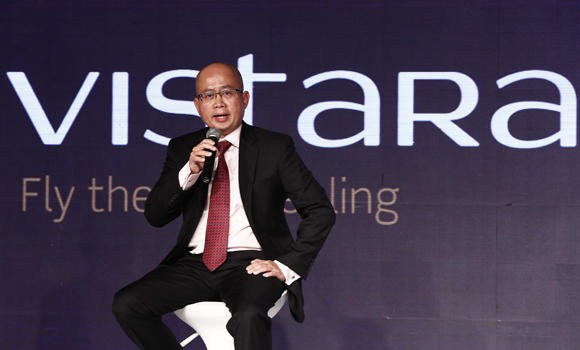
NEW DELHI: India’s newest airline announced Monday it would start flying next month and was “enthusiastic” about the future, even as rival carriers bleed red ink.
The new airline, called Vistara — a Sanskrit word meaning “limitless expanse” — will make its first flight on January 9.
The airline is 49-percent-owned by Singapore Airlines, one of the world’s top-rated carriers. Mumbai-based Tata conglomerate, one of India’s best-respected brands, controls 51 percent.
“We’re enthusiastic. There are no doubt challenges, but we believe in the immense potential of the Indian aviation market,” Vistara chief executive Phee Teik Yeoh told reporters.
The 46-year-old former senior executive of Singapore Airlines, added he had felt like “breaking into song” ever since Vistara cleared the final hurdle to start flying, obtaining its Air Operators Permit from the government earlier this month in India’s highly regulated market.
While airline analysts say India’s aviation future belongs to low-cost carriers, Yeoh said there was also room for full-service airlines.
“We’re here to redefine the flying experience” and “create a demand for a kind of personalized travel” that doesn’t exist, he said, referring to the “massification” of the Indian travel market.
Vistara will operate the 148-seater Airbus A320-200 with 16 seats in business class, 36 in premium economy and 96 in economy.
Once it takes off, Vistara will be the third full-service carrier after state-run Air India and Jet Airways, which are both making chronic losses.
The new carrier will start with Delhi-Mumbai flights and then include the western city of Ahmedabad. It will add routes as its current two-plane Airbus fleet grows.
The carrier expects to have five planes in a month and 20 Airbus planes within four years.
The launch comes after the debt-laden no-frills airline SpiceJet was grounded briefly last week for failing to pay fuel bills.
India’s air passenger market has expanded at breakneck speed but many airlines are laden with debt and beset by cut-throat fare wars, high fuel taxes and shoddy infrastructure.
IndiGo, India’s largest passenger carrier, is a budget operation and the sole one among the country’s four biggest airlines consistently to report profits.
Kingfisher, a full-service airline owned by liquor tycoon Vijay Mallya, was grounded by huge losses in 2012.
Tata also holds a stake in an Indian low-cost carrier which started flying in June, operated by Asia’s biggest-budget airline AirAsia.
The previous Congress government began allowing foreign airlines to buy up to 49 percent stakes in Indian carriers in 2012.

New India airline to start flying as others lose money
Saudi non-oil exports jump 21% as trade balance improves: GASTAT
RIYADH: Saudi Arabia’s non-oil exports, including re-exports, rose 20.7 percent year on year in November to SR32.69 billion ($8.72 billion), official data showed.
According to preliminary figures released by the General Authority for Statistics, national non-oil exports, excluding re-exports, increased by 4.7 percent in November compared with the same month in 2024.
The strong performance highlights progress under the Kingdom’s Vision 2030 strategy, which aims to diversify the economy and reduce its long-standing dependence on crude oil revenues.
In its latest report, GASTAT stated: “The ratio of non-oil exports, including re-exports, to imports increased in November 2025, reaching 42.2 percent, compared with 34.9 percent in November 2024. This increase was driven by a 20.7 percent rise in non-oil exports, alongside a 0.2 percent decline in imports over the same period.”
It added: “The value of re-exported goods increased by 53.1 percent during the same period, driven by an 81.9 percent increase in ‘machinery, electrical equipment and parts’, which accounted for 51.5 percent of total re-exports.”
Machinery, electrical equipment and parts also led the non-oil export basket, making up 24.2 percent of outbound shipments and recording an 81.5 percent annual increase. This was followed by products of the chemical industries, which represented 20.3 percent of total non-oil exports and rose 0.5 percent year on year.
The data adds to signs of resilience in Saudi Arabia’s non-oil economy, with S&P Global’s Purchasing Managers’ Index at 57.4 in December, well above the 50 threshold that separates expansion from contraction.
Top non-oil destinations
The UAE was the leading destination for Saudi non-oil exports in November, with shipments valued at SR10.48 billion.
India ranked second at SR3.01 billion, followed by China at SR2.32 billion, Singapore at SR1.76 billion and Bahrain at SR900.7 million.
Exports to Egypt totaled SR815.5 million during the month, while Turkiye and Jordan received goods worth SR799.1 million and SR773.3 million, respectively.
GASTAT said ports and airports played a central role in facilitating non-oil shipments in November.
By sea, Jeddah Islamic Seaport handled the largest volume of non-oil exports at SR3.57 billion, followed by King Fahad Industrial Seaport in Jubail at SR3.51 billion.
Ras Al-Khair Seaport was the exit point for non-oil goods valued at SR2.66 billion, while Jubail Seaport and King Abdulaziz Seaport in Dammam handled outbound shipments worth SR2.32 billion and SR2.14 billion, respectively.
By air, King Abdulaziz International Airport handled goods worth SR5.60 billion, while King Khalid International Airport in Riyadh processed exports valued at SR3.53 billion.
Exports and imports
Saudi Arabia’s total merchandise exports reached SR99.73 billion in November, representing a 10 percent increase compared with the same month in 2024.
“Merchandise exports in November 2025 increased by 10.0 percent compared to November 2024, and oil exports increased by 5.4 percent. The percentage of oil exports in total exports declined from 70.1 percent in November 2024 to 67.2 percent in November 2025,” GASTAT added.
China remained the Kingdom’s largest export destination, accounting for 13.5 percent of total exports, followed by the UAE at 11.7 percent and Japan at 9.9 percent. India, South Korea, the US, Egypt, Singapore, Bahrain and Poland were also among the top 10 destinations, which together accounted for 71.4 percent of total exports.
Imports declined by 0.2 percent year on year in November to SR77.38 billion, while the merchandise trade surplus surged by 70.2 percent, the report showed.
China was the Kingdom’s largest source of imports, accounting for 26.7 percent of inbound shipments, followed by the US at 10.2 percent and the UAE at 6.2 percent.
“Germany, Japan, India, Italy, France, Switzerland, and Egypt were also among the top ten import sources, with total imports from these ten countries representing 68.6 percent of Saudi Arabia’s overall imports,” added GASTAT.
King Abdulaziz Port in Dammam was the leading entry point for goods, handling 22.8 percent of imports in November. Jeddah Islamic Port followed with 22.6 percent, ahead of King Khalid International Airport in Riyadh at 17 percent and King Abdulaziz International Airport in Jeddah at 11.9 percent.