OSLO/COPENHAGEN: A helicopter transporting North Sea oil workers crashed off the coast of western Norway on Friday, killing all 13 people on board, rescue services said.
The Super Puma chopper went down around midday in the archipelago off the coast of Bergen, Norway’s second-biggest city.
The crash took place on the island of Turoey, near Bergen, Kronen said. He did not explain why people had ended up in the water and could not say what kind of helicopter was involved.
He said police had been told the helicopter was carrying 11 passengers and two pilots, but had not been able to verify the figure themselves.
The chopper was transporting workers from a North Sea offshore oil field when it crashed around midday near the shoreline off the coast of Bergen, Norway’s second biggest city.
“They are searching in the hope of finding survivors. So far we have not seen any sign of survivors,” Sola rescue center spokesman Anders Bang Andersen told reporters.
He told AFP that the chopper had been en route to the Bergen airport Flesland when it crashed with 13 people on board, including two crew members.
“The helicopter has been located and we are doing everything possible to rescue the occupants,” he added.
Several witnesses described seeing the aircraft spiral downward, followed by a powerful explosion, and people were seen in the sea.
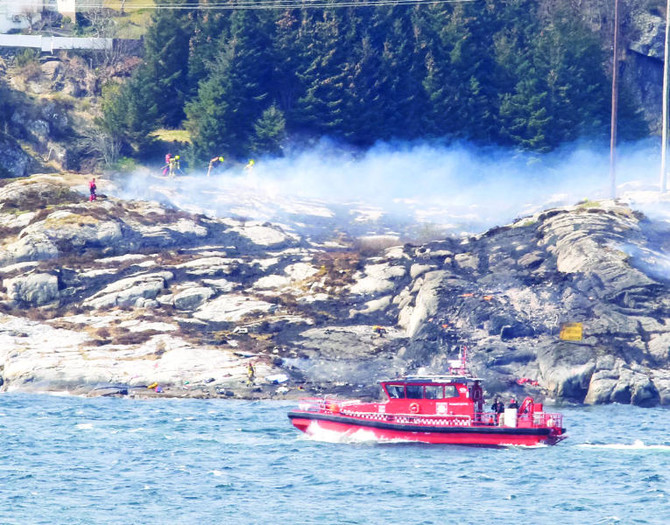
Norwegian media posted photos of huge billows of smoke. Eyewitness Rebecca Andersen told the Norwegian newspaper Verdens Gang that the helicopter’s “rotor blades came rushing toward us.”
“Pieces (of the helicopter) flew into the air,” a local resident said, adding that she saw a rotor blade detach.
Some media outlets reported that people had been rescued, but the reports were contradictory and Bang Andersen was not able to confirm or deny them.
“Horrible reports of a helicopter crash,” Prime Minister Erna Solberg tweeted. “I’m being continuously briefed on the rescue operations.”
Live footage showed leisure boats rushing toward the scene, where thick black smoke was billowing into the sky.
The accident took place around noon (1000 GMT), and more than an hour later boats could be seen criss-crossing across the water as helicopters hovered overhead. Divers were seen at the site, and ambulances were parked on shore.
On Twitter, police urged people to refrain from using drones in the area.
The helicopter was returning from the Gullfaks B platform, in one of Norway’s biggest offshore oil fields, which is operated by state-owned Statoil.
Media reports had initially spoken of up to 17 people on board.


![]()
Helicopter crashes off Norway; 13 dead
Helicopter crashes off Norway; 13 dead
Latest updates



Recommended


© 2026 SAUDI RESEARCH & PUBLISHING COMPANY, All Rights Reserved And subject to Terms of Use Agreement.