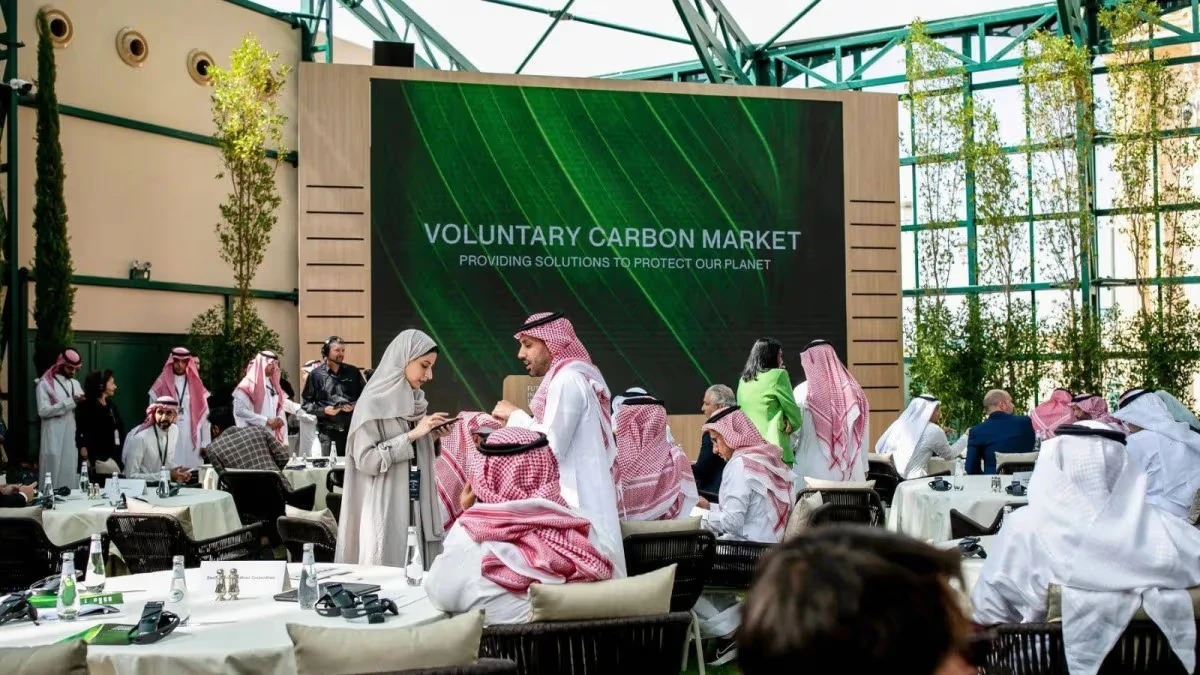
- The VCM is tracking more than 30 local and international project developers focusing on emissions reduction projects, including methane capture and nature-based solutions.
- Saudi Arabia's aim to achieve net-zero emissions by 2060 is supported by its Circular Carbon Economy framework and a developing voluntary carbon market.
RIYADH: Saudi Arabia’s carbon market is evolving from a platform supporting climate action into a channel for financing projects and reducing emissions, with the Voluntary Carbon Market Co. having traded more than 15 million carbon credits over three years, equivalent to SR350 million ($93.3 million) in financing directed toward climate projects worldwide.
This comes as demand for carbon credits in the domestic market exceeds supply, according to the company’s CEO, Fadi Saadeh, who spoke to Al-Eqtisadiah.
Saadeh said the platform facilitated trades of more than 2.5 million carbon credits in 2024 at a price of SR37.5 per tonne, adding that the market is working to stimulate domestic demand and attract developers and investors to projects that generate credits through emissions reduction or removal.
Saadeh said in a 30-minute interview via Microsoft Teams that the company is tracking more than 30 project developers locally and internationally, whose projects range from methane capture and waste treatment to nature-based solutions, direct air capture and the use of low-carbon concrete.
With domestic demand for carbon credits exceeding supply, he said the market needs to expand its project pipeline and diversify credit sources to meet the needs of Saudi companies seeking to manage their emissions.
This expansion comes as Saudi Arabia seeks to translate its target of achieving net-zero emissions by 2060 into practical tools for financing and emissions management through its Circular Carbon Economy, or CCE, framework and the development of a voluntary carbon market.
The company operates with the support of the Public Investment Fund and Saudi Tadawul Group, aiming to link financing with climate projects and develop market infrastructure for carbon trading.
The challenge extends beyond supplying sufficient carbon credits to building a market that is credible and capable of attracting investment, supported by clear standards for measuring actual emissions reductions and verifying the climate impact of projects.
The Kingdom is pursuing this agenda amid broader changes in global climate markets, with growth in energy-related emissions worldwide slowing to around 0.4 percent, while countries in the Middle East have begun developing regulatory frameworks to address emissions, according to the CEO.
Against this backdrop, the carbon market is emerging as a potential channel for directing financing toward climate projects, although its growth will depend on expanding supply, maintaining credit quality, and sustaining corporate demand.
Interview with Saadeh
Q: How do you assess the Middle East and Saudi Arabia’s position in global carbon emissions, and what competitive advantage does Riyadh have in carbon markets?
Globally, we are seeing some progress in carbon markets. For example, growth in energy-related carbon emissions slowed to around 0.4 percent this year. In the Middle East, however, progress remains relatively slow, although countries in the region are beginning to introduce regulations to support these efforts.
In Saudi Arabia, the Voluntary Carbon Market Co. was established to help develop the market and establish its standards.
Over the three years since the company was established, we have successfully traded more than 15 million tonnes of carbon credits, equivalent to approximately SR350 million directed toward financing climate projects worldwide.
In Saudi Arabia, we focused first on building demand for carbon credits. We are now seeing growing interest, alongside an increase in the number of projects and developers that could become suppliers of credits in the Saudi market.
We are tracking more than 30 project developers locally and internationally. Their projects span different sectors and environments, from waste landfills to nature-based solutions and advanced technologies such as direct air capture.
These projects are spread across different parts of the country, giving Saudi Arabia a significant opportunity to become a major hub in the Middle East and a leading market for carbon credits and investment in them globally.
Q: To what extent have voluntary carbon markets demonstrated their economic effectiveness in reducing emissions? How are carbon credit prices determined in Saudi Arabia compared with global markets?
Carbon credits are a tool for strengthening corporate climate action. Companies need to develop sustainability strategies aimed at reducing their emissions, and we at VCM help companies in Saudi Arabia and the Middle East develop these strategies.
There will always be emissions that are difficult to reduce or avoid. Carbon credits can therefore be one of the tools that help companies progress toward net zero by investing in climate projects through the purchase of credits.
Globally, a significant part of the impact on carbon markets comes from direct carbon-pricing mechanisms, such as compliance markets, which currently cover more than 29 percent of emissions.
Saudi Arabia has announced plans to launch a carbon compliance market. Globally, carbon credit retirements exceeded issuances for the first time in the first half of 2026, with retired credits exceeding 100 million tonnes.
One of the main differences between global and regional markets is the expansion of forward carbon credit purchase agreements in global markets. We are seeing strong interest in these transactions from major companies such as Google and Microsoft, while this trend is developing more slowly in regional and domestic markets.
Q: What are the main challenges facing the growth of Saudi Arabia’s market? Are they related to supply and demand, credit quality or pricing mechanisms?
We face several challenges in the Saudi market. One of the issues VCM is working to address is building a market with sufficient liquidity and transparency to enable companies to enter and participate.
One difficulty companies face is that every project has its own characteristics, quality, and areas of focus. Consequently, the prices of credits from different projects vary. There is no single price that applies to all projects.
Q: Which entities are driving demand for carbon credits in Saudi Arabia? Which sectors are showing the greatest interest, and is this driven by environmental, competitive, or investment considerations?
We are seeing interest from different sectors. Companies representing around 65 percent of corporate emissions in Saudi Arabia are represented on our trading platform.
These include companies in oil and gas, as well as heavy industries such as cement, metals, and steel.
One of the key developments we are seeing is the growing participation of companies listed on the stock market since the beginning of last year.
As the Saudi market opens to foreign investment, international investors are paying increasing attention to environmental, social and governance assessments. This is encouraging companies to improve their performance in these areas and publish their reports.
Carbon credits are one of the tools companies can use as part of these efforts, supporting the growth of demand.
Tracking 30 project developers
Q: Is the domestic supply of carbon credits sufficient to meet potential demand? Which projects are most economically viable? How do you ensure credit quality and prevent double counting of emissions reductions?
Demand currently exceeds supply, as we have observed over the past three years. We expect supply to increase as projects develop and more carbon credits are issued, particularly given that we are tracking more than 30 project developers.
We are working to support project developers in issuing carbon credits. Supply is expected to expand over time, alongside continued demand growth.
This is one of Saudi Arabia’s competitive advantages, and we are seeing international investors express interest in developing projects in the Kingdom to generate carbon credits.
Supply, investment and climate alignment
Q: How does the carbon market improve the profitability and competitiveness of Saudi companies? When does ignoring emissions-reduction requirements become economically costly?
Companies’ decisions to purchase carbon credits combine climate ambitions with commercial priorities.
The reasons for purchasing credits include confidence in the project and its quality, customer and investor expectations, and credibility linked to corporate reputation, as well as the need for suitable future supplies.Ultimately, competitiveness depends on spending discipline. Our role is to build a transparent market that reduces transaction costs and uncertainty, enabling companies to plan their budgets more effectively.
Companies should integrate carbon credit purchases into their investments in operational efficiency and cleaner technologies, while keeping direct emissions reductions at the forefront of their plans.
280m-tonne emissions cut by 2030
Q: How does the voluntary carbon market align with Saudi Arabia’s emissions-reduction targets and CCE framework? What impact could expanding mandatory carbon-pricing mechanisms have on the market’s future?
Saudi Arabia’s commitments are substantial, as the Kingdom aims to achieve net-zero emissions by 2060. It also targets reducing, avoiding, and removing emissions equivalent to around 280 million tonnes annually by 2030, rising to approximately 320 million tonnes during the 2040s.
This reflects Saudi Arabia’s ambition to implement and achieve these targets.
The CCE framework provides an approach based on four main principles: reduce, reuse, recycle and remove.
Financing carbon credit projects can support eligible projects in Saudi Arabia and contribute to achieving its climate targets.
I would like to emphasize that reliable measurement mechanisms, accurate registries and transparent disclosures of emissions reductions strengthen investor confidence.
International transfers of carbon credits under Article 6 of the Paris Agreement require the necessary authorizations and safeguards to ensure the integrity of the outcomes.
This means that companies’ purchases of carbon credits are not automatically counted toward Saudi Arabia’s national targets.
Q: To what extent does the market help attract investment in renewable energy, emissions reduction, and clean technologies, while creating new economic opportunities that support the Kingdom’s economic diversification?
We are seeing more than 30 projects in Saudi Arabia supporting these objectives through domestic and international investment.
The voluntary carbon market in the region has helped create demand for credits, encouraging investors to inject capital into project development.
An important point is that long-term purchase agreements can give project developers greater visibility over revenues and help them plan and secure financing.
We have multiple projects across Saudi Arabia, including methane capture, waste treatment, and industrial emissions reduction, as well as carbon removal and renewable energy projects that demonstrate eligibility and achieve additional emissions reductions.These projects can benefit from carbon credit revenues, which should be considered when assessing their investment viability.
Q: How can Saudi Arabia strengthen its presence in global carbon markets?
Saudi Arabia has a significant opportunity to become a trusted hub for the international market.
With the support of its shareholders, the PIF and Saudi Tadawul Group, VCM is working to build the infrastructure needed for carbon trading.
We are seeing growing confidence in the platform through participation from different regions, including Europe, the Americas, and Asia, as well as East Asia and Japan, reinforcing its international character.
Our role is to connect markets and establish a foundation for that integration. Maintaining long-term competitiveness, however, requires ensuring the integrity of carbon credits, transparent pricing, and reliable delivery, as well as a robust pipeline of projects under development with demonstrable viability.
Global competition, growth and pricing prospects
Q: How do you expect Saudi Arabia’s voluntary carbon market to grow over the next five to 10 years in terms of trading volumes, investment, and demand? What indicators will you use to measure its economic impact?
VCM has achieved an important milestone, with more than 15 million carbon credits traded in just three years. We expect this trajectory to continue at the same rates achieved over the past three years.
We hope growth will continue in the coming years as part of the company’s plans for the next five to 10 years.
The voluntary carbon market will support the different mechanisms enabling Saudi Arabia to achieve its targets and reach net zero by 2060, whether through the announced carbon compliance market or other projects and sustainability initiatives implemented by companies and governments to reduce emissions.
Over 2.5m tonnes traded at SR37.5 per tonne
Q: How are carbon credit prices determined in Saudi Arabia’s voluntary carbon market, and what local factors affect pricing compared with global markets?
There is no single price for carbon credits, as each credit represents an actual project on the ground that implements an emissions-reduction measure and contributes to climate action.
Pricing therefore depends on the project itself, its reliability and quality, the year the credit was issued, and other factors.
VCM seeks to provide a transparent and credible market that enables companies to trade carbon credits.
We also work to improve pricing clarity for companies. One of the mechanisms we use is what we call the “core basket,” a group of projects whose credits the company verifies in advance, and which are traded through large transactions or large-scale events such as auctions.
In November 2024, the company’s third auction saw more than 2.5 million tonnes of carbon credits traded at SR37.5 per tonne.
Q: Which entities play the main role in driving demand in carbon credit markets? Is demand driven by voluntary commitments, competitiveness, or pressure from international investors?
Both factors play a significant role. Each company has its own objectives that it seeks to achieve.
Some companies participate in this market voluntarily, while others seek to strengthen their competitiveness in international markets through their participation.
Q: Have carbon credits become a tool for reducing the cost of the environmental transition for companies, or do they represent an additional financial burden? When does ignoring the carbon market become an economically costly decision?
Carbon credits are a tool that supports the different measures companies need to take to achieve their sustainability objectives.
There is an economic dimension to using these credits, and they should not represent a burden on companies as they pursue these objectives.
Companies have annual targets within their sustainability plans that they seek to achieve. Carbon credits are one of the tools that help them do so, alongside direct emissions-reduction measures and improvements in operational efficiency.